Congressmembers Rob Menendez, Doris Matsui (CA-07), Nanette Barragán (CA-44), and Troy Carter, Sr. (LA-02) have introduced new legislation that would compel the Federal Communications Commission (FCC) to re-establish the Communications Equity and Diversity Council.
Local government organizations are voicing their strong opposition to the American Broadband Deployment Act, an industry friendly proposal being cooked up in the House that would take public rights of way management and property decisions away from state, local, and tribal governments through federal preemption and industry-friendly defaults.
The remote islands of San Juan County, Washington are increasingly being served with next-generation fiber and wireless thanks to Rock Island Communications, a locally-owned Internet subsidiary of the Orcas Power & Light Cooperative.
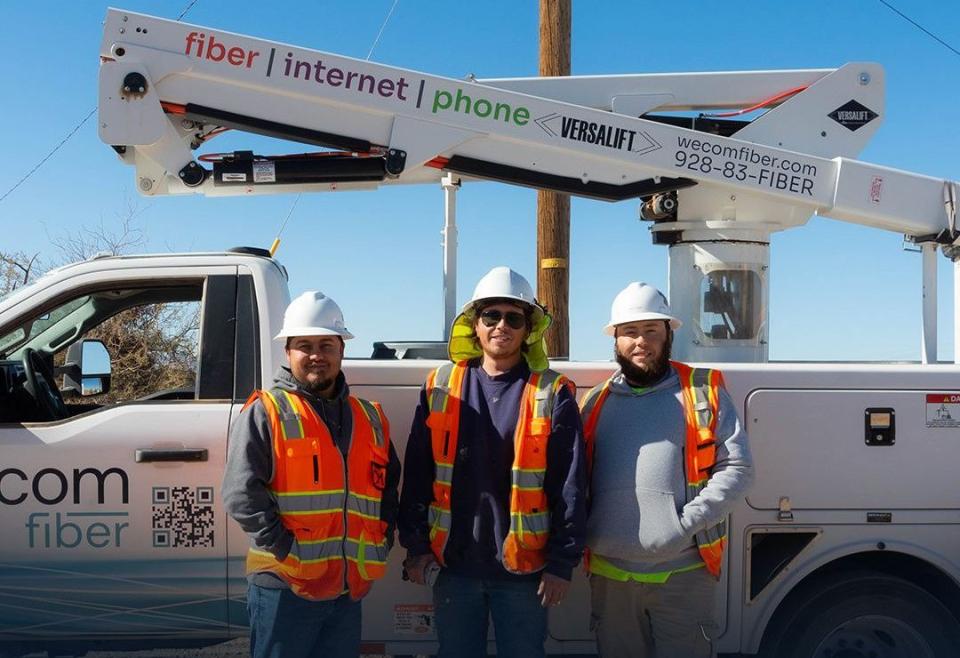
The public-private partnership the city struck Arizona-based Wecom Fiber is expected to inject at least $100 million into local economy over five years while saving the city an estimated $18 million in capital expenses.
Roanoke Cooperative’s Fybe has been awarded $2.4 million in state funds to expand affordable access to high speed Internet to 826 locations across eight predominantly rural North Carolina counties.
Join us for our very first episode of Unbuffered Live! at our new time, on Tuesday, April 28th at 2pm ET. Host Christopher Mitchell will be joined by guests Doug Dawson (CCG Consulting), Heather Mills (ITG) and Drew Garner (Benton Institute for Broadband and Society) to talk about the intersections of tech, Internet access, and policy.
With tax day as a backdrop, the ILSR Community Broadband Networks Initiative and the National Digital Inclusion Alliance convened its quarterly Building for Digital Equity livestream yesterday that shined a light on how public dollars and tax policy intersect with digital equity.
Traverse City, Michigan’s public, community-owned utility, Traverse City Light and Power (TCL&P), is putting the finishing touches on its $14 million plan to deliver affordable fiber to the community of 15,424. With build out estimates significantly lower than initial projections, the utility is finalizing an additional $1 million in loans to fund the recently started build.
Antelope Valley, California officials are hoping to leverage California’s historic recent round of broadband grant programs to deliver affordable fiber access to a significant swath of long-underserved southern California desert communities. According to Antelope Valley officials, they’ve applied for a $24.3 million California Advanced Services Fund (CASF) Broadband Infrastructure grant to help them deliver symmetrical 10 Gigabit Passive Optical Network (XGS-PON) technology to 988 total households, most of which would be seeing affordable fiber access for the first time ever.
Fort Collins, Colorado’s popular Connexion municipal broadband network has unveiled SmartHome, a new network management app that can help the ISPs customers better manage the security and bandwidth-consumption of their home networks. SmartHome lets users see every connected device, set parental controls, prioritize bandwidth for work or entertainment, and guard against online threats through integrated security services like ExperienceIQ and ProtectIQ.
A city utility manager, an economist, and a fiber technologist walk into a virtual webinar … And what followed was a deep dive into why delaying investment in smart city infrastructure is increasingly costly. Panelists emphasized how “smart cities” are built on fiber networks and what city investments in the gold-standard of Internet connectivity can do to boost economic development while improving the quality of life for local residents and businesses.
The Commerce Department has approved 18 final spending plans under its $42.45 billion Broadband Equity, Access, and Deployment program. One state, Louisiana, had access to its funding, according to the agency. NTIA approval is one of the last steps before states and territories can start signing contracts and projects can get underway. Louisiana had gone through the remaining reviews and had access to its BEAD deployment funding Tuesday, NTIA said.
In a new report from the Institute for Local Self-Reliance, we tell the story of how 19 very small Western Massachusetts towns worked together over a decade and a half to build an alternative to the monopoly broadband marketplace and deploy their own municipal networks. It's a unique story of perseverance and the power of public partnerships. "Seeking the Commonwealth of Connection: How Small-Town Volunteers and Public Partnerships Transformed Internet Access in Western Massachusetts tells the story of how this came to be, and the impact it is had for residents, businesses, and community anchor institutions in the region.
U.S. Senators Peter Welch (D-Vt.) and Roger Marshall (R-Kan.) have introduced a bill that would reauthorize the USDA’s ReConnect Loan and Grant program and expand the program to include Communications Union Districts. According to the announcement, the reauthorization would set a baseline of 100 megabit per second (Mbps) downstream and 100 Mbps upstream for broadband grants, up from the program’s dated 25 Mbps downstream, 3 Mbps upstream current standard.
The Pueblo of Jemez Tribal community was honored with a Project Excellence Award for its efforts to build-out a fiber network to reach hundreds of Tribal households, government buildings and businesses. Since January of 2024, JNET has been constructing its fiber-to-the home (FTTH) network, building-out more than 45 miles of fiber to date. More than 40 homes have already been lit up for service with the project expected to be finished in 2026.
Decorah, Iowa has launched a public private partnership with West Union Trenching to deploy a modern fiber-to-the-home (FTTH) network that passes every household in the city. The project is the culmination of decades of planning and frustration at the lack of affordable, next-generation broadband in the city of 7,500.
The livestreamed event will bring together community-driven broadband champions who are redefining what it means to be a “smart city” — and what communities risk when they fail to invest in modern connectivity. Moderated by AAPB Executive Director Gigi Sohn and ILSR’s Sean Gonsalves, the livestreamed discussion will bring together community-driven broadband champions who are redefining what it means to be a “smart city” — and what communities risk when they fail to invest in modern connectivity.
The Trump FCC has announced that it's taking formal steps to weaken or eliminate the rules as part of the agency’s broad, frontal assault on consumer protections. On October 30, the The Trump FCC under Brendan Carr voted in favor of a Notice of Proposed Rulemaking (NPRM) to eliminate or weaken the rules; especially requirements that ISPs transparently detail itemized fees buried in their advertised prices.
Legal analysts are questioning the recent assertion by the head of the National Telecommunications and Information Administration (NTIA) that the agency can legally withhold federal broadband deployment funds from states that have laws enforcing net neutrality or that have enacted affordable broadband legislation. Last week in speaking before the conservative Hudson Institute, NTIA administrator Arielle Roth offered remarks that have legal observers scratching their heads in bewilderment.