
Daunted by the high costs of building its own municipal fiber network, Flagstaff Arizona instead struck a public private partnership (PPP) in late 2024. A year and a half later and that partnership is starting to drive significant new fiber deployments and some significant new investment to the city of 77,000.
Or that’s at least the conclusion of a new whitepaper by the Fiber Broadband Association, a policy coalition of municipal broadband networks and key fiber industry giants such as Adtran, GFiber, Corning, Calix, and Graybar.
The analysis, "Broadband Community Profile: A Public-Private Partnership for Fiber – Flagstaff, Arizona," explores how the PPP the city struck Arizona-based Wecom Fiber is expected to inject at least $100 million into local economy over five years while saving the city an estimated $18 million in capital expenses.
Frustrated by market failure and a lack of meaningful broadband competition among regional telecom monopolies, Flagstaff considered building its own municipal fiber network in 2023. But city officials found that even just connecting 34 city-owned buildings (estimated to be around $20 million) would be untenable given budgetary constraints.
So city officials instead struck a partnership with Wecom Fiber in late 2024 to build a fiber network that will ultimately pass 30,000 locations within Flagstaff city limits, but also connect those 34 municipal facilities. Construction of the network began in April of 2025, and is poised to deliver more than 815 miles of new fiber across Coconino County.
Wecom, backed by Searchlight Capital Partners, is using $40-$45 million of its own funds to construct the fiber network, a trend of private equity fiber investment that will be examined in detail at the Fiber Broadband Association’s upcoming annual Fiber Connect 2026 conference being held May 17-20 in Orlando, Florida.
In addition to a massive infusion of private equity funding, Flagstaff was able to contribute $2 million in American Rescue Plan Act (ARPA) funding to the Wecom city expansion, which also took advantage of existing city fiber conduit.
“For its part, the city is supplying access to its conduit on a 20-year, no-cost lease arrangement while Wecom will build conduit to link the city’s existing infrastructure as part of the process of its construction to connect the city’s buildings,” the paper notes.

According to the Fiber Broadband Association, the resulting estimated $50 million Wecom investment is estimated to inject at least $100 million into the local economy over five years.
“In its 2023 study, ‘How U.S. Infrastructure Investment Would Boost Jobs, Productivity, and the Economy,’ the Information Technology & Innovation Foundation (ITIF), showed that each $1 million in broadband infrastructure generates approximately $2.45 million on total economic output,” the paper says. “Using this multiplier, the $50 million investment would yield a total economic impact of over $120 million over the five-year period.”
It’s worth noting that the ITIF is a DC-based think tank that receives funding from major telecom companies and tech giants, including AT&T, Charter Communications, Comcast, CTIA, Verizon, Amazon, Meta, and Google. As a result the organization has been, historically, outwardly hostile to, and at times misleading about, municipal broadband efforts. And, at times, can overstate the potential impact of private industry broadband investment.
Much of Flagstaff’s predicted investment is expected to come in the form of network investment, labor, and local direct spending by construction crews, the Fiber Association study predicts.
“The Flagstaff build is expected to support or sustain between 125 and 175 direct construction jobs, including fiber crews, splicers, engineers, subcontractors, and project management, as well as 250 to 350 indirect and induced jobs, including suppliers, local services, logistics, retail, and hospitality,” the analysis found.
Wecom’s website indicates the provider offers locals three tiers of fiber service: a symmetrical 500 megabit per second (Mbps) tier for $70 a month; a symmetrical 1 gigabit per second (Gbps) tier for $90 a month; a symmetrical 3 Gbps tier for $115 a month; and a symmetrical 5 Gbps tier for an undisclosed price point (locals have to call in to get estimates).
The prices come with no usage caps or long-term contracts, though there is a $75 installation fee for local residents.
Public Private Partnerships Can Have Their Downsides
Public private partnerships can certainly be promising for municipalities that want the introduction of competitive, next-generation fiber alternatives, but lack the resources or technical aptitude to embrace a true municipally-owned fiber network. PPPs can often vary dramatically in terms of scope and the level of government involvement and asset ownership.

That said, ILSR has often noted how some PPPs may result in less government control over the cost and particulars of the finished network, potentially eroding public benefits over time. If ownership or owner motivations change over time, the city can find itself without meaningful influence on the direction of an important infrastructure asset.
“Often private partners hold a significant advantage and a willingness to walk away simply because local communities have a critical need with few options,” ILSR’s Lisa Gonzales noted more than a decade ago. “They may feel compelled to make unnecessary sacrifices to expedite the project.”
Many communities say they’ve been best served through either direct municipal ownership, a regional coalition of municipalities collaborating jointly (like Vermont’s Communications Union Districts), or the creation of open access fiber networks, where multiple private providers compete over shared, publicly-owned infrastructure.
If municipalities like Flagstaff can’t afford the municipal route, they may still find themselves better off under a PPP. The city is largely dominated by a broadband duopoly of Optimum (cable) and CenturyLink (DSL, fiber) with a lack of meaningful competition resulting in higher prices, slower speeds, and substandard customer service.
How to navigate PPPs in a way that protect the public interest was the subject of a panel at last year’s Fiber Connect 2025 conference, with attendees noting municipalities need to be strict in terms of public interest protections, quick in terms of interfacing with private partners and streamlining unnecessary bureaucracy, cautious in terms of deployment promises and partner selection, and honest about the best interest of locals.
This year’s Fiber Connect 2026 conference will also examine public private partnerships, the rising infusion of private equity fiber investment, emerging tech, and the wide variety of creative ways that municipal and private efforts alike are bridging connectivity for neglected rural, suburban, and urban communities long stuck on the wrong side of the digital divide.
In Arizona, Wecom was recently awarded $42 million in Broadband Equity, Access and Deployment (BEAD) grant funding to connect an additional 10,500 homes and businesses across Coconino County.
Wecom is expected to be the biggest BEAD grant recipient in Arizona, receiving roughly $195 million to connect 66,000 homes and businesses across numerous rural Arizona counties, including Coconino County, Yavapai County ($49.5 million), and Mohave County ($24.5 million). All told, Wecom’s financing is expected to help connect 160,000 Arizona households and 1,200 community institutions to modern generation fiber broadband access.
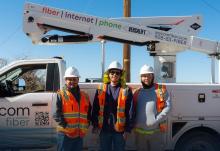
Header image of Wecom fiber workers in Flagstaff courtesy of Flagstaff Greater Chamber of Commerce Facebook page
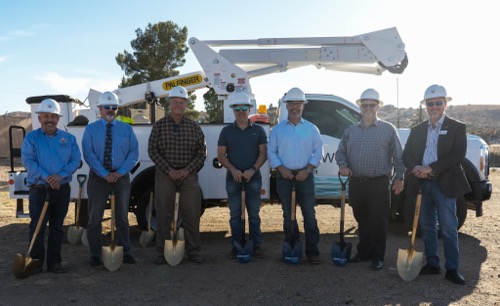
Inline image of Flagstaff fiber build groundbreaking courtesy of Flagstaff Greater Chamber of Commerce Facebook page
Inline image of downtown Flagstaff, AZ courtesy of Wikimedia Commons, CC BY 2.0, Attribution 2.0 Generic
Inline image of partnership handshake courtesy of PickPic, Public Domain List