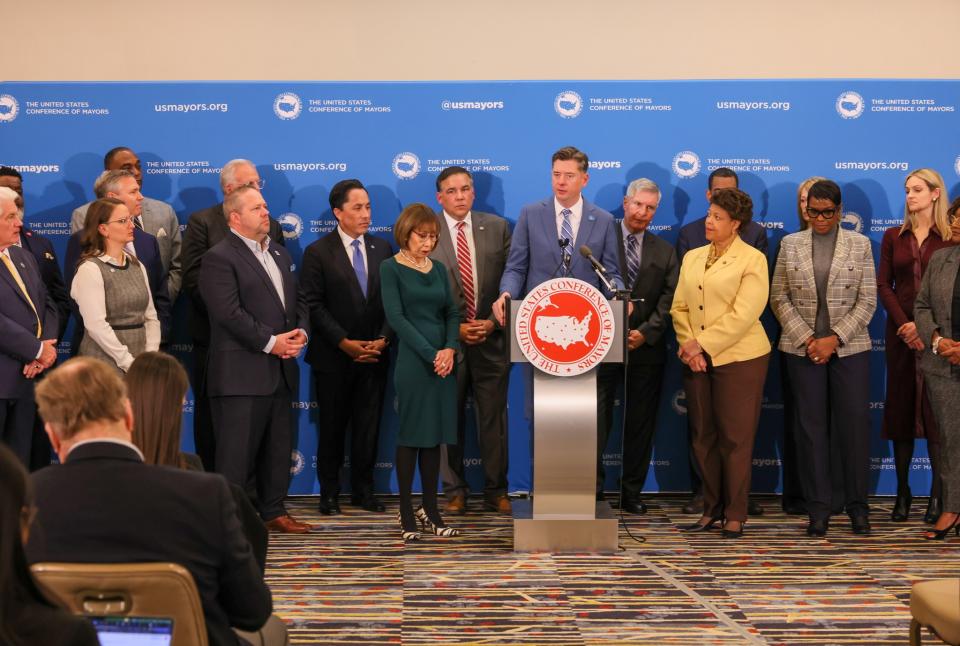
Local government organizations are voicing their strong opposition to the American Broadband Deployment Act, an industry friendly proposal being cooked up in the House that would take public rights of way management and property decisions away from state, local, and tribal governments through federal preemption and industry-friendly defaults.
The remote islands of San Juan County, Washington are increasingly being served with next-generation fiber and wireless thanks to Rock Island Communications, a locally-owned Internet subsidiary of the Orcas Power & Light Cooperative.
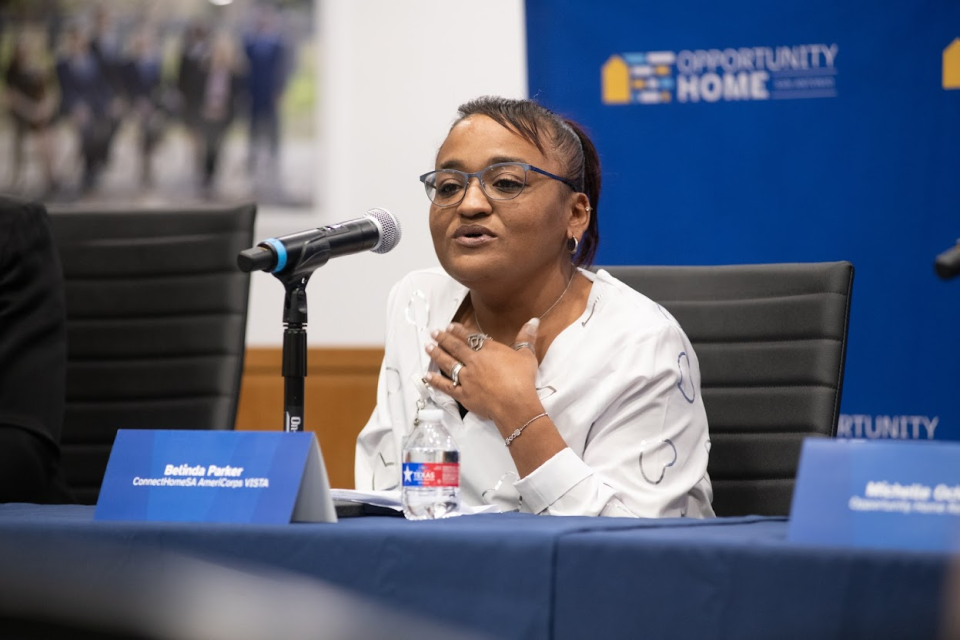
A laptop and a low-cost Internet connection opened the door of opportunity for a first-generation college graduate. It wasn’t just about getting online – it was about unlocking access to everything that comes with it.
Congressmembers Rob Menendez, Doris Matsui (CA-07), Nanette Barragán (CA-44), and Troy Carter, Sr. (LA-02) have introduced a new legislation that would compel the Federal Communications Commission (FCC) to re-establish the Communications Equity and Diversity Council.
Roanoke Cooperative’s Fybe has been awarded $2.4 million in state funds to expand affordable access to high speed Internet to 826 locations across eight predominantly rural North Carolina counties.
Join us for our very first episode of Unbuffered Live! at our new time, on Tuesday, April 28th at 2pm ET. Host Christopher Mitchell will be joined by guests Doug Dawson (CCG Consulting), Heather Mills (ITG) and Drew Garner (Benton Institute for Broadband and Society) to talk about the intersections of tech, Internet access, and policy.
With tax day as a backdrop, the ILSR Community Broadband Networks Initiative and the National Digital Inclusion Alliance convened its quarterly Building for Digital Equity livestream yesterday that shined a light on how public dollars and tax policy intersect with digital equity.
The Sonoma County Board of Supervisors recently announced that it has approved a list of new affordable housing sites that are eligible to receive free Internet for one year. According to the county, 556 low-income Sonoma County households across 10 different housing locations should qualify for the free broadband service.
The early story coming out of states like Tennessee, Colorado, and Texas, where state leaders are being forced to dramatically revamp billions of dollars in Broadband, Equity, Access, and Deployment (BEAD) grant planning, is a move away from future-proof fiber networks toward slower, more expensive satellite options that don’t seem likely to fix U.S. broadband woes. In all three states the changes have introduced new delays and lowered last mile quality control standards. But an early look at the revamped bidding process in all three states shows that millions of dollars are likely being redirected away from locally-owned fiber networks to billionaire-owned low-Earth-orbit (LEO) satellite broadband options insufficient to the task.
The Town of Dryden just signed up their 400th customer and continue to make steady progress expanding the popular network into rural enclaves in and around Dryden long deemed “unprofitable” by regional telecom monopolies. The first year and a half of operations focused on building the core fiber ring around the city. They’ve since shifted to the time-consuming task of extending last mile fiber access out to rural unserved and underserved homes in Dryden and nearby Caroline.
Last week, a California Assemblymember who had sponsored legislation for a broadband affordability law abruptly withdrew the legislation. But what really killed the broadband affordability bill in California? In explaining why Assemblymember Tasha Boerner withdrew the legislation, she did not say it was because of the pushback her office was getting from digital inclusion advocates across the state – or because of industry objections for that matter. Boerner laid it at the feet of the Trump administration.
Isle au Haut has completed its municipally-owned fiber network with ample help from locals – and federal and state grants. After a decade of planning, several dozen residents of the island (with a summer population of around 300) recently celebrated a ribbon cutting ceremony on June 28, alongside build partners that included the Island Institute, Axiom Technologies, and Hawkeye Fiber Optics.
Four leading broadband deployment scholars release new analysis today that may help state broadband offices evaluate “the capacities and saturation limits of the Starlink satellite infrastructure.” The overarching goal is to help states determine where – and if – Starlink can meet federal requirements for broadband, which is defined as delivering minimum connection speeds of at least 100 Megabits per second (Mbps) download and 20 Mbps upload.
The Paulding Putnam Electric Cooperative (PPEC) says it has officially launched the construction of a major new residential fiber expansion project that should dramatically improve affordable fiber access across major swaths of Northwest Ohio and Northeast Indiana. According to an announcement by the co-op, mainline construction of the extended network technically started last April in the Haviland and Latty substation area, and extended during the month of June to the Roselm substation area.
From inaccurate broadband mapping data and an over-reliability on industry-provided coverage claims, to inconsistent broadband definitions and patchwork federal oversight, a new study by the Pew Charitable Trusts examined decades of U.S. broadband policy, and data analysis and found plenty of room for improvement. Pew’s analysis of U.S. broadband data collection found numerous areas of concern that have been repeatedly brought up by researchers over the last few decades.
Hudson, Ohio officials are now accepting bids on a promising new fiber-to-the-home network that should dramatically improve affordable, next-generation broadband access in the city of 23,000. It’s just the latest effort by a city that has been exploring the option of municipal broadband infrastructure for more than a decade.
The Sault Ste. Marie Tribe of Chippewa Indians will host a four-day Tribal Broadband Bootcamp on the Tribe's Marquette campus in Michigan’s Upper Peninsula in August. It will be the second held in the Great Lakes region, designed primarily for members of 36 federally recognized Tribes across Michigan, Wisconsin and Minnesota. Participants will be reimbursed for travel costs, room and board, and meals.
ILSR publishes new piece in The American Prospect on how the "One Big Beautiful Bill Act" cuts food assistance benefits to households that pay for internet access.
The FCC’s Universal Service Fund has survived a Supreme Court challenge by a right wing activist nonprofit, but the program – which for decades has helped extend broadband to underserved rural homes and schools – still faces a precarious immediate future. It is a peculiar political story, given that the rural regions that overwhelmingly vote for Republicans are now seeing Republicans try to dismantle a program that has been crucial for rural investment and development.