Local government organizations are voicing their strong opposition to the American Broadband Deployment Act, an industry friendly proposal being cooked up in the House that would take public rights of way management and property decisions away from state, local, and tribal governments through federal preemption and industry-friendly defaults.
The remote islands of San Juan County, Washington are increasingly being served with next-generation fiber and wireless thanks to Rock Island Communications, a locally-owned Internet subsidiary of the Orcas Power & Light Cooperative.
A laptop and a low-cost Internet connection opened the door of opportunity for a first-generation college graduate. It wasn’t just about getting online – it was about unlocking access to everything that comes with it.
Congressmembers Rob Menendez, Doris Matsui (CA-07), Nanette Barragán (CA-44), and Troy Carter, Sr. (LA-02) have introduced a new legislation that would compel the Federal Communications Commission (FCC) to re-establish the Communications Equity and Diversity Council.
Roanoke Cooperative’s Fybe has been awarded $2.4 million in state funds to expand affordable access to high speed Internet to 826 locations across eight predominantly rural North Carolina counties.
Join us for our very first episode of Unbuffered Live! at our new time, on Tuesday, April 28th at 2pm ET. Host Christopher Mitchell will be joined by guests Doug Dawson (CCG Consulting), Heather Mills (ITG) and Drew Garner (Benton Institute for Broadband and Society) to talk about the intersections of tech, Internet access, and policy.
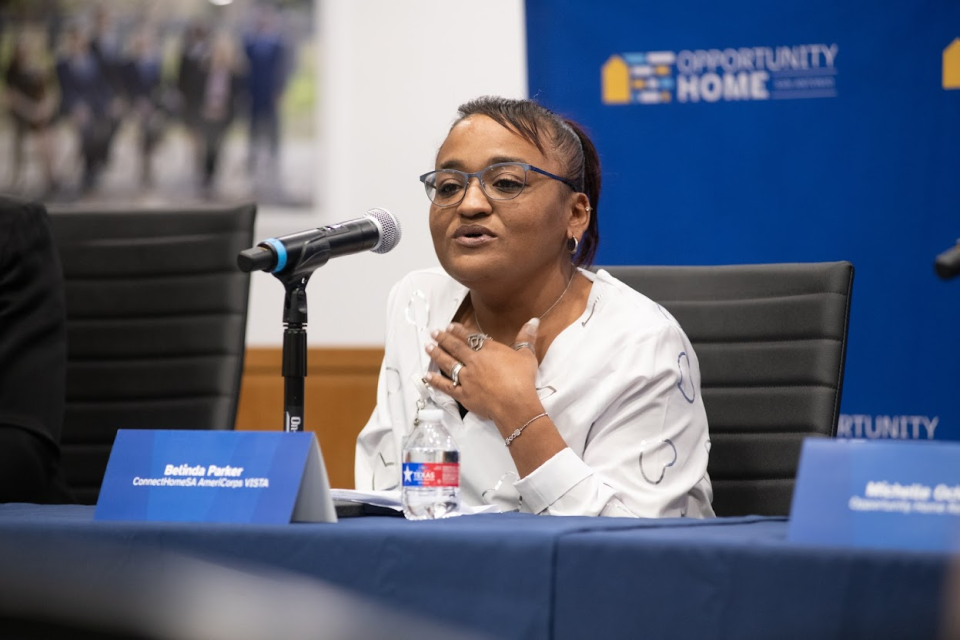
With tax day as a backdrop, the ILSR Community Broadband Networks Initiative and the National Digital Inclusion Alliance convened its quarterly Building for Digital Equity livestream yesterday that shined a light on how public dollars and tax policy intersect with digital equity.
Vermont’s Otter Creek Communications Union District not only recently finished its major fiber deployment, CUD leaders say the project came in significantly under budget, saving Vermont state leaders more than $3 million in taxpayer dollars. That money will now be redirected toward efforts to make access more affordable for state residents.
The California Public Utilities Commission (CPUC) is poised to include new broadband affordability requirements as part of the state’s looming approval of Verizon’s massive $20 billion merger with Frontier Communications, even as some consumer advocacy groups worry the changes may not go quite far enough to hold Verizon accountable. The CPUC’s Public Advocates Office has struck a partial settlement with Verizon that the state hopes will take some of the sting out of the telecom industry’s latest consolidation spree.
NTIA, the federal office administering the largest single investment to expand Internet access across the nation, appears to once again be changing the BEAD program in ways that would only force states to further reduce investment in rural areas. NTIA seems to have added yet another time-consuming wrinkle: a super secret “Best and Final Offer” round imposed on states after submitting final proposals.
Michigan-based Thumb Electric Cooperative says its ongoing fiber deployment has hit a new milestone: its 4000th connected broadband subscriber. The cooperative’s latest customer, Verona Hills Golf Course in Huron County, Michigan, comes three years after the cooperative joined the growing trend of expanding into broadband access.
The first installment of an ongoing series we are calling Connected Complex looks at how states, local communities, and Internet service providers are working to address the often complex challenges involved in bringing high-speed Internet access to multi-dwelling units. In Massachusetts, state leaders have announced a new $31.5 million investment to bring reliable, high-speed Internet access to residents in affordable and public housing statewide by helping to update long outdated wiring in multiple-dwelling-units, many of which were built before the advent of the Internet.
The second installment in the ongoing Community Broadband Film Series spotlights “Rocketeers: The UTOPIA Fiber Story” – an eye-opening documentary that tells the story of how a publicly-owned fiber network has ignited local Internet choice and competition across dozens of cities. The event will begin with a screening of the 24-minute film and then treat attendees to a live Red Carpet discussion with UTOPIA Fiber CEO Roger Timmerman and key leaders of two communities that are now part of the fast growing UTOPIA network – Sid Boswell, CEO of Yellowstone Fiber in Bozeman, Montana; and Bountiful, Utah Councilmember Kate Bradshaw.
As states struggle to readjust their plans to expand high-speed Internet access in the wake of the Trump administration “termination” of the Digital Equity Act, Vermont is working to address the multi-million dollar shortfall by aligning the state’s Digital Empowerment initiative with its newly established Affordable Long Drop Program. The Affordable Long Drop Program was established to provide grants to eligible Internet service providers (ISPs) in order to cover the connection costs for Vermonters whose homes are beyond standard drop distances.
On September 10th, in New Prague, the Minnesota Public Broadband Alliance (MPBA) will be hosting an in-person event with speakers aimed at community leaders and residents working to expand Internet access to unserved and underserved homes.
Vineland, New Jersey officials say they’ve secured a $3.7 million grant from the state that will help expand fiber and wireless broadband access to the city of 62,000. Local officials are hopeful the grant is just the beginning steps toward dramatic expansion of affordable access.
Officials in Bountiful, Utah say they’ve completed the city’s $48 million open access fiber network a year ahead of schedule, bringing fast, affordable broadband access to the Salt Lake City suburb of 45,000. The city of Bountiful owns the network while UTOPIA designed, built and manages the network and takes a share of the revenue.
The mystery of who and what killed the California Affordable Home Internet Act is coming into view. The evidence seems to be pointing to the new leadership now directing the National Telecommunications and Information Administration. In a recently released FAQ published by the NTIA this week, a corroborating clue has emerged. And what may be the smoking gun is a bullet buried on page 48, under section 3.29.
Syracuse, NY officials say the city’s community-owned broadband network Surge Link continues to dramatically expand two years after the network first launched, bringing affordable broadband access to the city of 145,000 – with a particular eye on helping the city’s disadvantaged. A recent update from the city states that the network now serves more than 9,200 households in Syracuse.