
Infrastructure Investment and Jobs Act

Content tagged with "Infrastructure Investment and Jobs Act"

Related Topics
Displaying 41 - 50 of 102

State BEAD Plans and “Chilling Effect” of Municipal Broadband Restrictions

As the National Telecommunications and Information Administration (NTIA) continues to move forward in administering the single biggest federal investment to expand high-speed Internet access in U.S. history, each state and U.S. territory is wrestling with how to best spend the windfall as they lay out their Five Year Action Plans and Initial Proposals necessary to claim their portion of the $42.5 billion BEAD program.

One major barrier to providing universal access to fast, reliable and affordable Internet service–long recognized by ILSR, telecom experts, and a growing number of ordinary citizens–are the monopoly-friendly preemption laws that either outright ban or erect insurmountable barriers to building publicly-owned, locally-controlled broadband networks, aka municipal broadband.

Preemption in the BEAD Era

Currently, 17 states have such preemption laws, most of which have filed their Five Year Action Plans and/or their Initial Proposals. In each of those states, at the behest of Big Cable and Telecom incumbents, state lawmakers have erected legislative barriers to municipal broadband to protect the monopoly players from competition, which is at the very heart of why the digital divide exists in the first place and why tens of millions of Americans suffer from the slower speeds and higher costs that go hand in hand with monopoly service.

Initial BEAD Proposals and Five Year Action Plans Come Into Focus

The key for states to unlock their portion of the $42.5 billion in federal BEAD funds is the submission and approval of their Five Year Action Plans and Final Proposal. The infrastructure law requires states to first file an action plan, and then prepare more detailed Initial Proposals, allowing residents and stakeholders to submit public comments.

So far, 14 states have filed their Five Year Action Plans with the National Telecommunications and Information Administration (NTIA), the Treasury Department agency in charge of allocating the funds to each state and U.S. territory. According to the NTIA’s website, Maine, Louisiana, Delaware, Georgia, Hawaii, Idaho, Kansas, Montana, North Carolina, Ohio, Oregon, Pennsylvania, Utah, and Vermont have all filed their draft Five Year Action Plans.

Image
NTIA logo

The states that are now in the process of completing their Initial Proposals include: Delaware, Kansas, Louisiana, Montana, Ohio, Tennessee, Vermont, Virginia and Wyoming.

Today, we will look at two states (Maine and Louisiana) and follow up with the others as we are getting a clearer picture of how each state intends to put this historic infusion of federal funds to use.

Maine

Nushagak Cooperative Driving Fiber To Rural Alaskan Communities For The First Time

Data unsurprisingly ranks remote Alaska dead last when it comes to the availability of affordable broadband. That’s particularly true in areas like Bristol Bay, an area the FCC’s updated broadband maps suggests lacks access almost entirely. But as with most underserved regions, local cooperatives are at the forefront of efforts to finally address the problem.

Launched in 1975, the member-owned Nushagak Electric & Telephone Cooperative, based in Dillingham, Alaska, offers locals broadband access through microwave towers; often the only way to provide service across Alaska’s rugged landscape. But the co-op, which also offers a electric, telephone, and cable TV service, says it’s on the cusp of new fiber deployments that should finally bring next-generation speeds to a chunk of the co-op’s members.

The co-op has been working since 2021 on a $22.4 million plan to expand more reliable fiber to the region. The project is partially funded by the USDA ReConnect program as well as $6.5 million in term loan money from the National Rural Utilities Cooperative Finance Corporation. The cooperative will also use $784,000 of its own money to get the project underway.

Congress Could Soon Decide Fate And Future Of Affordable Connectivity Program

It may not generate a lot of headlines in a national press obsessed with AI and billionaire fist fights, but the debate over the final version of the looming farm bill remains important all the same. Especially when it comes to the future of affordable broadband.

The farm bill, generally renewed every five years, provides U.S. policymakers the occasional opportunity to address agricultural and infrastructure issues essential to not only the basic functioning of the country, but the very survival of marginalized Americans.

That includes programs like the Supplemental Nutrition Assistance Program (SNAP, or “food stamps”), which provides affordable food to an estimated 41.9 million Americans–or roughly 12.5 percent of the U.S. population.

The bill has also proven essential to the ongoing maintenance and equitable distribution of modern infrastructure, including affordable broadband access. That includes the funding of essential programs such as the U.S Department of Agriculture’s ReConnect broadband grant program, and the Community Connect Grants program.

Image
FCC logo

The farm bill may also soon play a key role in maintaining another key government program: the $14 billion Affordable Connectivity Program (ACP) currently overseen by the Federal Communications Commission (FCC).

Both Band Aid And Key Lifeline

Open Access Fiber Network Comes to Rural Enclave in Washington

Public Utility Districts across the state of Washington have become key players in building out high-speed Internet infrastructure for residents and businesses in rural parts of the Evergreen State. One of those PUD’s, the Whatcom County Public Utility District (PUD) is now leading that charge in one of the most difficult-to-reach parts of the state, building an open access dark fiber network that will bring high-speed connectivity to over a thousand homes and businesses in Point Roberts.

Point Roberts is a pen-exclave of Washington State, about 25 miles south of Vancouver. (Pen-exclave: an area that can only be accessed through another country – in this case, Canada). The rural community, known for its peaceful beaches and mountain views, as well as its orca and eagle populations, is just under 5 square miles and home to about 1,200 residents.  

Designated to the United States in 1846 as the border between the United States and Canada was drawn along the 49th parallel, Point Roberts has a distinct geographic identity, which presents a unique challenge when it comes to building broadband infrastructure.

CBN’s Signal To Noise Ratios

Now that there’s broad consensus high-speed Internet connectivity should be universally accessible, there’s no shortage of broadband news/content floating around out there.

There’s the wheat (more truthful, useful, and informative stuff); the chafe (a mundane grain of truth buried under a steaming pile of bs), and a vast spectrum of perspectives in between.

In this new space we will highlight insightful news stories, blog posts, podcasts, or videos we’ve come across over the past week or so – with an eye to separate the signal from the noise.

Downloading now …

What Happened to Gigi?

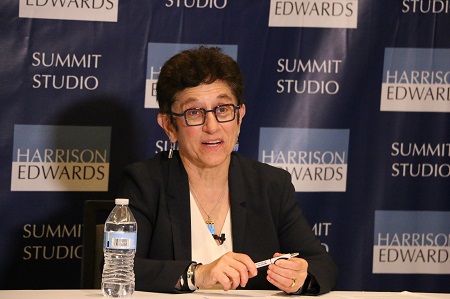
While the FCC has been defanged in many ways, the agency is still at the center of our shared telecommunication ecosystem. So when President Biden nominated Gigi Sohn to serve as the fifth and final commissioner to break the 2-2 partisan deadlock at the agency, numerous consumer and public interest groups were ecstatic. The nation’s telecommunication workers backed her nomination. She even had the respect and quiet support of a number of conservative lawmakers.

Image
Gigi Sohn AAPB press conference

But her nomination was sunk by a vicious smear campaign, which led her to withdraw herself from consideration in March.

At the Broadband Communities Summit in May she described the process both like being put in a “washing machine full of rocks” and going through “a 16 month proctology exam.”

New Episode of Connect This! Show Tomorrow

Join us Wednesday, July 12th at 4pm ET for the latest episode of the Connect This! Show.

Co-hosts Christopher Mitchell (ILSR) and Travis Carter (USI Fiber) will be joined by regular guests Doug Dawson (CCG Consulting) and Kim McKinley (UTOPIA Fiber) to talk about all the recent broadband news that's fit to print – and probably a few things not fit for print but worth discussing anyways.

The interactive livestream is always chock full of humorous observations and insightful broadband commentary, including previous episodes that remain relevant as states and communities are putting together their digital equity plans and gearing up for federal BEAD funds to build new broadband networks.

Back in December Christopher recalled how things went when Uncle Sam doled out federal infrastructure dollars in 2009. There's lots of excitement (and rightly so) around the recent announcement of how much each state and U.S. territory will get from the $42.5 billion BEAD program. However, this short clip (below) from Episode 60 is a good reminder that this time around we ought to take what the big telecom and cable companies say with a huge grain of salt so we don’t blow this once-in-a-generation opportunity to expand broadband access only to have taxpayer watchdog groups railing years from now about wasteful government spending because we took the word of monopoly incumbents at face value.

Allegan County Michigan Open Access Fiber Network Gets $30 Million Grant Infusion

Allegan County, Michigan will soon receive a $30 million state grant to finalize the deployment of a new open access, carrier-neutral fiber network. The end result will bring overdue competition – and affordable multi-gigabit fiber access – to long neglected communities by 2025.

The $30 million award is part of Michigan’s $238 million Realizing Opportunity with Broadband Infrastructure Networks (ROBIN) grant program, made possible by 2021’s American Rescue Plan Act (ARPA) and the resulting Capital Projects Fund.

123NET was chosen by Allegan County in late 2021 to help spearhead the Allegan County Broadband Project. The public-private partnership will bring access to more than 10,000 Allegan County residents either underserved or completely unserved by regional telecom giants, spread out across 1,000 square miles.

123NET and Allegan County had already committed to contributing $17.5 million for the construction of the network, with the county’s share coming from earlier ARPA awards.

Image
123Net logo

"We are pleased to be selected as a recipient of the Michigan ROBIN Grant Funding. This recognition validates the hard work and dedication that both we and Allegan County have put into this Project,” Dan Irvin, CEO of 123NET said of the award. “We look forward to partnering with additional communities throughout Michigan in a combined effort to make this state the best connected on the planet."

ECFiber in Vermont Marches Toward Completion

It was a big week for ECFiber as Vermont’s first – and oldest – Communication Union District (CUD) celebrated lighting up the last hub of its 1,500 mile-network in White River Junction.

To mark the occasion of connecting the “golden patch cord” that will extend high-speed Internet service to eight more communities in the Upper Valley region, White River Junction’s VFW Hall was packed this past Tuesday with CUD officials, local and state leaders, enthusiastic residents, and U.S. Sen. Peter Welch. They were there to celebrate what ECFiber officials liken to “the Golden Spike moment tying the first transcontinental railroad together.”

Image
ECFiber logo

After a 30-piece band played marching tunes, ECFiber Chairman F.X. Flinn marched to the podium to describe the meaning of the moment.

"It’s come to fruition today with a lighting of the White River Junction hub," he said. "This is the last piece of the puzzle for the network we originally envisioned that would bring world-class broadband to every home and business in the 23 member towns that originally voted town meeting day 2008 to create ECFiber."

Sen. Welch, an ECFiber subscriber who also spoke at the event, credited the state’s community broadband approach as the linchpin to solving the state’s digital divide:

“If we in rural Vermont were going to depend on the big telecommunication companies to wire our homes and get us Internet, we’d be waiting until our grandchildren had grandchildren. It wasn’t going to happen.”

Eight More Towns Join CUD 

In Case You Missed It: Does Federal Policy Disincentivize New Small Broadband Providers?

Lots of food-for-thought, with seasoned broadband bits, are served up on our Connect This! Show.

Apropos to yesterday’s BEAD allocation announcement, here’s a sample from Episode 72.

In that episode, ILSR’s Community Broadband Networks Initiative Director Christopher Mitchell and the livestream crew discuss whether federal policy disincentivizes new small broadband providers by setting up barriers to the historic amount of grant funds being made available, favoring the big incumbent providers and their entrenched regional monopolies.


Remote video URL


You can watch the full episode below:


Remote video URL


Email us at broadband@communitynets.org with feedback and ideas for the show.