
Fast, affordable Internet access for all.
competition
A Closer Look at FiberNet Monticello
City administrator Jeff O'Neill said that the city has no intention of abandoning FiberNet's 1,700 customers, including about 130 businesses. "This system isn't going anywhere," he said. "We're not going out of business." Despite the problems, he said the city has one of the fastest Internet systems in the country that has driven down prices and improved services by providing competition.The article also notes that prior to the City-owned network, the telephone company (TDS) provided very poor DSL service that was harming area businesses with slow and very unreliabile phone and broadband services. Without FiberNet Monticello, we don't know how many businesses would have been forced to relocate to be competitive in the digital economy. We decided to dig a little deeper to get a sense of what Monticello has received for its investment and difficulty. We previously examined the prices charged by Charter cable in town and found that households taking that deal were saving $1000/year.
We also noted that Charter was almost certainly engaging in predatory pricing. After talking with other networks, we would guess that Charter is losing between $30 and $50 (conservatively) per subscriber per month.Five Cities Denounce Verizon/Comcast Spectrum Deal
If you live in Boston, Baltimore, Albany, Syracuse, or Buffalo, you won't be getting FiOS from Verizon. Absent any public investment, you will likely be stuck with DSL and cable... like 80% of the rest of us.
Not long after Verizon announced it would cease expanding FiOS, we learned that Verizon was coming to an arrangement with the cable companies that would essentially divide the broadband market. Verizon won't challenge cable companies with FiOS and the cable companies won't challenge Verizon's "Rule the Air" wireless domain.
For a while now, the FCC has reviewed a potential deal for a Verizon purchase of Comcast's wireless spectrum. The possible deal involves multi-layered questions of anti-competitive behavior, collusion, and corporate responsibility.
Along with many other interested parties, such as the Communications Workers of America, Free Press, Public Knowledge, and the five towns are publicly opposing the deal. They have expressed their derision to the FCC but whether or not they will influence the result remains to be seen.
From a FierceTelecom article by Sean Buckley:
Curt Anderson, chair of the Baltimore City Delegation to the Maryland House of Delegates, expressed...outrage on the agreement the telco made.
"Under this transaction, Baltimore will never get a fiber-optic network, and the city will be at a disadvantage," he said. "The direct job loss will be the hundreds of technicians that would be employed building, installing and maintaining FiOS in the area. The indirect costs of this deal are even higher: the lack of competition in telecommunications will raise prices and reduce service quality.
And:
The deal, said Albany Common Council President Carolyn McLaughlin, "is not in the best interest of those who need to get and stay connected the most and is "a step backwards in bridging the digital divide."
Susan Crawford Presentation at Freedom to Connect
To support her thesis, Crawford presented some stunning numbers. In the last two years, Comcast market share has grown from 16.3 million subscribers to 18.5, a 14 percent growth. Time Warner Cable has grown 10 percent, from 9.2 to 10.7 million customers. Meanwhile, DSL subscribers have plummeted: AT&T and Verizon market share is down 22 and 21 percent respectively. So, while it's good to be Comcast, it's not good to be an American citizen. Without competition, there's no drive to improve the service. The average speed of an Internet connection in the United States is around 5Mbit/s. An astoundingly low number if you look at other western countries. South Korea, for example, has an average of 50Mbit/s. And faster connections are starting to be implemented around the world.
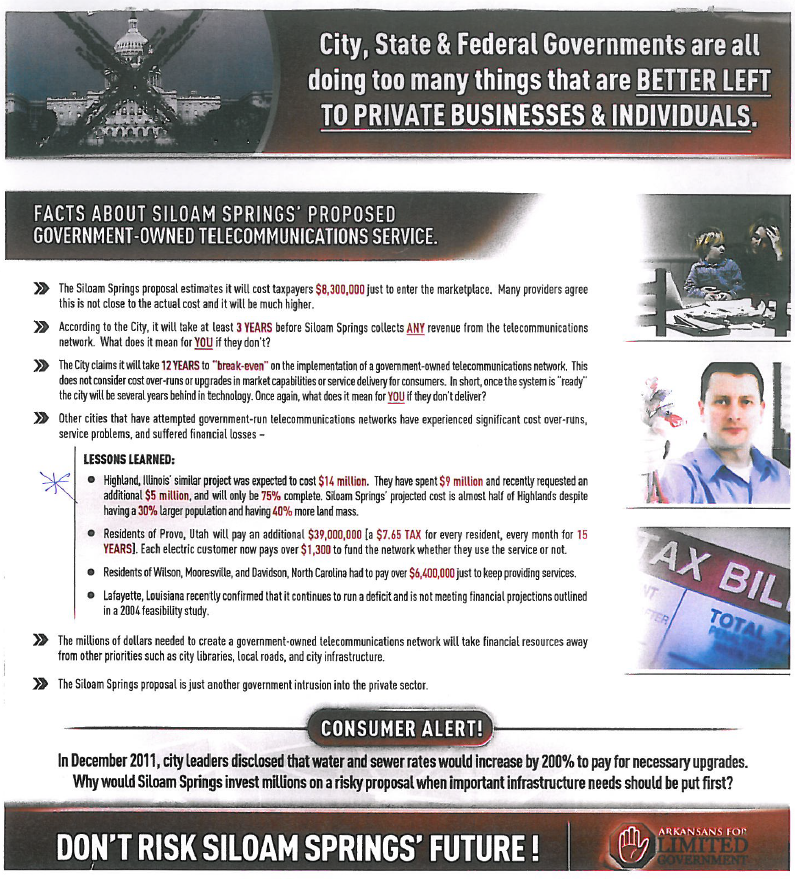
Fiber Referendum Fails in Siloam Springs
HBC Steps Down from Managing FiberNet Monticello
Senator Franken Calls on FCC to Actually Enforce Its Rules
Susan Crawford Keynote at The Next Web Conference
Susan Crawford on the importance of government policy. People who are concerned about the future of the Internet need to pay attention or the cable and telephone companies will take over the Internet (or at least access to it). Not because they are evil, but because what is best for them (or what they think is best for them in the short term) is not what is best for the rest of us or the vast majority of businesses that depend on access to the Internet.
How Chattanooga, Bristol, and Lafayette Built the Best Broadband in America
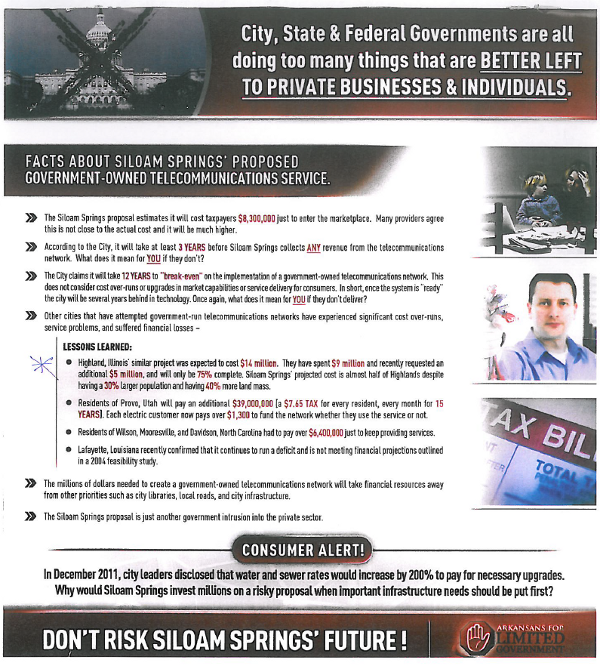
Arkansas Town Targeted by Cox Prior to Community Broadband Referendum
David Cameron, city administrator, said the proposal is not so much about dissatisfaction with current providers as it is about finding new revenue for the city. Cameron said revenue from electric services has been a key source of funding for various projects and necessities for the city. That “enterprise” fund is getting smaller, Cameron said, and an alternative funding source is needed. “We have done a good job managing accounts, building a reserve,” Cameron said. “We want to keep building on the programs we have. It takes money and funds to do that.” City officials discussed the issue for the last 18 months and decided to put it to a referendum. Voters will decide the issue May 22.That is a fairly unique reason. Most communities want to build these networks to encourage economic development and other indirect benefits to the community. Given the challenge of building and operating networks, few set a primary goal of boosting city revenue.
If approved by voters, the city plans to spend $8.3 million to install 100 miles of fiber optic cable directly to homes and businesses. The city should be able to repay the debt in 12 years, if things go according to a feasibility study presented to the city’s board of directors in January.