
Opelika Builds First Full Fiber Network in Alabama - Community Broadband Bits Episode 40
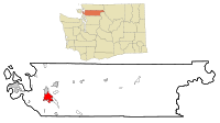
Mount Vernon, Washington, started building their own fiber optic network in 1995 and over the past 18 years have continued to add incrementally. While the network started as a way to connect a few municipal facilities, it has since expanded to nearby Burlington and the Port of Skagit. The network now serves government, schools, hospitals and clinics, and a broad range of businesses in the area.
We spoke with community leaders from Mount Vernon for our 38th episode of the Broadband Bits podcast. Mount Vernon owns the network and operates it out of the Information Systems office.
The network required no borrowing or bonding because initial funding came from a state Community and Economic Revitalization Board (CERB) grant. Since then, Mount Vernon has used revenue from the network and creative cost sharing with partners to expand throughout the city. When expanding into Burlington and the Port of Skagit in 2008, city leaders received a county sales tax grant to fund deployment.
The Mount Vernon School District became a partner early in the evolution of the network. According to Kim Kleppe, Information Services Director, K-12 schools do not pay a monthly fee to receive up to 1 gig of capacity for their 10 facilities. He estimates the current costs of a dark fiber connection for one facility at $700 per month. Total savings are astronomical, allowing the schools to dedicate significant dollars toward other expenses.
Mount Vernon city government saves over $100,000 per year and nearby Burlington saves over $52,000. The network has never been in debt and maintains a reserve.
Mount Vernon's network is an open access model on which ISPs serve customers via the city's infrastructure. Subscribers pay a one time fee to the city to be connected. Onging revenue comes from the ISPs, who pay to the city a percentage of what they collect in customer connectivity fees. Currently, eight different providers offer services via the Mount Vernon network, providing ample competition.
We finally see television news outlets asking the tough questions of bill pushed by powerful cable and telephone companies to prevent giving residents a real choice in cable and Internet service providers. We been covering this Georgia bill closely, and were glad to see this segment:
This video is no longer available. The segment makes an error in suggesting that tax dollars are commonly used by local governments in building networks. They are not. Most municipal networks are built using revenue bonds, where the community does not pledge its full faith and credit. Instead, they sell bonds to private investors who are then repaid by the revenues generated by the network. But this mistake is more than outweighed with the reveal at end of the video, that the municipal network in Thomasville allowed the city to drop its local property entirely. Yet another community benefiting tremendously from owning its own network.
Community leaders from several Georgia cities made the trek to Atlanta to oppose HB 282 on Thursday, February 28th. Opposition to this bill to limit investment in Internet networks includes community leaders, high tech companies, and citizens all over the state. Nevertheless, legislators on the House Energy, Utilities, and Telecom Committee chose to ignore the needs of communities, prefering to tell them from afar how to run their towns. Winners? Incumbents Windstream, AT&T, CenturyLink, and Comcast.
A substitute bill [PDF] was introduced that exempts communities with municipal electric utilities from the prohibition to provide telecommunications. Additionally, the bill's definition of "broadband service" is now defined as service equal to or greater than 3.0 Mbps. "in the faster direction." While these look like compromises at first blush, they do very little to change the real world application of the bill.
Our earlier analysis of the bill addressed the fact that the expense and time required to prove locations of unserved areas as defined by the bill, would foreclose the possibility of communities making investments in this essential infrastructure. Likewise, communities that already have networks would be similarly burdened.
Last year, we reported on the failed SB 135, which would have eliminated the "carrier of last resort" requirement in the state. The bill, sponsored by Republican Senator Paul Hornback would have let AT&T decide who could receive basic telephone service and would have limited consumer protections.
Last year's bill did not become law, but a progeny, SB 88, has already passed in the Kentucky Senate and was received in the House on February 15th. (We'd like to report what committee will hear it first but the Kentucky Legislative web has not yet published that information.) Senator Hornback is again the chief author of the bill, crafted by AT&T and its ALEC pals.
The Kentucky Resources Council (KRC) provides an analysis of SB 88 and a prognosis on how it would affect Kentuckians. KRC must be feeling deja vu, as are many organizations looking out for rural dwellers who depend on their landlines. These bills continue to be introduced year after year as large telecommunications companies spend millions of lobbying dollars, also year after year.
WMMT, Mountain Community Radio in Whitesburg, Kentucky, recently reported on the legislation. Sylvia Ryerson spoke with Tom Fitzgerald from KRC, who discussed the analysis. From KRC's report on the legislation:
At potential risk is the opportunity for existing and new customers, to obtain stand-along basic telephone services from the incumbent telephone utility, or “Plain Old Telephone Service (POTS)” as it is called. Those most adversely affected by this loss of access to basic, stand-alone, telephone service are those least able to obtain affordable and reliable alternatives – those who live in rural, lower density areas, and the poor in dense, urbanized areas who have no affordable alternative priced as low as POTS.