
fixed wireless

Content tagged with "fixed wireless"

Displaying 151 - 160 of 185

Transcript: Community Broadband Bits Episode 245

This is the transcript for episode 245 of the Community Broadband Bits Podcast. Brough Turner of Netblazr joins the show to explain point-to-point wireless service. Listen to this episode here.


Brough Turner: Here's the deal. It's $59.95 a month. No contracts. No teaser rates. No special deals. But we're not pulling any funnies on anybody and you can leave at any point.

Lisa Gonzalez: This is Episode 245 of the Community Broadband Bits Podcast from the Institute for Local Self-Reliance. I'm Lisa Gonzalez. NetBlazr is a Boston wireless Internet service provider that focuses on urban delivery of high-quality Internet access. This week, Brough Turner, founder and chief technology officer, connects with Christopher to talk about the ins and outs of providing the point-to-point wireless service in an urban area. Brough gets into the technology and the guys discuss what might be in the future of wireless. Brough also shares his company's experience as a startup, some of the challenges they faced, and how NetBlazr is keeping up with demand. Check out their website, NETBLAZR.com, to learn more about the company, the technology, and the team. Here's Christopher talking with chief technology officer and founder of NetBlazr, Brough Turner.

Christopher Mitchell: Welcome to another edition of the Community Broadband Bits Podcast. I'm Chris Mitchell. Today I'm speaking with Brough Turner, the founder and chief technology officer for NetBlazr. Welcome to the show.

Brough Turner: Thank you.

Christopher Mitchell: We'll get into this in a second, but NetBlazr's a wireless firm. We're going to talk a lot about wireless technologies. Maybe you can just tell us a little bit about what you know about wireless networks. I guess a different way of saying that would be, tell the audience why they should listen to you.

netBlazr Offering Blazing Fast Fixed Wireless - Community Broadband Bits Podcast 245

Like other urban centers in the U.S., Boston is filled with multi dwelling units (MDUs) and buildings that house multiple business tenants. Obtaining high-quality connectivity in such an environment can be a challenge, especially if choices are limited to just one or two incumbents with little or no competition. With the advancement of new fixed wireless technologies in recent years, however, residential and business subscribers now have better options.

This week, Christopher talks with Brough Turner, the founder and Chief Technology Officer at netBlazr. The company provides high-quality fixed wireless Internet access to residents and businesses across the city. Listeners who enjoy our occasional deep dives into the technical side of wireless connectivity, you’re in for a treat.

Brough and Christopher also discuss the company and the challenges they face working in a market traditionally reserved for the big incumbents. The guys spend time discussing the future of wireless and what Brough, who has extensive experience in this field, expects to see both in the short and long term.

This show is 35 minutes long and can be played on this page or via Apple Podcasts or the tool of your choice using this feed

Transcript below. 

We want your feedback and suggestions for the show-please e-mail us or leave a comment below.

Listen to other episodes here or view all episodes in our index. See other podcasts from the Institute for Local Self-Reliance here.

Thanks to Break the Bans for the music. The song is Escape and is licensed under a Creative Commons Attribution (3.0) license.

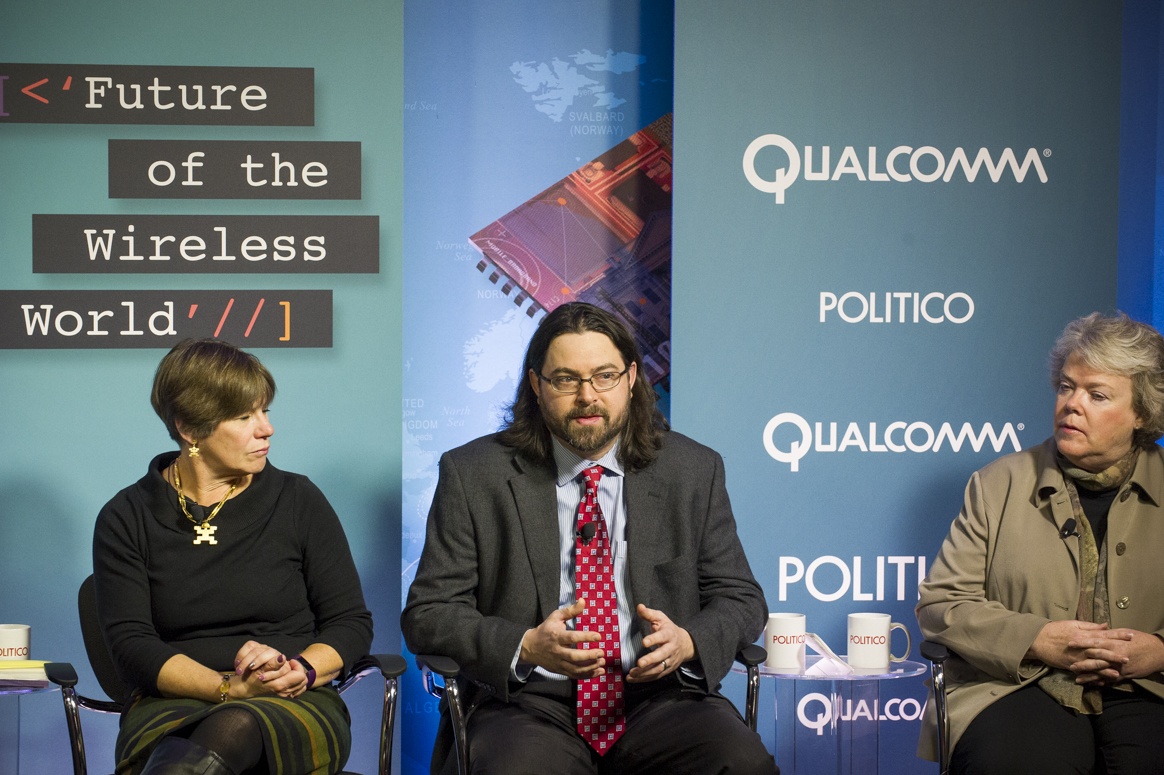
Christopher Speaks to Politico Live on "The Future of the Wireless World"

On March 7th, Christopher participated in a panel discussion sponsored by Politico and Qualcomm as part of an event called "The Future of the Wireless World." The panel was moderated by Politico Technology Reporter Alex Byers and included the following participants:

  • Steven Crowley, P.E., Consulting Wireless Engineer
  • Mindel De la Torre, former Chief of the International Bureau, Federal Communications Commission
  • Christopher Mitchell, Director of Community Broadband Networks Initiative, Institute for Local Self-Reliance
  • Joan Marsh, Senior Vice President of Federal Regulatory, AT&T

Watch the video at Politico's website.

Highlights from this conversation include Christopher's interaction with the AT&T representative about their claim that a "one touch make ready" policy was specific to Google Fiber. This interaction is at 36:20 in the conversation.

Sho-Me Your Fixed Wireless, Houston, MO!

Electric cooperatives are increasingly creating local solutions to rural connectivity woes. Many have built networks that rival those in the best connected cities in the U.S. Rather than waiting for disinterested national providers, cooperatives and their members have found workable solutions.

In south-central Missouri, the Sho-Me Power Electric Cooperative is once again exercising the power of community network projects. The Houston Herald reports that Sho-Me Technologies, the communications subsidiary of the co-op, is deploying a fiber-backed, fixed wireless project to connect businesses in Houston, Missouri.

Houston, We’ve Got A Problem

Houston (population: 2,000) is the capital of Texas County, Missouri -- yes, Missouri. Home to about 25,000 people, the rural county has poor connectivity; about 90 percent of the county’s population doesn't have access to high-speed Internet service of 25 Mbps download and 3 Mbps upload. The Houston Herald reports that speeds of up to 10 Mbps download are the norm in Texas County. Upload speeds are even slower.

The situation has been rough for small businesses in Houston, where they could not perform routine updates without impeding service. For instance, the local dentist office, Family Dentistry, could not accept Microsoft updates for its network without disrupting daily operations at the practice.

Downtown Houston Finds The Local Co-op Solution

Eastern Shore of Virginia Broadband Authority Improves Connectivity

In 2008, the counties of Accomack and Northampton created the Eastern Shore of Virginia Broadband Authority (ESVBA) to serve local needs and boost economic development. NASA provided key funding to build the backbone of the regional network. Today, the ESVBA has already improved wireless services in several communities and is at work on a Fiber-to-the-Home (FTTH) test project.

The space agency played a key role in bringing high-speed connectivity to rural communities on the Eastern Shore of Virginia. Wallops Flight Facility on Wallops Island, Virginia, employs 1,100 people, launches rockets, and features a visitor center. Government agencies, local schools, and healthcare institutions on the shore all needed reliable connectivity for their programs.

Internet Service Like Lightspeed

The FTTH test project started last September in Harborton, Virginia, as part of the Town Broadband Initiative Project. The landscape is typical of rural Virginia with little density as houses and businesses spread out into the woods. They have recently signed up the first few customers; this small town on the eastern shore has about 100 homes.

Community Effort: Local Seed Funding

In 2008, the counties of Accomack and Northampton created the public, not for profit entity through the Virginia Wireless Service Authorities Act to solve a growing problem on the shore. The lack of connectivity was having a negative impact on local rural communities. The counties provided an initial sum of about $270,00 to ESVBA to plan the network. 

logo-ESVBA.png

United Fiber Tackles Missouri's Most Rural - Community Broadband Bits Podcast 240

The most rural area of Missouri is getting a Fiber-to-the-Home network from the United Electric Cooperative, which has created United Fiber and is expanding across its footprint and to adjacent areas that want better Internet access. Chief Development Officer Darren Farnan joins us to explain why his co-op has taken these steps.

We discuss how they are rolling it out - focusing on areas that need the service while respecting the telephone cooperatives that are within their electric footprint. The project has benefited from a broadband stimulus award and also incorporates fixed wireless technology in some areas.

We discuss some of the economics behind the project and are sure to clarify that though the utility has needed some capital subisides to build the network, it does not need any operating subsidies to continue - it runs under its own revenue. And we talk about the demand for better, faster connections - it is much higher than most realize.

This show is 30 minutes long and can be played on this page or via Apple Podcasts or the tool of your choice using this feed

Transcript below. 

We want your feedback and suggestions for the show-please e-mail us or leave a comment below.

Listen to other episodes here or view all episodes in our index. See other podcasts from the Institute for Local Self-Reliance here.

Thanks to Admiral Bob for the music. The song is Turbo Tornado (c) copyright 2016 Licensed under a Creative Commons Attribution (3.0) license. Ft: Blue Wave Theory.

Librarians Leading The Way: Apply For "Beyond the Walls" Grant

San Jose State University’s School of Information (iSchool) and the Gigabit Libraries Network are accepting proposals for projects under a National Leadership Grant from the Institute of Museum and Library Services (IMLS) to expand the Libraries WhiteSpace Project. According to the announcement, five projects will be funded.

The “Beyond the Walls” Awards will provide $15,000 grants “to libraries for the most innovative proposals to use TV WhiteSpace (TVWS) technologies to enable new library hotspots in the service of their communities.”

Co-director Kristen Reman of SJSU said:

"This initiative will further explore the role of libraries as leading community anchors promoting access and inclusion through strategic technology integration. There's a nice intersection between what we're implementing and the concept of community anchors, which has been used by IMLS to describe the role of libraries in providing civic engagement, cultural opportunities, and economic vitality to communities,"

The first round of applications will be accepted until March 6th winners will be announced near the end of April. Libraries interested in applying for an award can watch a quick 2-minute video to help them determine if they meet qualification criteria. You can also contact info(at)giglibraries.net with questions; they will even help you put together a project plan.

Read the full announcement online.

Watch the video here:  

White Space Technology

"White spaces" or "TVWS" are the unlicensed low-frequency spectrum that was reserved for television signals prior to digitization of television. Now that the spectrum is not being used for TV, it's been freed up for fixed wireless Internet accesss.

Columbia County, Georgia: Community And Network Grow Together

Local officials in Columbia County, Georgia, wanted better public safety communications, synchronized traffic signals, and better connectivity for government facilities. They decided the best strategy was a publicly owned network and their decision is creating opportunities they hadn't anticipated.

When he considers how the county expanded its fiber network to improve economic development, education, and public savings, Columbia County Broadband Utility (C3BU) Broadband Manager Lewis Foster still sounds a little surprised. After all, Columbia County planned on using the network for a limited purpose, but then they realized the diversity of the asset. "It was almost an afterthought," he says.

Poor Options Created A Positive Path

Before the idea of a publicly owned network saw the light of day in Columbia County, local leaders contacted the incumbent providers to set up a dark fiber lease. To their dismay, incumbents AT&T, Comcast, and WOW, would not lease the county dark fiber.

County officials approached incumbents in 2007 and 2008 hoping to secure a dark fiber lease. The large providers, however, said they either didn’t have any dark fiber to lease, they could offer lit services, or they would build a dark fiber network for the county to use. Incumbents demanded a model where the county would pay the construction costs but the infrastructure would be owned and operated by the incumbents – who would then charge the County for access to the network the county had paid for. Foster recalls that incumbents we’re most interested in charging premium rates for lit services. Columbia County officials wanted a better option and found a more fiscally responsible approach in simply owning the network.

DIY Wireless in Brinnon, Washington

Seattle has received a lot of attention as it's struggled with the concept of a community network, but people in the small community of Brinnon are moving past the talking phase. A group of residents are tired of waiting for high quality Internet access and don't expect a national provider to bring it to them any time soon. People in Brinnon are considering a fixed wireless approach pioneered in the San Juan Islands, which is a few hours north.

Community members have formed a nonprofit, West Canal Community Broadband Project, to bring wireless Internet service to the town and neighboring communities. Two hundred people have already signed up on the nonprofit’s website.

The community is located about 25 miles due west (62 miles by car to get through the Sound) and home to about 800 people. People in Brinnon with the best connections have DSL, but many use satellite or mobile Internet access. Data caps associated with satellite and mobile plans drive up the costs and neither source is reliable. With such a small population, the locals don't expect any incumbent investment soon; they're exercising their self-reliant muscles and hashing out the details of better local connectivity on their own.

If all goes as planned, Brinnon could see better Internet access options by next summer.

Very Little Connectivity

The community center and the school have high-speed Internet service thanks to a federal grant project in Jefferson County, but residents and businesses struggle to connect. 

The goal of this wireless project is fast, reliable Internet service without data limits for both business and residents. The residential download speed will be 25 Megabits per second (Mbps), and business connections will have speeds of 50 Mbps. Customized plans with speeds of up to 250 Mbps will also be offered. No word yet on expected upload speeds. The cost for each tier of service has not yet been decided.

The DIY Wireless Project

Rural Electric Co-ops Power Up A Gig In Pacific Northwest

Rural electric cooperatives are providing next-generation connectivity. In Oregon a consortium of electric cooperatives called LS Networks built a middle mile network a few years ago and now are taking the next step with last mile connectivity.

LS Networks’ Connected Communities program hopes to bring last mile fiber connectivity to 25 communities in rural Oregon and Washington. Internet access will officially be available in early 2017 in some communities. Depending on the needs of each community, the solution could be Fiber-to-the-Home (FTTH), or fixed wireless using the fiber-optic network for backhaul.

Connected Communities

The project started in July, but LS Networks only now made the official announcement. The Connected Communities program asks folks to nominate their community to be connected by filling out a short form. LS Networks will offer two types of monthly plans [pdf]: 100 Megabits per second (Mbps) for $40 and a Gigabit (1,000 Megabits) for $70. Customers will also be able to purchase voice service for an additional $15 per line and 50 cents per phone number.

Currently, the small, northern Oregon town of Maupin is the only official Connected Community. LS Networks is already at work building out a fiber connection to nearly all of the 400+ homes and businesses in the community. On November 9th, Maupin residents can take part in a town hall meeting at the South Wasco County High School to learn more about LS Networks’ plans and the Connected Communities program.

Consortium of Cooperatives