
digital equity

Content tagged with "digital equity"

Related Topics
Displaying 81 - 90 of 130

Let’s Get Going Broadband Bootcamps Continue To Roll

ILSR’s Community Broadband Networks (CBN) Initiative continues to host Let’s Get Going Broadband Bootcamps across the country.

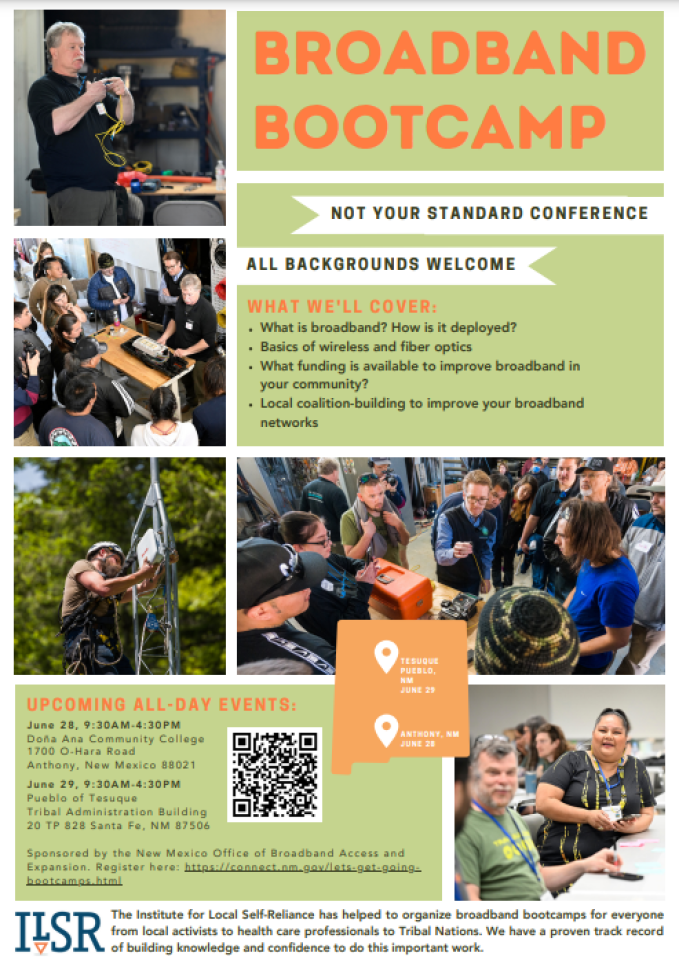
The next two upcoming bootcamps are being sponsored by the New Mexico Office of Broadband Access and Expansion and will be held at Doña Ana Community College in Anthony, New Mexico on June 28 from 9:30 a.m. to 4:30 p.m. Another will be held the following day, June 29, at the Tribal Administration Building on the Pueblo of Tesuque in New Mexico.

Image
Let's Get Going Bootcamp flyer

The bootcamp agenda includes:

  • What is broadband and how is it deployed?
  • The basics of wireless and fiber optics
  • What funding is available to improve broadband in local communities?
  • Coalition-building to improve local broadband networks

The in-person, hands-on bootcamps are aimed at helping participants understand broadband and digital equity basics, identify local needs, evaluate options, and chart a path forward. From leveraging existing assets, to financing, to partnerships, to evaluating models for success, this program is designed to demystify every step of the process.

If you are in New Mexico or nearby, there is still time to register here.

Attendance is free, but submission and acceptance of an application is required prior to the event. Space is limited and priority will be given to local community members and small local teams eager to learn together and mobilize locally to improve connectivity.


Brandon Forestor Puts Local in Local Internet Organizing - Building for Digital Equity Podcast Episode 13

Building for Digital Equity logo

Brandon Forester is the National Organizer for Internet Rights at Media Justice. We talk about organizing for digital equity and more specifically Brandon's vision for communities having agency over how technology shows up in their neighborhoods and digital communities. We discuss how Media Justice came to prioritize prison phone justice, what organizing is and how local solutions may differ in different communities, and the need to avoid purity politics in doing this work. 

This show is 20 minutes long and can be played on this page or using the podcast app of your choice with this feed.

Transcript below. 

We want your feedback and suggestions for the show-please e-mail us or leave a comment below.

Listen to other episodes here or see other podcasts from the Institute for Local Self-Reliance here.

Thanks to Joseph McDade for the music. The song is On the Verge and is used per his Free-Use terms.

B4DE Starts Tomorrow with NDIA’s Angela Siefer as Keynote

In just over 24 hours our next Building for Digital Equity (#B4DE) event goes live.

Tomorrow, June 7, beginning at 3 pm ET, #B4DE promises to offer engaging examples, practical tools, and nuggets of insight as digital equity advocates across the nation prepare to take advantage of unprecedented federal funds and programs spurred by the Digital Equity Act and bipartisan infrastructure law.

This free event, sponsored once again by UTOPIA Fiber, will be headlined by National Digital Inclusion Alliance (NDIA) Executive Director Angela Siefer. She will offer thoughts on what those working to close the digital divide should be thinking about while setting priorities in this historic moment, as states are developing their digital equity plans and getting ready to receive their share of the $42.5 billion contained in the Infrastructure Investment and Jobs Act (IIJA).

Though seats are filling up fast, there is still time to register here.

The livestream will be available (and later archived) on Facebook, YouTube, Twitter, and LinkedIn, with live viewer questions answered by the panels. We recommend viewing it on YouTube here where the live chat will be most lively.

Co-hosted by NDIA Training & Community Engagement Manager Pamela Rosales and ILSR’s Community Broadband Networks Director Christopher Mitchell, the 75-minute online webinar brings together a variety of front-line experts and digital inclusion practitioners who will share focused, concise lessons-learned and best-practices relevant for those working in both rural communities and urban centers.

Ini Augustine on Mutual Aid and Community Connectivity - Building for Digital Equity Podcast Episode 11

Building for Digital Equity logo

Ini Augustine is a technologist who was ready to organize with her community to improve access to computers and Internet access when the pandemic hit and many low-income neighborhoods in Minneapolis and Saint Paul were cut off from education and other resources. More recently, she organized the Black Broadband Summit and the Family Broadband Coalition. We talk about her work and the promise and challenge of forming a cooperative to bring better Internet access to people who have been abandoned by traditional business models.

We also talk about whether kids in North Minneapolis would be in better shape today than they were in 2020 if they suddenly were cut off from school again. And who should be taking responsibility to make sure that answer is yes?

Her work has been featured in Minnesota Public Radio as well as Sahan Journal. Follow their progress on Instagram as well - Project Nandi.

This show is 15 minutes long and can be played on this page or using the podcast app of your choice with this feed.

Transcript below. 

We want your feedback and suggestions for the show-please e-mail us or leave a comment below.

Listen to other episodes here or see other podcasts from the Institute for Local Self-Reliance here.

Thanks to Joseph McDade for the music. The song is On the Verge and is used per his Free-Use terms.

CA Broadband Activists Aim For Big Wins On Mapping, Cable Franchise Reform

As California aims to boost broadband competition and Los Angeles County pursues what could be the biggest municipal broadband network ever built, local activists say they’ve made some meaningful recent inroads on both improving broadband mapping, and regulatory reform that should aid the equitable deployment of modern, affordable access.

Recently, inroads have been made on fixing long-broken California cable franchise law. In the early aughts, cablecos (and telcos pushing into the TV business) successfully lobbied for state-level “cable franchise reform” laws they promised would dramatically lower prices. In reality, such bills were often little more than legislative wishlists crafted by telecom giants.

Often these state-level replacements for local franchise agreements eroded legal regulatory authority, eliminated long standing requirements for uniform broadband and TV deployment, and in some states–like Wisconsin–even acted to strip away local consumer protections and eminent domain rights. Warnings by academics on this front were widely ignored.

Seventeen years after its passage, California activists say that California’s 2006 Digital Infrastructure and Video Competition Act (DIVCA) was no exception.

Approaches to Digital Equity Work in Cleveland and Detroit - Episode 553 of the Community Broadband Bits Podcast

This week on the podcast, Christopher speaks with Joshua Edmonds, CEO of DigitalC, a nonprofit technology social enterprise in Cleveland. DigitalC offers affordable wireless service for $18/month, as well as a co-working and collaboration space for the community.

Joshua served as Detroit’s Digital Inclusion Director for four years before heading DigitalC, and he and Christopher discuss Joshua's coalition-building work in Detroit. They compare his experience working under the city of Detroit to his nonprofit digital equity work in Cleveland. Detroit and Cleveland also have two of the highest Affordable Connectivity Program (ACP) enrollment rates among prominent metro areas – Joshua offers his approach to ACP, outlining the organized and relentless campaign it took to achieve substantial enrollment in the subsidy program during his time in Detroit. He highlights how important it is to focus on long-term, structural solutions for closing the digital divide at the same time as we find ways to make Internet more affordable in the short term.  

Joshua also speaks about DigitalC’s focus on being locally-rooted, mission-driven and sustainable, and offers his thoughts on the viability of wireless.  

This show is 28 minutes long and can be played on this page or via Apple Podcasts or the tool of your choice using this feed

Transcript below.

We want your feedback and suggestions for the show-please e-mail us or leave a comment below.

Listen to other episodes here or view all episodes in our index. See other podcasts from the Institute for Local Self-Reliance here.

Thanks to Arne Huseby for the music. The song is Warm Duck Shuffle and is licensed under a Creative Commons Attribution (3.0) license.

Register Now For Upcoming Building For Digital Equity Event

Our next Building for Digital Equity (B4DE) event is only weeks away. Have you registered yet?

Sponsored by UTOPIA Fiber, the June 7 virtual gathering will feature engaging debates on the hottest topics in broadband: the upcoming release of BEAD funds, the challenges around mapping, updates on efforts to boost enrollment in the Affordable Connectivity Program (ACP), and the looming implications for both urban and rural communities.

Like B4DE in the past, this event, slated to begin at 3 pm ET on June 7, will be cohosted by Pamela Rosales, from the National Digital Inclusion Alliance (NDIA), and our own Christopher Mitchell, Director of ILSR's Community Broadband Networks Initiative. 

Register now for the event here.

As with previous B4DE events, this one will include informative, concise presentations, a series of interactive trivia games, and an introduction to new data tools for those working on the front lines of digital equity. It will all be livestreamed and will be available (and later archived) on Facebook, YouTube, Twitter, and LinkedIn, with live viewer questions answered by the panels.

Building for Digital Equity Podcast Series New Episodes

Meanwhile, be sure to check out our most recent episodes of our Building for Digital Equity podcast, which features short interviews with the people working in the trenches for digital inclusion.

Episode 7 is a discussion with Dwight Thomas, who built the first citywide municipal fiber network in Mont Belvieu, Texas. Thomas goes on talk about the importance of community engagement and how to make sure people can use the network once it is built before explaining his passion for discipleship and sharing knowledge.

Jessica Strom and Opportunity Home Help People Build Marketable Skills - Building for Digital Equity Podcast Episode 10

Building for Digital Equity logo

Jessica Strom, Digital Inclusion Manager for Opportunity Home - the Public Housing Authority of San Antonio, shares the challenges of digital inclusion on their many properties as well as leaving us with exciting success stories of how people landed well-paying jobs after completing their courses. We also discuss the challenges for housing residents to avoid scams and the importance of free Wi-Fi to be ready if ACP runs out. 

This show is 18 minutes long and can be played on this page or using the podcast app of your choice with this feed.

Transcript below. 

We want your feedback and suggestions for the show-please e-mail us or leave a comment below.

Listen to other episodes here or see other podcasts from the Institute for Local Self-Reliance here.

Thanks to Joseph McDade for the music. The song is On the Verge and is used per his Free-Use terms.

Deb Socia and Free, Fast Internet Access in Chattanooga - Building for Digital Equity Podcast Episode 9

Building for Digital Equity logo

Sean Gonsalves interviews Deb Socia, President and CEO of the Enterprise Center, about Chattanooga's remarkable municipal fiber network, which began offering free, high-speed service to thousands of low-income families during the pandemic under a program called HCS EdConnect. They go on to talk about one of Sean's favorite slogans, "If it isn't affordable, it isn't access." And finally, they discuss some advice for people newly joining digital equity work. 

This show is 15 minutes long and can be played on this page or using the podcast app of your choice with this feed.

Transcript below. 

We want your feedback and suggestions for the show-please e-mail us or leave a comment below.

Listen to other episodes here or see other podcasts from the Institute for Local Self-Reliance here.

Thanks to Joseph McDade for the music. The song is On the Verge and is used per his Free-Use terms.

Broadband Commons Forms, New Resource for Broadband Data Wranglers Emerges

Finding good data on broadband is hard to come by. But, it’s about to get a bit easier with a new online resource being developed by an informal group known as Broadband Commons.

Broadband Commons is a group of folks from very different backgrounds – nonprofit, industry, and academic – who work in the broadband and digital equity space and have a shared enthusiasm for making sense of messy broadband data.

Their primary mission is to make broadband data (e.g., FCC Broadband Availability data and more) accessible to all, both in terms of understanding and using the data.

Image
Broadband Commons website

Broadband Commons (ILSR’s Community Broadband Networks Initiative counts itself as a member) is excited to share a peek into the development of their guidebook: Introducing Broadband Data. This book is intended to be the “missing manual” for broadband data users — how to find the data you need, how to wield it to answer your research questions, common gotchas to look out for, and how to share your work back with the community.

They invite interested folks to share any feedback you might have as this guidebook develops – what else might be needed? If you're interested in contributing your expertise by writing a particular section, please head over to the Broadband Commons website to check out the book and sign up for an invite to the discord channel.

Updates about the project will also be posted on the website.

Header image of data graphic courtesy of www.epictop10.com on Flickr, Attribution 2.0 Generic (CC BY 2.0)