
digital equity

Content tagged with "digital equity"

Related Topics
Displaying 111 - 120 of 126

Y-ZONE is Connecting Families with CBRS – Episode 500 of the Community Broadband Bits Podcast

This week on the podcast, Christopher is joined by Margaret Kaufer, President of the New York-based STEM Alliance, and Bob Cacase, Commissioner of Information Technology for the City of Yonkers. During the conversation, the three talk about Y-ZONE, a partnership between several community groups working to connect households in Yonkers. They discuss origins of the partnership, performance of the CBRS technology the network relies on, and some technical details of their particular build. They also get into the nitty gritty of real world costs associated with building CBRS networks, and how they overcome obstacles they have faced regarding adoption by the community.

This show is 35 minutes long and can be played on this page or via Apple Podcasts or the tool of your choice using this feed

Transcript below. 

We want your feedback and suggestions for the show-please e-mail us or leave a comment below.

Listen to other episodes here or view all episodes in our index. See other podcasts from the Institute for Local Self-Reliance here.

Thanks to Arne Huseby for the music. The song is Warm Duck Shuffle and is licensed under a Creative Commons Attribution (3.0) license.

Missed Our Building for Digital Equity Event with NDIA? Here's Everything That Happened

On Wednesday, March 16th, the Institute for Local Self-Reliance teamed up with the National Digital Inclusion Alliance for a two-hour, fast-paced webinar on the ways communities can accomplish digital equity goals called Building for Digital Equity: Demystifying Broadband Policy and Funding. It was just as fun to do as we hoped, and packed with speakers providing practical, easy-to-understand advice and a wonderful audience full of questions and additional information.

We heard from an array of people and about a host of projects, from Broadband Action Teams in Washington state, to coalitions in Maine, an update on the Digital Navigator model, mapping, talking to local governments, and a breakdown of the funding available to communities.

If you did not have a chance to leave feedback for us, please do it here - especially if you have ideas for segments in future events.

We also want to make sure you have links to all of the resources shared by the event speakers:

Empowering Community in Cleveland, with DigitalC - Episode 499 of the Community Broadband Bits Podcast

This week on the show, Christopher is joined by Angela Thi Bennett, Director of Advocacy & Impact at DigitalC, a community-based Cleveland nonprofit which operates a fixed wireless network in the city's unserved and underserved neighborhoods. Before she leaves to become the first Digital Equity Director for National Telecommunications and Information Administration (NTIA), Angela sits down with Christopher to talk about everything the organization does to advance digital equity goals in the city, driven by an agenda that focuses on healthcare, education, and economic growth. She shares how the nonprofit developed a sustainable model to delivery reliable, fast Internet access for $18/month, how success comes from listening intentionally and regularly to what community members need and want, and what true empowerment means in the face of shifting agendas at the state and national level.

This show is 20 minutes long and can be played on this page or via Apple Podcasts or the tool of your choice using this feed

Transcript below. 

We want your feedback and suggestions for the show-please e-mail us or leave a comment below.

Listen to other episodes here or view all episodes in our index. See other podcasts from the Institute for Local Self-Reliance here.

Thanks to Arne Huseby for the music. The song is Warm Duck Shuffle and is licensed under a Creative Commons Attribution (3.0) license.

Join Us Thursday, March 24th at 5pm ET, To Discuss Cities Taking On Digital Equity - Episode 38 of the Connect This! Show

In this episode of the Connect This! Show, co-hosts Christopher Mitchell and Travis Carter (USI Fiber) are joined by guests Joshua Edmonds (City of Detroit) and Jason Hardebeck (Baltimore City) to talk about large cities prioritizing equity in building community broadband.

The panel will talk current events in broadband, what digital equity problems affect their cities, solutions to these problems, and the biggest challenges to implementing those solutions.

Subscribe to the show using this feed on YouTube Live or here on Facebook Live, or visit ConnectThisShow.com.

Email us broadband@muninetworks.org with feedback and ideas for the show.

Watch here on YouTube Live, here on Facebook live, or below.


Study Highlights Importance of Community-Based Digital Equity Leaders

Last year, nearly two dozen community leaders in Baltimore were brought together with national experts for a five-week crash course on network engineering, federal policymaking, community broadband networking, and grassroots organizing.

It was an online program called “The Digital Equity Leadership Lab (DELL)” – an initiative created by the Robert W. Deutsch Foundation in response to “other digital inclusion programs across the U.S. that have failed to consider the technical aspects of the Internet and social inequalities alongside broader Internet policy and advocacy goals.”

It spawned a case study led by Colin Rhinesmith, Faculty Associate and Director of the Community Informatics Lab at the UCLA Center for Critical Internet Inquiry and a Senior Fellow with the Benton Institute for Broadband & Society. Released earlier this week, The Digital Equity Leadership Lab (DELL): A Case Study of Community Leadership Development to Promote Digital Equity and Justice highlights the importance of developing community-based leaders around digital equity, gifting rising and next-generation digital equity advocates with important insights for their work.

Through interviews with 15 of the 25 DELL participants, and with the input from a range of national experts and Deutsch Foundation staff, the study set out to answer the question: how might DELL serve as a community-based leadership training model to develop the next wave of digital equity leaders?

The analysis surfaced three key findings:

  • Bringing national policymakers and advocates together with community leaders is powerful and transformative.
  • Digital inequality is a social, not a technological problem. 
  • Community leaders need access to a shared platform and each other to create change. 

But the study didn’t stop there. Rhinesmith (with research assistance from Jie Jiang and Malana Krongelb) offers three recommendations in light of the study’s findings:

Field Reports: Municipal Broadband and Digital Equity in Baltimore

This week, we bring you a special field report from Maryland-based radio and podcast producer Matt Purdy. Through interviews with citizens, digital equity advocates, and the city's new Director of Broadband and Digital Equity, Purdy documents the connectivity struggles that have persisted in Baltimore's historically marginalized neighborhoods for decades.

Those challenges have only become more pronounced with the pandemic, prompting local officials to begin making moves in the direction of something we've not yet seen in a community the size of Baltimore: building a city-owned, open access fiber network.

This is a great story, so we won't give anything else a way. Listen below, or here.

Special Report: Baltimore Builds Muni Fiber, Prioritizing Equity - Episode 496 of the Community Broadband Bits Podcast

This week on the podcast, radio producer Matt Purdy reports a story on Baltimore’s efforts to build a municipal broadband network that prioritizes equity for historically marginalized communities.

This show is 13 minutes long and can be played on this page or via Apple Podcasts or the tool of your choice using this feed

Transcript below. 

We want your feedback and suggestions for the show-please e-mail us or leave a comment below.

Listen to other episodes here or view all episodes in our index. See other podcasts from the Institute for Local Self-Reliance here.

Thanks to Arne Huseby for the music. The song is Warm Duck Shuffle and is licensed under a Creative Commons Attribution (3.0) license.


Sneak Peek at Upcoming Building for Digital Equity Event

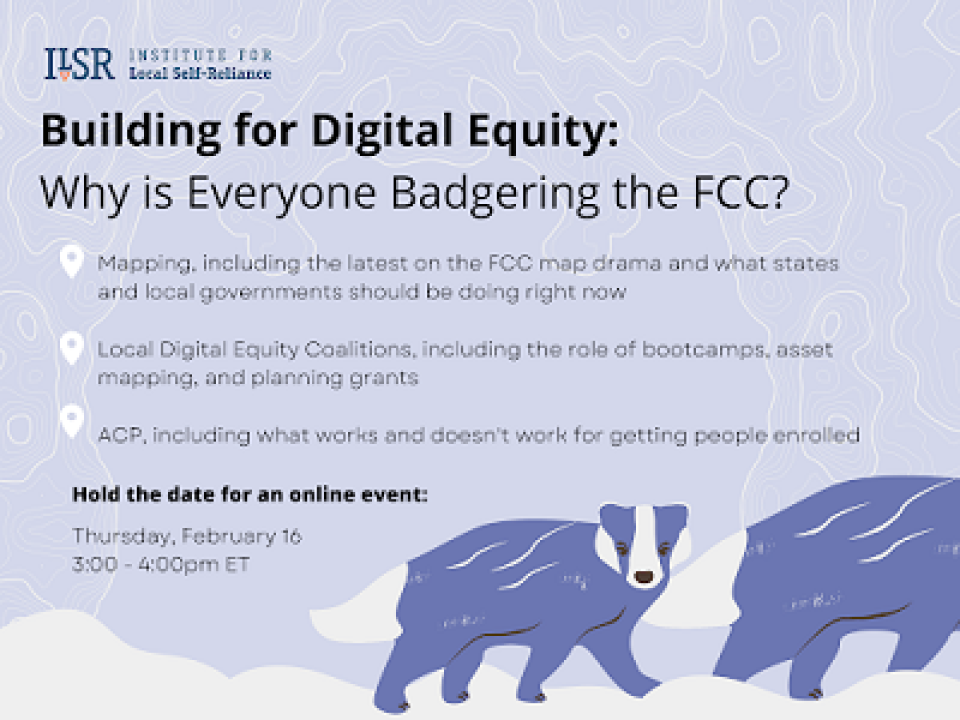
Last week we invited you to save the date for a two-hour livestream event Building for Digital Equity: Demystifying Broadband Policy and Funding that the Institute for Local Self-Reliance (ILSR) is co-organizing with the National Digital Inclusion Alliance (NDIA).

Image

We told you this event – which will be held on Wednesday, March 16th, from 2-4pm ET – was not going to be your average conference or webinar with 45-minute panels that make your derriere doze off or your eyes glaze over like a stale donut.

We are aiming for a fast-paced, fun, and interactive virtual gathering of network builders, local stakeholders, policy advocates, and funding experts from across the country that will feature a mix of short presentations, a sprinkling of trivia and prizes, and panels with Q & A’s that will be accessible on a variety of popular social media platforms.

Well, the event is coming together, promising to offer practical insights on how communities can seize this unprecedented moment to pursue community-driven broadband solutions.

You can register for the event here.

Here’s a sneak peek at the line-up:

Event: Building for Digital Equity - Demystifying Broadband Policy and Funding

We're living through a time with an unprecedented level of broadband infrastructure funding, fueled not only by the American Rescue Plan, but the Consolidated Appropriations Act, the Coronavirus Capital Projects Fund, and the Infrastructure Investment and Jobs Act. Hundreds of community-driven projects are already underway, but finding solid footing amidst these programs, statutes, and evolving rules is difficult. 

To help, the Institute for Local Self-Reliance is teaming up with the National Digital Inclusion Alliance for a two-hour livestream event to demystify the landscape. On Wednesday, March 16th, from 2-4pm ET, we're hosting an online conversation to bring together local stakeholders, policy advocates, and funding experts in one place. We're calling it Building for Digital Equity: Demystifying Broadband Policy and Funding.

Image

But this isn't your average conference or webinar, with 45-minute panels that make your butt go numb and your eyes glaze over. Oh no. We're aiming for a fast-paced, fun, and most importantly interactive conversation between policy advocates, network builders, local officials, and anyone else interested in learning how we can ensure that the tens of billions in upcoming infrastructure funding goes to solving the connectivity crisis permanently rather than once again disappearing into the pockets of the monopoly Internet Service Providers (ISPs).

Fort Collins' Connexion Continues to Expand and Adds Construction Projections for Residents

With a little less than a year left in its projected build schedule, Fort Collins (pop. 168,000) continues to make progress on its municipal fiber-to-the-home (FTTH) network, while also releasing new resources to help keep citizens informed and help households with affordability challenges stay online. 

When we last checked in on Fort Collins' Connexion a little more than a year ago, the network was nearing a milestone, having spent roughly 49 percent of its construction budget. Today, the network is well over the halfway point of its $142 million-dollar build. In fact, it expects to be done placing vaults and with boring work in July.

Along the way, local officials have taken steps to increase transparency and improve communication with local residents. Last summer, it released a construction map of the networks' anticipated 357 fiberhoods, delineating which areas were in design, under construction, or fully lit.

Image

In addition, at the end of November of 2020 the network released a Network Status tracker so that users could see in each of the four quadrants of the city if connections were down.