

FCC's Wheeler Forging Ahead As Support Grows to Restore Local Decision-Making

In a June 10 Official FCC Blog post, Chairman Tom Wheeler's words show continued resolve to restore local decision-making to communities that want to evaluate their own investments and partnerships. This is the latest in a series of public statements indicating the agency is ready to assert authority and remove barriers to community networks.
Wheeler writes:
If the people, acting through their elected local governments, want to pursue competitive community broadband, they shouldn’t be stopped by state laws promoted by cable and telephone companies that don’t want that competition.
I believe that it is in the best interests of consumers and competition that the FCC exercises its power to preempt state laws that ban or restrict competition from community broadband. Given the opportunity, we will do so.
In April, Wheeler raised a few lobbyist eyebrows in a speech on the role of municipal networks at the Cable Show Industry conference in Los Angeles. In this latest post, he notes that Chattanooga's network transformed it from "a city famous for its choo-choos," into the "Gig City." The network spurs economic development, improves access, and inspires innovation, notes our FCC Chairman.
The National Journal also takes note of the FCC blog post. Its article points out that Wheeler criticizes Tennessee's state law restricting Chattanooga's ability to expand. Even though nearby communities want service from EPB, the City is forbidden from serving them. Not acceptable, says Wheeler.
While the National Journal suggests Tennessee may be the first state to face FCC authority to eliminate state barriers, policy experts have no expectations yet. From the article:
Harold Feld, the senior vice president of consumer advocacy group Public Knowledge, said Wheeler will probably not launch a broad initiative to attack state laws around the country. Instead, the FCC chief will probably wait for groups or individuals to file complaints about specific state laws, Feld predicted.



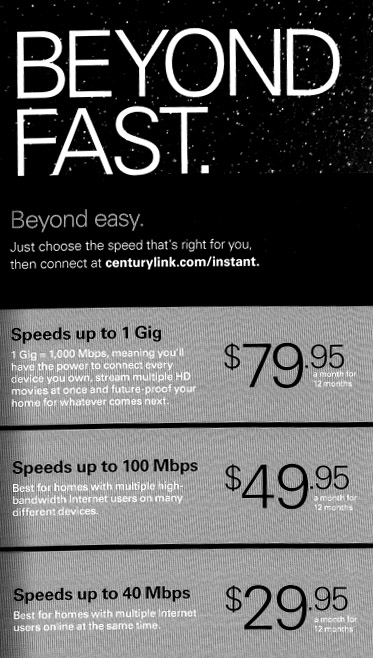 The promotional sheet claims CenturyLink will offer speeds "up to" 1 Gig for $79.95/month for 12 months. 100 Mbps runs $49.95 and 40 Mbps is $29.95 - each for 12 months. No mention of upload speeds but CenturyLink has demonstrated a real aversion to symmetry so users can expect far slower upstream than what modern municipal networks and Google fiber deliver.
The standard operating procedure in apartment buildings will be for CenturyLink to try to lock up the internal wiring to buildings and deny it to competitors. FCC rules make exclusive agreements with landlords unenforceable, but there are a host of tricks that incumbents use to prevent any competition and landlords getting a kickback often have little reason to encourage competition.
The CenturyLink copy notes that its fiber optic GPON option is "up to" more than 92 percent energy efficient than cable modem Internet access. I have to wonder how it compares to DSL energy efficiency and whether that number holds up better than the "up to" 12 Mbps claims they make on DSL circuits that seldom peak at 5 Mbps.
At any rate, it is more than we can expect in the many communities CenturyLink is serving where there the local government have done nothing to spur competition by investing in publicly owned assets that could form a municipal network or be used to entice independent service providers to enter the market. In particular, I would be curious where else CenturyLink is rolling out fiber to buildings without any upfront charges.


