


When Congress passed the Telecommunications Act of 1996, it sought to foster innovation and competition in telecommunications markets, expand the definition of universal service, and modernize regulatory structures for the digital age. Three decades later, architects of the ‘96 Act say it achieved many of those goals, but numerous legal challenges following its passage reshaped how key provisions were implemented.
“Litigation shaped so much of what the Act eventually became,” said Mignon Clyburn, a former commissioner of the Federal Communications Commission, speaking Thursday among a panel of former FCC regulators, legal counsel, and policy advisors who helped shape and defend the landmark telecom law.
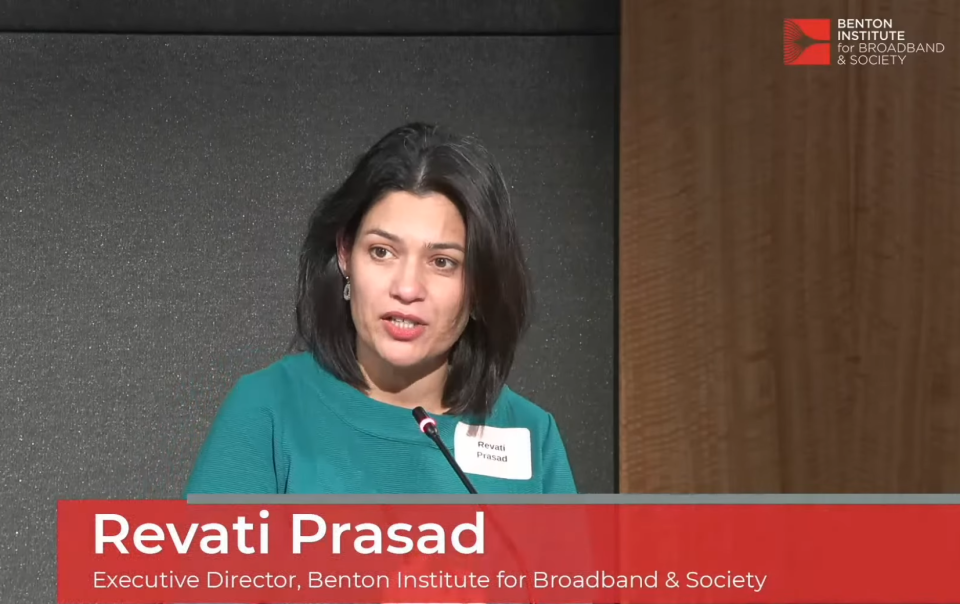
Gathered for an event organized by the Benton Institute for Broadband & Society marking the law’s 30th anniversary, the event reflected on both the spirit and letter of the landmark legislation which has shaped much of the modern Internet in the United States. The first major overhaul of telecommunications law in more than 60 years, the ‘96 Act required the FCC to conduct more than 80 separate rulemakings addressing everything from appropriate pricing, to interconnection rules and the unbundling of incumbent telephone networks.
“What we were hoping to do was unlock a future in which innovation would be uncoupled from the embedded networks of the past,” said Blair Levin, a policy advisor at New Street Research and former chief of staff at the FCC, who was credited with effectively “quarterbacking” the team that implemented the Act. Levin prefers to think of the 1996 Act instead as the central pillar of the series of acts (1992, 1993, 1996, 1997) which tackled the huge bucket of reforms needed at the time. “We did not want the monopoly land-line phone networks to control the future of data or wireless,” he said.
But translating that vision into policy proved contentious and the fights over defining and enforcing its dimensions dramatically reshaped the landscape. “Appellate litigation would follow every single important decision under that bill,” said Christopher Wright, partner at Harris, Wiltshire & Grannis, and former general counsel at the FCC. And panelists emphasized today’s legal environment could make reforms on the scale of the ‘96 Act near impossible to carry out, expressing doubt that today’s Congress or FCC can successfully modernize the Universal Service Fund programs born out of the Act.
Early legal challenge reshaped USF
One early flashpoint involved the creation of the schools and libraries universal support program, known as E-Rate. Under Section 254(h) of the ‘96 Act, Congress added three new categories of universal service recipients: schools, libraries, and rural health clinics. To implement the provision in part, the FCC created the E-Rate program, providing subsidies to schools and libraries for telecommunications services, Internet access, internal connections, computer networking, network servers, and server software.
The FCC initially capped the program at roughly $2.25 billion annually, with funding collected from telecommunications carriers, which ultimately passed the cost on to consumers through phone bills. But the effort quickly faced political and legal backlash. “As soon as we got to implementing E-Rate, it almost didn’t happen,” said Wright. “Suddenly what had been bipartisanship on the Hill became something entirely different. Soon we had a firestorm on our hands.”
More than 30 telecom companies and state governments challenged the program in Texas Office of Public Utility Counsel v. FCC (1999), arguing that the FCC lacked statutory authority to create such a funding mechanism. The Fifth Circuit ultimately upheld the program, allowing the subsidies for schools and libraries to move forward. But the court ruled that the FCC could not assess universal service contributions based on carriers’ intrastate telephone revenues, forcing the FCC to revise the funding mechanism for the broader Universal Service Fund.
“We saved E-Rate in the courts, although they lopped off part of the contribution mechanism that supplied the program,” Wright said. In retrospect, this was a harbinger of the future to come. The USF funding mechanism has been a central fight over the last thirty years, and it’s easy to draw a line from our failures to adequately fund USF to the access and affordability gaps today.
Municipalities were carved out
Another legal challenge brought under the ‘96 Act left a lasting mark on local broadband efforts, the panel reflected. At issue was Section 253 of the Act, which bars state and local laws from prohibiting “any entity” from providing telecommunications services. The dispute arose after the state of Missouri passed a law preventing political subdivisions, including cities, counties, and municipal utilities, from offering telecom services.
In Nixon v. Missouri Municipal League (2004), a coalition of municipal organizations and utilities argued the broad language of Section 253, especially when modified by “any,” manifested clear congressional intent to include government entities within its scope. But the Supreme Court disagreed. In a 8–1 opinion, authored by Justice David Souter, the court ruled that Congress had not clearly intended for the word “entity” to include municipalities. The ruling overturned a decision from the Eighth Circuit that had sided with municipalities.
In the years that followed, at least 22 states adopted significant legal barriers or bans on municipal broadband networks. That number has since declined to 16 in recent years as states repeal or loosen those restrictions, but the various obstacles placed in front of cities to solve the raft of problems stemming from a lack of competition has been one of the enduring problems of the Act’s legacy.
Competition gains in local telephony did not materialize
One of the central goals of the ‘96 Act was to open local telephone markets to competition. But in practice, implementation proved complicated.
The law required incumbent phone companies, or ILECs, to allow new entrants to interconnect with their networks, lease portions of their infrastructure at regulated rates, and charge reciprocal termination rates to competitors. These rules aimed to reduce barriers to entry and foster a competitive, modernized telecom market, but they were quickly challenged by incumbent carriers.
A series of cases in the Eighth Circuit questioned whether the FCC had overstepped in dictating how competition should work in local markets. The dispute eventually reached the Supreme Court in AT&T Corp. v. Iowa Utilities Board (1999), which upheld the FCC’s authority to implement the law but limited some of its rules on network sharing. Due to slow implementation and extensive legal challenges, the anticipated boom in local telephone competition did not materialize immediately.
“What fell short was the hope—which reflected both a political and economic calculus—that long-distance companies and CLECs would in the short term use the last mile networks of the ILECs to build out new networks,” said Levin. “That hope collapsed when the FCC pulled the plug on sharing around 2004. Whether that was inevitable due to wireless and cable competition and data replacing voice as the core product (which the FCC believed) or a policy failure (leading to the ILECs buying up the long-distance carriers) remains debatable. The more important vision of innovation and competition succeeded.”
The mission of the ’96 Act remains unfinished
Despite repeated calls throughout the day for updates to the ‘96 Act to modernize the Universal Service Fund, panelists expressed little optimism that today’s Congress or FCC could soon tackle the technology access disparities they are charged with addressing. “The tech community has shown a certain allegiance to the President, so it looks like nothing's going to happen. There's a bipartisan [USF] working group – not going to do anything,” said Levin. He noted that attempts to expand the contribution base for Universal Service Fund have repeatedly failed over the years.
Phillip Verveer, a veteran communications lawyer who served in senior roles at the FCC, and former deputy assistant secretary of the U.S. State Department, suggested two elements of the ‘96 Act still need to be contended with today. “One is universal service—how do you fund it? We haven’t done a great job addressing that over the last 30 years,” Verveer said. “The other is jurisdiction: does [the ‘96 Act] cover only narrowband telephony, or should it include broadband? That question needs to be resolved sooner rather than later.”
Verveer suggested that the 1934 Communications Act offers a useful framework that could be adapted for today’s digital era, and further suggested updating the Universal Service Fund by requiring broadband providers to contribute, ensuring the fund can continue to support affordable, universal access in the digital era.
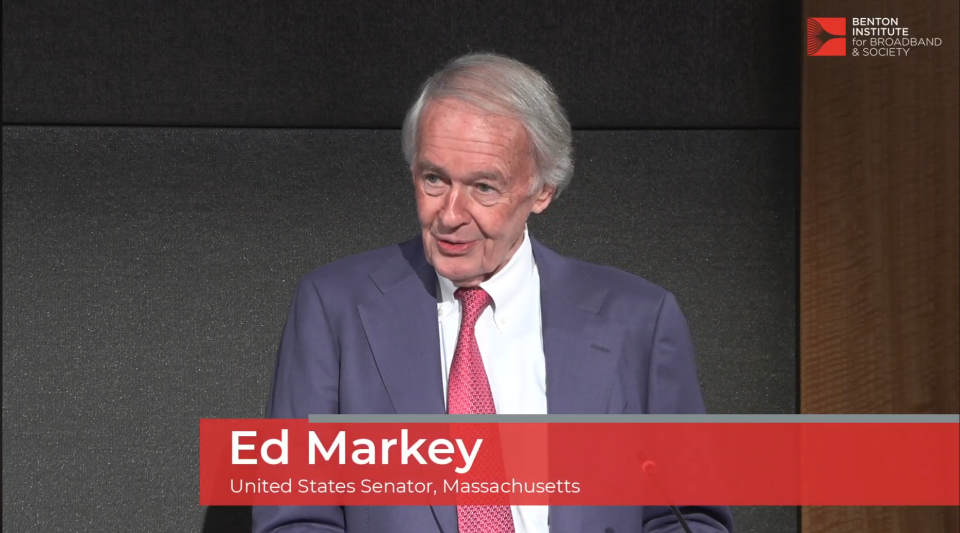
Looking ahead, Senator Ed Markey, D-Mass., stressed that the principles of universal service must continue to guide policy in the digital era. He highlighted two urgent priorities: ensuring broadband remains affordable for all families and preparing Americans to equitably participate in an AI economy. “Access without affordability is an illusion,” Markey said. And, “the next chapter of universal service must ensure that Americans have equitable access to the tools and opportunities created by artificial intelligence.”
Thirty years after the ‘96 Act, while in many ways the letter of the law has come to pass, its spirit has a long way to go. Telephone calls are basically free, but few households have a robust market to choose from for their home Internet access. Millions more Americans have no decent Internet access available to them at all. Judging from the panel’s assessments, it may be another 30 years until Congress gets around to resolving that.
Watch The Telecommunications Act at 30: Universal Service as the North Star.