
Google Fiber

Content tagged with "Google Fiber"

Related Topics
Displaying 11 - 20 of 105

West Des Moines, Iowa is a Model for Open Access Conduit Networks - Episode 573 of the Community Broadband Bits Podcast
A little more than three years ago, the city of West Des Moines, Iowa announced that it would build a citywide open access conduit system to lower the cost of new broadband deployment to facilitate better connections at lower costs for residents. GFiber (formerly Google Fiber), Mediacom, Lumen (formerly CenturyLink), and local ISP Mi-Fiber have since signed on as providers. 

This week on the podcast, Deputy City Manager Jamie Letzring and city Innovations Consultant Dave Lyons join Christopher to talk about overcoming design and legal challenges of building an infrastructure system that remains relatively unique, and the commitment the city has made to reach economically disadvantaged households to make sure everyone has a quality and affordable connection. Finally, they share a little about how the city has been taking steps to use the new conduit system to supplement its already-robust fiber network for government facilities, smart-city initiatives, and more.

This show is 36 minutes long and can be played on this page or via Apple Podcasts or the tool of your choice using this feed

Transcript below.

We want your feedback and suggestions for the show-please e-mail us or leave a comment below.

Listen to other episodes here or view all episodes in our index. See other podcasts from the Institute for Local Self-Reliance here.

Thanks to Arne Huseby for the music. The song is Warm Duck Shuffle and is licensed under a Creative Commons Attribution (3.0) license.

Murfreesboro, TN Soon To Be Awash In Affordable Fiber Thanks To Local Cooperative, Google Fiber

Murfreesboro, Tennessee suddenly finds itself awash with looming broadband competitors thanks to the city’s booming growth. In less than a month, United Communications – owned by not-for-profit electric cooperative Middle Tennessee Electric (MTE) – and Google Fiber have unveiled major plans to expand affordable gigabit fiber within city limits.

MTE-owned United Communications says it has some big plans for the city of 157,000, starting with broadband upgrades for the utilities’ 77,000 existing electricity customers.  

According to a recent announcement, the cooperative-owned ISP will spend $85 million in existing cash reserves to deploy 1,400 miles of fiber in the city, bringing affordable gigabit access to existing MTE electricity customers. As with many utility deployments, the upgrades will prove beneficial for electrical grid monitoring and maintenance.

“We’ve already completed phase one in the Boro, which includes our fiber backbone and service to more than 1,000 homes and businesses. As part of phase one, we also built fiber to the square in downtown Murfreesboro,” United President and CEO William Bradford said in a statement. “It was a privilege to put our fiber infrastructure to work by connecting our neighbors in disadvantaged communities and adding resiliency to the local emergency communications network.”

Image
Middle Tennessee Electric logo

Last year, United received $53.4 million in grants from the Tennessee Emergency Broadband Fund (made possible by the The American Rescue Plan Act of 2021) to help shore up broadband access in numerous Tennessee counties, including Bedford, Franklin, Giles, Lincoln, Marshall, Maury, Moore and Williamson.

Net Neutrality, Spectrum Sharing, and the Mystery of the Missing Monopolies | Episode 81 of the Connect This! Show

Connect This

Join us Thursday, September 28th at 3pm ET for the latest episode of the Connect This! Show. Co-hosts Christopher Mitchell (ILSR) and Travis Carter (USI Fiber) will be joined by regular guest Doug Dawson (CCG Consulting) and Kim McKinley (UTOPIA Fiber), with special guest Sean Gonsalves (ILSR) to tackle the promised return of net neutrality rules by the FCC, Google Fiber's recently announced ACP plans, why the word "monopoly" seems in such short supply in the BEAD plans states have begun to file, and the future of spectrum sharing in the United States.

Email us at broadband@communitynets.org with feedback and ideas for the show.

Subscribe to the show using this feed or find it on the Connect This! page, and watch on LinkedIn, on YouTube Live, on Facebook live, or below.

Remote video URL

A Scattering of Wonks - Episode 569 of the Community Broadband Bits Podcast

Naming groups of things is one of the few pure joys in life. But despite having a shiver of sharks, a thunder of hippopotami, a discovery of witches, and about a million others, as of yet we've got nothing to describe a group of Internet access and infrastructure who have forgotten more about the business of broadband than the average person is likely to ever see, smell, or hear. From the economics of building fiber networks to the technical challenges of different radio spectrum bands, they separate the signal from the noise every single day.

So how about a scattering of wonks?

This week on the podcast, we bring over the most recent conversation from our Connect This! Show, where for 80 episodes we've hosted broad discussions about broadband policy and infrastructure deployments and live by the mantra that the devil's in the details. Christopher is joined by Travis Carter (USI Fiber), Kim McKinley (UTOPIA Fiber), and Heather Gold (Mears Group) to tackle a host of issues, including why we don't see more cities doing deals with entities like Google Fiber, what we can expect now that Anna Gomez has been confirmed to the FCC, what it means for BEAD grantees if the Affordable Connectivity Program goes away, and more.

Along the way, they hit on what we're seeing in Vermont's Communications Union Districts, a partnership in West Des Moines, Iowa, and whether there's renewed hope for the ACP as it nears the six-month mark from running dry.

This show is 79 minutes long and can be played on this page or via Apple Podcasts or the tool of your choice using this feed

Transcript below.

We want your feedback and suggestions for the show-please e-mail us or leave a comment below.

Listen to other episodes here or view all episodes in our index. See other podcasts from the Institute for Local Self-Reliance here.

Thanks to Arne Huseby for the music. The song is Warm Duck Shuffle and is licensed under a Creative Commons Attribution (3.0) license.
Tribal Broadband Bootcamp Comes to Saint Regis Mohawk Reservation in Northern New York

As a young woman of the Nuxalk Nation, Mallory Hans is “clearing a path for future generations.”

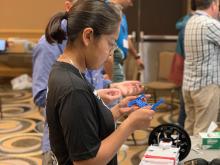
A 2022 graduate of the British Columbia Institute of Technology, she’s one of about 50 people hailing from various Tribes and First Nations across North America in attendance for the latest Tribal Broadband Bootcamp, a three-day intensive learning experience focused on building and running Tribal Internet networks.

Held in different tribal regions several times a year since the initiative began in 2021, this bootcamp (the eighth in an ongoing series of hands-on seminars) is being hosted at the Akwesasne Mohawk Casino Resort on the Saint Regis Mohawk reservation along the New York/Canada border.

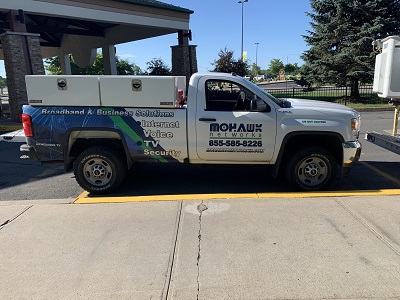
“So far so good,” Mallory said on Day Two of the bootcamp just as the attendees broke into small groups to go through a variety of demonstration stations set up by bootcamp instructors and Tribal employees who run Mohawk Networks, which provides fiber-to-the-home (FTTH) Internet, video, and voice services across the reservation in northern New York.

Image
Mohawk Networks Truck

In continuing the driving impulse to demystify technologies and build capacity among cohorts in Tribal nations, Day Two was centered around fiber stations that included demonstrations of how network operation centers are run; one on fiber splicing; another showcasing equipment used to install fiber inside of households with representatives from Calix, and another station on the electronic equipment that measures the performance of fiber lines.

“I’m enjoying it, feeling more confident and finding out I’m capable,” said the 22 year-old, newly minted fiber technician.

Open Access Conduit in West Des Moines, Iowa Brings Google Fiber, Choice to City Residents

West Des Moines, Iowa is making steady progress on a $60 million open access fiber-optic conduit system to expedite the delivery of affordable fiber citywide. And they’re doing it with the help of Google Fiber, which has slowly started to reverse course after the company’s 2016 decision to lay off hundreds of staff and freeze most meaningful expansion.

West Des Moines is a suburb of Des Moines with a population of 67,000 residents. Like so many U.S. communities, locals have long complained of high broadband prices, spotty coverage, and terrible customer service by the area’s entrenched local monopolies. Iowa studies routinely identify substandard broadband access as a top regional complaint.  

So, as in many communities across the U.S., West Des Moines leaders decided to do something about it, in the form of a new public-private partnership with Google. The $60 million bond-funded project will result in citywide fiber conduit, which will be made available to any Internet service provider (ISP) interested in serving the city in a bid to dramatically boost local broadband competition.

The city is hopeful that ISP access costs ultimately cover the full build cost of the fledgling network. Google Fiber has already committed to pay the city an estimated $16 million to access the city’s new open access conduit system. Other ISPs that have never served the city before, including locally owned and operated Mi-Fiber, have also stated they’ll pay to access the conduit.

Generate City Revenue and Meet Growing Need of Residents

West Des Moines first announced the project in the summer of 2020, noting that it would lay more than a 1,000 miles of conduit alongside city streets, after which Google would come in and deploy its own fiber network to every last city address. In preparation, Google Fiber opened a brick and mortar retail location in West Des Moines in 2021.

Wireless Is Essential, But Fiber Remains the Future (For Now)

From the miraculous benefits of WiMax to the hype surrounding 5G, U.S. wireless companies have long promised near-Utopian levels of technological revolution.

Yet time after time these promises have fallen short, reminding a telecom sector all-too-familiar with hype that fiber optics remains, for now, the backbone of bridging the digital divide. 

From Google Fiber to Starry, numerous companies have promised to use wireless technology as a supplement or even replacement for future-proof fiber. But more often than not these promises have failed to have any meaningful impact at scale. Worse, many wireless services often fail to deliver on a routinely neglected aspect of telecom policy: affordability.

That’s not to say that wireless doesn’t have an immense, integral role to play in shoring up the nation’s broadband gaps. 5G, rural and urban small WISPs, satellite, and other wireless options are all essential in bridging the digital divide and extending access to rural communities and tribal nations (see: the FCC Tribal Priority Window and the beneficial wireless options that have emerged). 

But reality continues to demonstrate that there’s simply no substitute for the kind of high capacity, affordable fiber efforts being deployed by a steady parade of municipalities, cooperatives, and city-owned utilities. And as an historic level of federal subsidies wind their way to the states, the distinction is more important than ever. 

A Rich History Of Wishful Thinking

The industry crown for unwarranted wireless industry hype likely belongs to WiMax, a family of wireless broadband communication standards based on the IEEE 802.16 set of standards and introduced in 2001.

From 2001 to 2011, there were no shortage of missives about how the standard would revolutionize connectivity worldwide, ushering forth the golden age of affordable broadband access. There were countless warnings that marketing departments had gotten well ahead of themselves, all widely ignored by the speculative investment set.

Colorado Springs Embarks on Citywide Network with Ting as Anchor Tenant

Back in January, Colorado Springs Utilities (CSU) announced it was going to begin building a city-wide, open access fiber network owned, and that Ting would be its first anchor tenant. Construction of the network is expected to begin in the third quarter of this year, with a target completion date of 2028 (originally planned for fifteen years). The network will provide multi-gigabit service to roughly 200,000 homes as well as city businesses and anchor institutions. It’s still early in the process, but projections at the moment have the utility spending $45 million to $100 million a year for the next six years to complete the project. The first phase will see 225 new fiber route miles laid.

CSU Has Long Used Fiber

For thirty years CSU has built fiber across Colorado’s second-largest city. CSU’s dramatic  expansion of this existing network directly benefits the utility by reducing overall costs, improving infrastructure monitoring, and boosting overall utility network resiliency. And it all will come with no rate increases to CSU electric customers.

But the company’s decision to lease access to this fiber expansion also directly aids the local community by lowering consumer utility costs, and delivering universal, affordable, high-speed Internet access. It’s a significant boon to Colorado’s second largest city that’s now an attractive, high-tech growth market

NDIA’s Digital Navigator Corps Goes Nationwide with $10M Grant

Two years after launching a community-based model to help residents overcome the digital skills challenges that keep so many offline, the National Digital Inclusion Alliance (NDIA) announced in February 2022 that it has received a $10 million grant from Alphabet subsidiary Google to dramatically expand the impact of its Digital Navigator Corps model across the country. The money will allow NDIA to take the Corps nationwide to 18 new rural communities (including Tribal sites), helping thousands of people overcome adoption barriers with the help of local experts. 

Filling a Need at the Onset of the Covid-19 Pandemic

In August of 2020, NDIA first announced the launch of its new venture - the Digital Navigator initiative - to directly reach the many households across the United States that have access to wireline infrastructure but lack the knowledge, skills, trust, or comfort to turn that possibility into an affordable connection. The goal was to help people “get connected with affordable home Internet [access], find affordable computing devices, and learn basic digital skills,” and was borne directly out of the onset of the Covid-19 pandemic the previous spring.

The Salt Lake Public Library and Rural LISC were pilot partners, but NDIA has since worked with more than 20 organizations and communities over the last two years in addition to releasing a cornucopia of resources for cities and anchor institutions that to adapt and use as they see fit, in places as wide ranging as Austin, Cleveland, Denver, Nashville, Philadelphia, Portland, Providence, and Seattle. All of this work has led to refinement of the Digital Navigator model while also helping thousands get and stay online. 

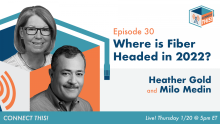
Join Us Thursday, January 20th at 5pm ET to Talk About Fiber in 2022 - Episode 30 of the Connect This! Show

In this episode of the Connect This! Show, co-hosts Christopher and Travis Carter (USI Fiber) will be joined by Heather Gold (CEO, HBG Strategies LLC) and Milo Medin, an industry veteran who recently left Google as VP of wireless services.

The panel will tackle what we can expect to see in the broadband marketplace in 2022, with a special focus on fiber, including who is building it and why the capital markets are so hungry for it. What are we likely to see from builders big and small? What will competing against the national monopoly providers look like? Is fixed wireless a viable option ten years from now?

Subscribe to the show using this feed on YouTube Live or here on Facebook Live, or visit ConnectThisShow.com

Email us broadband@muninetworks.org with feedback and ideas for the show.

Watch here on YouTube Live, here on Facebook live, or below.