
pennsylvania

Content tagged with "pennsylvania"

Displaying 41 - 47 of 47

Gigabit Nation Interview with Frank Caruso of Kutztown, PA

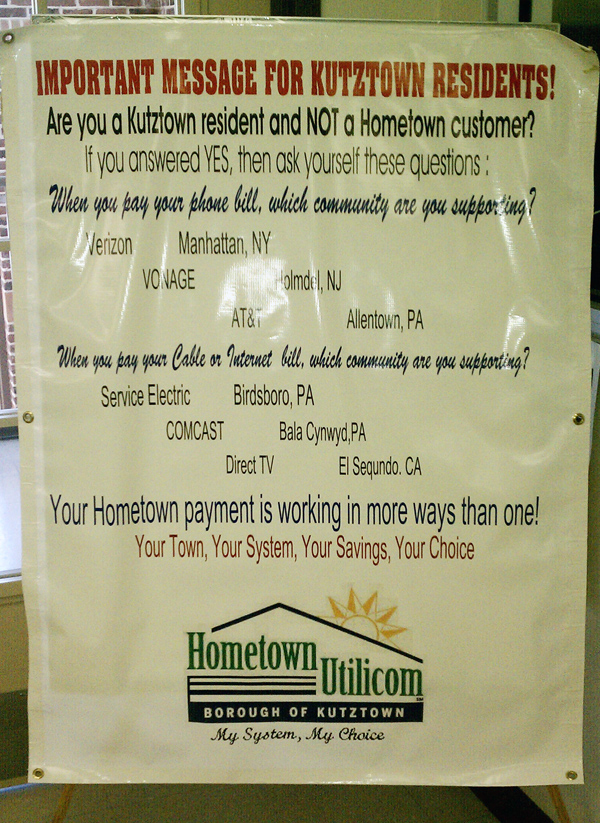
The Borough of Kutztown, Pennsylvania, with a year-round population around 5,500 that is swelled by Kutztown University, has been on the community broadband map for 10 years. In this informative Gigabit Nation interview, Craig Settles visits with Frank Caruso, IT Director for the Borough of Kutztown.

The interview is embedded below and runs approximately one hour and is sandwiched between a one hour interview with Chattanooga about smart grid economics and an hour interview with Todd Marriot about UTOPIA -- so if you want to hear the portion on Kutztown, skip 60 minutes into the show.

Kutztown award news article

In the interview, Craig and Frank discuss how the municipal network, Home Net, started out of necessity. The community wanted to link their utilities with a telecommunications network and government facilities needed a cohesive option. FTTH became part of the equation later, but was not the main impetus. Kutztown issued RFPs for a new network, but the response was silence. The community investigated the next option - building it themselves.

After several conflicting feasibility studies, the Borough decided to go ahead and build the network with the hope that "if we build it, they (ISPs) will come." Kutztown issued taxable bonds and built their own fiber network. The goal was to provide the infrastructure for government purposes and in the future create real choice for consumers. Again, no ISPs answered the call.

According to Caruso, large providers were not able to accept a business model which created a "middle man" between them and their customers. The only interest from the private market was from a small local telecommunications company that eventually leased a line from the city to expand their footprint for telephone service.

Antitrust Allegations Against Comcast Nothing New

We have frequently written of Comcast's anti-consumer actions past posts, so we were not surprised to learn that the Department of Justice (DOJ) recently decided to investigate the cable company for antitrust. The borders between antitrust and hyper competitive business practices are grey; Comcast has experimented in the shadows on more than one occasion. We looked into one nine-year-old case, that recently advanced in the Pennsylvania courts. The Behrend v. Comcast class action case began in 2003 against the cable giant. The suit alleges that Comcast violated the Sherman Antitrust Act by building itself into an “illegal monopoly.” The plaintiffs are current and former customers of Comcast and damages are estimated at $876 million, although the amount could be tripled under the Act. The plaintiffs claim that Comcast’s strategy was to “cluster” as a way to eliminate competition and be able to raise rates above the market. “Clustering” involved acquiring the cable systems of other large multi-system operators that operated and offered multichannel video programming distributor service in various franchise areas in the Philadelphia area. There are internal documents, referred to in the April 12 Summary Judgment Memorandum [pdf], supporting the argument that Comcast’s business strategy was to eliminate competition through clustering. Growing by gobbling up smaller entities in the same industry is not a new idea and certainly not illegal on its face. The issues in the 2003 case were how Comcast went about expanding, why they did it, and to what extent they took steps to hinder competition. There was a cable system asset swap with AT&T and the two worked together to divide up the Philadelphia assets of former MediaOne, rather than compete with each other during the bidding process. Other swaps involved Aldelphia, Time Warner, and even smaller operators, like Patriot Media & Communications. Swapping and clustering with intent to eliminate competition may be considered Sherman Act violations.

Understanding User Fees and the Community's Right-of-Way

A friend once told me about his battle with the local government over whether it would charge him a fee for inspecting the house he wanted to begin renting out (he had bought another house but didn't want to sell the first in a down market). His house was well maintained and he said he would be happy to schedule the inspection whenever convenient for the City but absolutely would not pay a fee so they could inspect his house. Consider this from a different perspective. The local government should make sure that rental properties meet certain standards (building and fire codes if nothing else). This means inspections. Who should pay for the inspections? It boils down to two choices: the property owner or the tax-base at large. It seems more fair to charge property owners at least a portion of the cost as they benefit the most from being able to rent out their property. I make this point to lead into another discussion about managing the Right-of-Way (ROW), the city-owned property used for utilities. An article in TribLive about a town near Pittsburgh fighting to keep its cable fees offers insight into a national discussion about fees for using the ROW.
Hempfield charges utilities $750 for a right-of-way permit, $500 for a renewal, and $250 for a construction permit, according to a township ordinance. Ferguson said without the fees, the township would not be able to monitor the work. "We use the monies, those permit fees, to pay staff to make sure they repair roads as they're supposed to," Ferguson said. "Part of the fee is ... for our inspectors to go out and make sure they (utilities) complete the job right." Ferguson said utility companies sometimes dig up new roads to install or repair lines and leave the road in shambles afterward. "Taxpayers should not be required to pay the staff to make sure utility companies do the right thing," he said.
FCC Logo Telecommunications providers have long claimed that local government fees are unreasonable and getting the necessary permits is too difficult. But when asked to document such claims, they rarely do. The FCC is currently examining whether it believes the fees charged by local governments are fair.
Comcast Customers Call for Competition

Two cities, located on opposite coasts, have recently cried out for cable competition in their communities. A few weeks ago, SunBreak ran a story under "Why Comcast Needs Competition...Badly." The post describes a significant outage in Seattle and Comcast's slow response to fix the problem.
You may think to yourself, Hey, come on, it's 90 minutes out of your day. But what I think about is how much time cumulatively was wasted in Seattle this morning, much of it simply because people would not have been sure where the problem was. An early, all-hands-on-deck announcement from Comcast would have been a big help. It seems slightly insane that a company that provides internet service isn't very good at using the internet.
The folks at Sunbreak apparently were not aware that the City is still slowly considering building a network to ensure everyone in the community has affordable high speed broadband access (which would likely be far more reliable than Comcast's network). After I noted this in the comments, they reprinted one of my posts about Seattle's deliberations. Meanwhile, the folks in Scranton, Pennsylvania, (immortalized in the television show The Office) have been asking when they get the faster broadband now available in Philly, Pittsburgh, and parts of the Lehigh Valley. The answer came bluntly from Stop the Cap: Sorry Scranton, You’re Stuck With Comcast Cable… Indefinitely An article from the Times Tribune explains why the private sector fails to provide competition:
"Offering out television service is expensive, too expensive for most smaller telephone companies," said telecom industry analyst Jeff Kagan. "So many are reselling satellite service to keep customers who want one bundle and one bill." Because of that, satellite television providers, who were never a formidable challenge to conventional cable companies, gained market share, Mr.

What is Wrong With This - Lancaster Edition

From an article in the local paper about Lancaster, Pennsylvania's Google Gigabit Application:
Brogan said that if Lancaster is selected, it would not run afoul of the state Telecommunications Act. That law prohibits cities from establishing municipal broadband networks except if existing providers indicate they have no immediate plans to offer similar services. She said the city already has a letter from Verizon clearing the way for the Google application.
Oh good, glad the city secured permission from one private company to ask a different private company to build infrastructure. In the words of Yakov Smirnoff, "What a Country!"

Kutztown Bullet Points

In this short two-page summary of Kutztown's progress, Frank Caruso briefly explains the benefits of the network and the reason behind their investment.