
Fast, affordable Internet access for all.
network neutrality
Content tagged with "network neutrality"
FCC to Investigate Barriers to Community Networks
The Commission will look for opportunities to enhance Internet access competition. One obvious candidate for close examination was raised in Judge Silberman’s separate opinion, namely legal restrictions on the ability of cities and towns to offer broadband services to consumers in their communities.The FCC has a history of encouraging states not to pass such laws (Commissioner Clyburn, previous FCC Chair, former Commissioner Copps) and the National Broadband Plan made recommendation 8.19: "Congress should make clear that Tribal, state, regional and local governments can build broadband networks." Even if communities choose not to build their own networks, having that capacity changes the dynamic of the big cable and telephone companies - something Franklin D. Roosevelt described as the "birch rod" in the cupboard (regarding municipal electricity):
But on the other hand the very fact that a community can, by vote of the electorate, create a yardstick of its own, will, in most cases, guarantee good service and low rates to its population.
Susan Crawford on National Public Radio
"Unless somebody in the system has industrial policy in mind, a long-term picture of where the United States needs to be and has the political power to act on it, we'll be a Third World country when it comes to communications."
Susan Crawford recently spoke with Dave Davies on NPR's FreshAir. During the conversation Crawford touches on a variety of interrelated topics that affect telecommunications in the U.S. The interview is worth a listen; Crawford and Davies discuss her book, Captive Audience: The Telecom Industry and Monopoly Power in the New Gilded Age, and get into U.S. telecommunications policy.
Crawford discusses the recent U.S. Court of Appeals for the D.C. Circuit decision on network neutrality. Davies and Crawford also tackle the inteplay between the court decision and role of government in bringing access to more people:
I think the problem is actually much more profound than mere discrimination by a few cable actors when it comes to high-speed Internet access. We seem to currently assume that communications access it a luxury, something that should be left entirely to the private market, unconstrained by any form of oversight.
The problem is, that's just not true in the modern era. You can't get a job, you can't get access to adequate healthcare, you can't educate your children, we can't keep up with other countries in the developed world without having very high capacity, very high-speed access for everybody in the country. And the only way you get there is through government involvement in this market.
That's how we did it for the telephone. That's how we did it for the federal highway system. And we seem to have forgotten that when it comes to these utility basic services, we can't create a level playing field for all Americans or indeed compete on the world stage without having some form of government involvement.
A Roadmap for the FCC To Ensure Local Authority to Build Networks - Community Broadband Podcast #84
When the DC Circuit Court handed down a decision ruling against the FCC's Open Internet (network neutrality) rules, it also clarified that the FCC has the power to overrule state laws that limit local authority to build community networks. Harold Feld, Senior Vice President for Public Knowledge, joins us for Community Broadband Bits Episode #84 to explain the decision. Harold exlains what Section 706 authority is and how all the DC Circuit judges on the case felt that the FCC, at a minimum, has the authority to strike down laws that delay or prohibit the expansion of broadband infrastrcturue. We then discuss how the FCC can go about striking down such laws to reestablish local authority - a community in a state like North Carolina could file a petition with the FCC for action or the FCC could decide to take action itself. Either way, it will have to build a record that laws revoking local authority to build networks are harmful to expanding this essential infrastructure. Finally, some of this power filters down to state public utility commissions, but just how much is unclear at present. Read the transcript from our discussion here. We want your feedback and suggestions for the show - please e-mail us or leave a comment below. Also, feel free to suggest other guests, topics, or questions you want us to address. This show is 15 minutes long and can be played below on this page or via iTunes or via the tool of your choice using this feed. Listen to previous episodes here. You can can download this Mp3 file directly from here. Find more episodes in our podcast index. Thanks to Fit and the Conniptions for the music, licensed using Creative Commons.
Danger of "Sponsored Data" via AT&T, Others
Entrepreneur: I plan to launch a better streaming music service.
Network Neutrality Decision and Importance of Community Owned Networks
Crawford Explains Network Neutrality on 99% Invisible
Common Cause, Network Neutrality, and the FCC Come Together in Episode 73 of Community Broadband Bits Podcast
We welcome Todd O'Boyle of the good government group Common Cause to our Community Broadband Bits podcast this week. He is the Director of the Media and Democracy program there, which recently released an explanation of network neutrality in comic form, which we discuss in our discussion. We also talk about the impression of municipal networks in Washington, DC, and what the FCC can do about mandating meaningful disclosure of political ads without any action from Congress. These are all issues that impact whether government is responsive to local needs or to a few powerful interests. Todd and I previously collaborated on two case studies related to his hometown, Wilson in North Carolina. We wrote a case study of that municipal fiber network and The Empire Lobbies Back regarding Time Warner Cable's response to that successful fiber network. Read the transcript for this episode here We want your feedback and suggestions for the show - please e-mail us or leave a comment below. Also, feel free to suggest other guests, topics, or questions you want us to address. This show is 23 minutes long and can be played below on this page or via iTunes or via the tool of your choice using this feed. Listen to previous episodes here. You can can download this Mp3 file directly from here. Find more episodes in our podcast index. Thanks to Mudhoney for the music, licensed using Creative Commons.
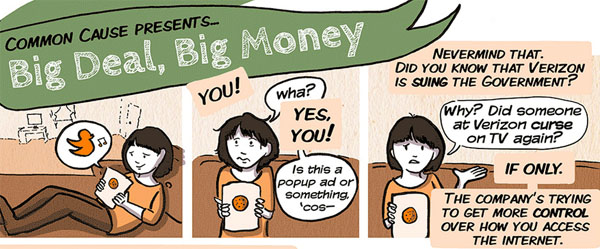
Common Cause Network Neutrality Comic
We have reported on network neutrality many times in the past. This has been a policy debate on whether Internet service providers should be able to prioritize some content at the expense of others - should Comcast be able to charge me more to visit Fox News than it does to reach MSNBC? Should it be able to make YouTube videos very slow to load and unreliable unless I pay a special fee to access that site? This is the question of network neutrality.
Common Cause just released a "comic book" that takes a look at the concept, the political influences, and the consequences we may face if we lose network neutrality. "Big Deal, Big Money" also provides some options for action.
A short snippet:
Read Big Deal, Big Money here.