multi-dwelling units

Content tagged with "multi-dwelling units"

Displaying 41 - 47 of 47

San Francisco Proposal Aims At Giving Multi-Tenants Access Choice Of ISPs

If San Francisco Board of Supervisor Mark Farrell gets his way, tenants in multiple-occupancy buildings will have a greater opportunity to choose their Internet Service Providers. 

In October, Farrell introduced a proposed ordinance that would require owners of multi-tenant residential and commercial properties to give building access to all state-licensed ISPs. 

Choice Effectively Denied 

Farrell’s proposal comes amidst reports of tenants denied access to ISPs of their choice.

According to a legislative digest of the proposed ordinance, property owners are not legally allowed to force tenants to sign up with one provider, but by limiting access their building to install fiber or antennas, they prevent their renters from choosing the provider they want:

"[M]any occupants of residential and commercial multiple occupancy buildings are unable to choose between service providers because their buildings property owners allow only one provider to install the facilities and equipment necessary to provide services to occupants..."

The San Francisco Chronicle reports: 

“The reality in San Francisco is that tens of thousands of residents have been denied access to different Internet service providers,” Farrell said. “I fundamentally believe competition is a good thing that will ultimately drive prices down and improve Internet access across all of San Francisco.”  

Charles Barr, founder of up and coming fixed wireless provider Webpass, said owners block their access to approximately 400 large apartment buildings in the city. Google Fiber recently acquired Webpass.

The Proposed Ordinance  

Farrell’s proposed ordinance would guarantee:

Saint Louis Park is Prepared for the Fiber Future - Community Broadband Bits Podcast 219

Saint Louis Park, a compact community along the west side of Minneapolis, has built an impressive fiber network, a conduit system, and several deals with developers to ensure new apartment buildings will allow their tenants to choose among high speed Internet access providers. Chief Information Office Clint Pires joins me for Community Broadband Bits podcast 219. In one of our longest episodes, we discuss how Saint Louis Park started by partnering with other key entities to start its own fiber network, connecting key anchor institutions. Years later, it partnered with a firm for citywide solar-powered Wi-Fi but that partner failed to perform, leaving the community a bit disheartened, but in no way cowed. They continued to place conduit in the ground wherever possible and began striking deals with ISPs and landlords that began using the fiber and conduit to improve access for local businesses and residents. And they so impressed our previous podcast guest Travis Carter of US Internet, that he suggested we interview them for this show. Clint Pires has learned many lessons over the years and now we hope other communities will take his wisdom to heart. Well-managed communities can make smart investments that will save taxpayer dollars and drive investment in better networks.

This show is 40 minutes long and can be played on this page or via Apple Podcasts or the tool of your choice using this feed

Transcript below. 

We want your feedback and suggestions for the show-please e-mail us or leave a comment below.

Listen to other episodes here or view all episodes in our index. See other podcasts from the Institute for Local Self-Reliance here.

Thanks to Roller Genoa for the music, licensed using Creative Commons. The song is "Safe and Warm in Hunter's Arms."

Webpass and Its Fixed Wireless Seek Fix for Landlord Abuses - Community Broadband Bits Episode 197

San Francisco is one of the rare cities that has multiple high quality ISPs competing for market share, though the vast majority of people still seem to be stuck choosing only between Comcast and AT&T. This week, we talk to a rising ISP, Webpass, about their success and challenges in expanding their model. Charles Barr is the President of Webpass and Lauren Saine is a policy advisor - both join us for episode 197 of the Community Broadband Bits podcast. 

We discuss the Webpass model, which uses fixed wireless and fiber to serve high density apartment buildings where they are allowed in by the landlord. Unfortunately, they have been locked out of many of these buildings and are looking to the city of San Francisco to adopt better policies to ensure a single provider like AT&T cannot monopolize the building. Though the FCC has made exclusive arrangement unenforceable, the big providers are still finding ways to lock out competition. We also talk a little about the role of fiber and fixed wireless technologies, chokepoints more generally, and why Webpass is so sure it could succeed if residents were all able to to choose the ISP they wanted. 

This show is 27 minutes long and can be played on this page or via Apple Podcasts or the tool of your choice using this feed

Transcript below. 

We want your feedback and suggestions for the show-please e-mail us or leave a comment below.

Listen to other episodes here or view all episodes in our index. See other podcasts from the Institute for Local Self-Reliance here.

Thanks to Kathleen Martin for the music, licensed using Creative Commons. The song is "Player vs. Player."

Gigabit Awards Contest From Siklu: RFI Deadline March 14th

Siklu, known for its wireless technology innovation, is now in the process of granting a number of "Gigabit Awards." Their goal is to offer municipalities an opportunity to use their high-speed wireless technology.

Who Can Compete?

Communities who can offer quick deployment and meet the company's qualifying criteria will win the equipment package. A municipality will need the following to be considered for a "Gigabit Award":

1. An existing fiber network with accessible PoPs, and the ability to provide internet services over this network 


2. The capability to install (internally or with a partnering ISP) the Gigabit links within a tight deployment schedule


3. Free services to underserved locations will be considered as an advantage: affordable housing, community sites, school facilities 

The Siklu equipment package includes:

1. 10 gigabit links to connect buildings (MDUs, anchor institutions etc.) 


2. Wireless planning, training and support services 

Speed Is Of The Essence

The RFI submission deadline of March 14th is fast approaching and "Gigabit Award" announcements will begin on March 21st. Rollout plan submissions, approvals, and kick offs will all happen in April with completion goal scheduled for May 31st, 2016.

For more details, download the Gigabit Award Checklist, which contains information on RFIs, or contact Siklu's Boris Maysel at boris.m(at)siklu.com.

Madison, Wisconsin Pilot: Fiber In The Fall

Four low-income neighborhoods in Madison will soon have access to fast, reliable, affordable Internet access, thanks to a municipal fiber-to-the-home (FTTH) pilot program.

Fast, Affordable, Reliable...Soon!

According to a recent Cap Times article, installation will begin in the spring of 2016; community leaders anticipate the network will start serving residents in the fall. The cost of the pilot is estimated at $512,000. The original plan was to offer the pilot in two areas, but in the City Council recently approved an amendment to the city budget to cover the cost of expanding the pilot. Funds for the construction will come from the city's capital budget.

When the city first released its RFP, it received 3 proposals. Ultimately, the city selection committee chose the only FTTH proposal over two wireless proposals, citing reliability and speed as determining factors. Local Internet service provider ResTech will build the network, which will be owned by the city. Residential subscribers will have access to a minimum 10 Megabits per second (Mbps) download and 10 Mbps upload (symmetrical) service for $9.99 per month. There will be no data caps.

Testing the Waters

The Cap Times reports that the results of the pilot will determine the next steps for the city, population 243,000, which has flirted with the idea of a citywide municipal network in the past:

In conjunction with the pilot, Madison will be pursuing a feasibility study and cost-benefit analysis to determine whether to expand the Internet service to other parts of the city in the future.

The city is working with Columbia Telecommunications Corporation for the feasibility study component as a parallel track to the pilot.

The pilot will be two years, and [Chief Information Officer Paul] Kronberger said they hope to have enough data to do the cost-benefit analysis after about one year of operation.


CenturyLink Seeks Apartment Buildings for Gigabit in Portland

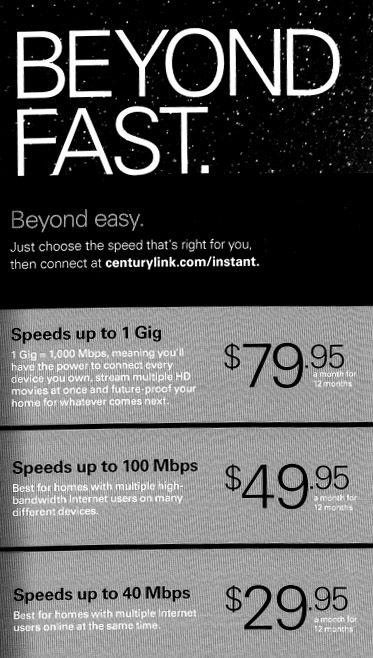
In the wake of Google's announcement that Portland could be one of the next communities for the Google Fiber network, CenturyLink is circulating an offer to select apartment buildings to apply for CenturyLink fiber. This appears to be more than the standard fiber-to-the-press-release responses we often see from the big telephone companies that prefer to lobby, litigate, and lie rather than invest in next-generation networks. CenturyLink notes it has the "ability to do approximately 15 total" apartment buildings. centurylink-promo-portland-2014.jpg The promotional sheet claims CenturyLink will offer speeds "up to" 1 Gig for $79.95/month for 12 months. 100 Mbps runs $49.95 and 40 Mbps is $29.95 - each for 12 months. No mention of upload speeds but CenturyLink has demonstrated a real aversion to symmetry so users can expect far slower upstream than what modern municipal networks and Google fiber deliver. The standard operating procedure in apartment buildings will be for CenturyLink to try to lock up the internal wiring to buildings and deny it to competitors. FCC rules make exclusive agreements with landlords unenforceable, but there are a host of tricks that incumbents use to prevent any competition and landlords getting a kickback often have little reason to encourage competition. The CenturyLink copy notes that its fiber optic GPON option is "up to" more than 92 percent energy efficient than cable modem Internet access. I have to wonder how it compares to DSL energy efficiency and whether that number holds up better than the "up to" 12 Mbps claims they make on DSL circuits that seldom peak at 5 Mbps. At any rate, it is more than we can expect in the many communities CenturyLink is serving where there the local government have done nothing to spur competition by investing in publicly owned assets that could form a municipal network or be used to entice independent service providers to enter the market. In particular, I would be curious where else CenturyLink is rolling out fiber to buildings without any upfront charges. centurylink-portland-mdu-letter2014.png

Verizon Begs Regulators for Protection While Demanding Deregulation

From the "A Pox on Both Your Houses" files, Verizon is squaring off against greedy landlords in New York City as it tries to fix lines damaged by Superstorm Sandy. In short, Verizon needs access to the common areas of the multi-dwelling units (MDU or industry-speak for apartments) to fix or upgrade the lines. Verizon is using these repairs as an opportunity to transition connections from copper to its fiber optic FiOS system. AT&T and Verizon have been arguing that once a household transitions from a copper connection to FiOS (in the case of Verizon) or U-Verse (in the case of AT&T, which actually hasn't even changed the copper connection), they are using a fundamentally different, less regulated service. My conversation with Bruce Kushnick delved into some of these claims. Verizon's copper to fiber upgrade could actually therefore be an accountability downgrade if regulators agree that households deserve fewer protections on connections over fiber than over copper. This appears to be a major fight brewing -- how to regulate the same services over different types of connections. And this is where it gets interesting. Verizon, AT&T, and the other big cable/telcos are constantly arguing for deregulation, saying that the market is so competitive that the government should just get lost. But then Sandy rips through and landlords (that I have ZERO sympathy for) see an opportunity to shakedown Verizon. After all, Verizon is going to use the new connections to increase revenues from these households by selling more services (triple play over fiber). This seems a perfectly reasonable deregulated market showdown. Crying Verizon But Verizon immediately goes crying to the state regulators: "The landlords aren't playing nice, force them to let us into their buildings!" Anyone who still believes competitive or free markets are synonymous with unregulated markets is fooling themselves. Big firms use deregulation or regulation in their attempts to corner and monopolize markets.