
FCC

Content tagged with "FCC"

Displaying 281 - 290 of 643

Mapping Broadband Competition In Idaho

Like many other states, connectivity across Idaho is unequally distributed. Urban areas may have a choice of one or two broadband providers while many rural areas have no options whatsoever. We have compiled the latest data from December 2016 into a map to highlight competition and show these disparities.

According to the Federal Communications Commission's (FCC) 2018 Broadband Progress Report, 98 percent of urban areas and 68 percent of rural areas in Idaho have broadband service, defined by the FCC as 25 Megabits per second (Mbps) downstream and 3 Mbps upstream. While about 1 million people in Idaho have access to two or more options, nearly half a million people are not nearly as lucky. Approximately 327 thousand of the state's 1.683 million people have only one option for broadband service, and 169 thousand still do not have access to broadband. This, however, is actually a best-case scenario.

Image

Failures In Broadband Data

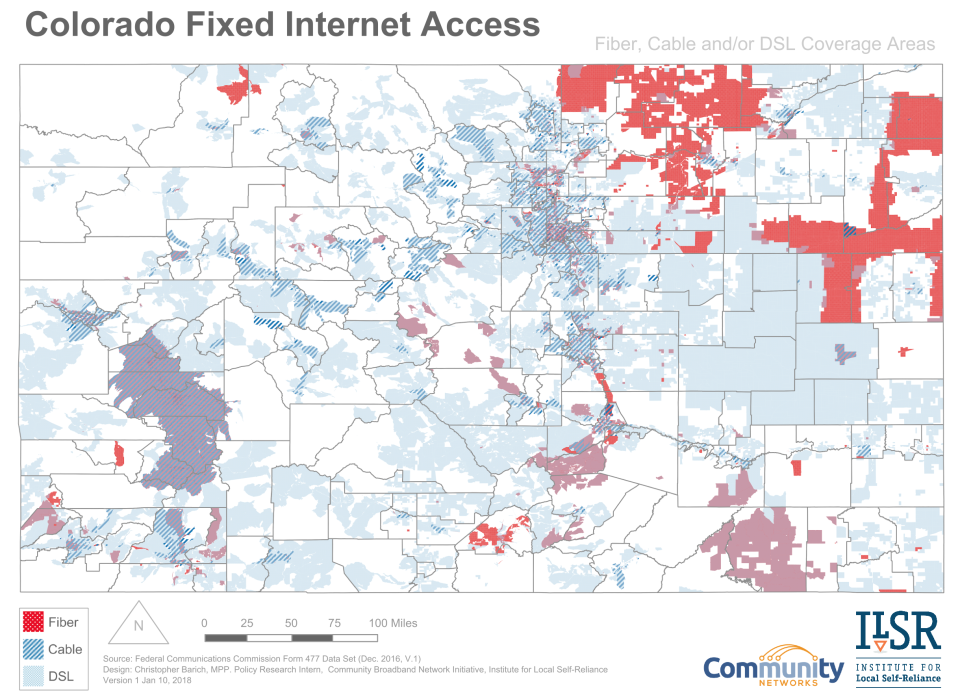
These statistics and this map, like most broadband data, rely on FCC Form 477. Internet Service Providers (ISPs) complete the form explaining which census blocks they serve or could serve. Census blocks are the smallest unit of measurement for the U.S. Census, and they vary in size. Rural census blocks often cover more land mass than urban areas. ISPs need only be able to offer service to one person in a census block in order to claim the entire census block. This can lead to an overstatement of how many people are actually served. The FCC launched an interactive map with this data, and FCC Commissioner Jessica Rosenworcel has invited people to submit corrections to broadbandfail@fcc.gov

Vermont Takes Net Neutrality Action

Maple syrup, the Green Mountains, and network neutrality. On February 15th, Vermont Governor Phil Scott signed Executive Order No. 2-18, the Internet Neutrality in State Procurement, following closely the actions of four other Governors over the past few weeks. You can read the E.O. here.

States Take A Stand 

Like similar actions in Montana, New York, Hawaii, and New Jersey, Vermont’s executive order applies to contracts between ISPs and state agencies. The order directs the state Agency of Administration to change its procedures so that any ISP it contracts with doesn't throttle, engage in paid prioritization, or block content. The Agency of Administration has until April 1st to make the changes to Vermont’s procedures. 

If a state agency cannot obtain services from an ISP that agrees to comport with network neutrality policy, the state agency can apply for a waiver. The E.O. is silent as to what would allow a waiver; presumably the Agency of Administration would need to establish criteria.

Action In The State Chambers

In early February, the State Senate passed S.289 with only 5 nays and 23 yeas. The executive order Scott recently signed reflected the intention behind the language of S.289 regarding state contracts. When Sen. Virginia Lyons introduced the bill, she described it as a necessary tool to ensure transparency in government. “We don’t want to see information held back or slowed down or deviated in any way when it relates to our state or local government,” Lyons said.

Louisiana Net Neutrality Proponents Urge Senator Support

After the FCC chose to overturn federal network neutrality protections on December 14th, 2017, open Internet advocates and elected officials that favor network neutrality have sought avenues past the Commission to reinstate the policy. In Louisiana, four groups of citizens organized together to form Team Internet and stage Louisiana rallies in four cities in January. Their goal was to bring attention to the overwhelming opinion that network neutrality benefits Internet users and to convince Senator John Kennedy that he should vote to block the harmful FCC decision.

Fight for the Future (FFTF), Free Press Action Fund, and Demand Progress worked together to form Team Internet, which organized protests in Lafayette, Shreveport, Baton Rouge, and New Orleans at Kennedy’s offices. At the Lafayette office, a group of advocates led by Layne St. Julien presented petitions with more than 6,000 signatures to Kennedy’s deputy state director, Jay Vicknair. The petitions urged Sen. Kennedy to use his vote to overturn the FCC action.

According to Vicknair, constituents have called and emailed the office in numbers rivaled only by last year’s healthcare debates.

Advocate Tool, The CRA

Proponents of network neutrality — mostly people, companies, and entities that aren’t big ISPs — consider the FCC’s order harmful. In order to regain network neutrality protections, which would remove the threat of paid prioritization and better ensure an open exchange of ideas online, advocates hope to use the Congressional Review Act (CRA). Under the CRA, Congress can reverse the FCC decision within 60 legislative days of it being published in the Federal Register as long as there is a majority vote. At last count, 50 Senators had committed to supporting a reversal. Public Knowledge has created a quick video describing the process:

At the recent Team Internet protest, attendees called on Kennedy to “be a hero” and be the 51st.

In A Net Neutrality Zone

West Virginia Awards Community Development Block Grants To Improve Rural Connectivity

The U.S. Department of Housing and Urban Development (HUD) provided Community Development Block Grant funds (CDBG) to West Virginia as in other states. This year, the Community Development Division of the West Virginia Development Office that distributes CDBG funds will provide $1.5 million to local broadband projects that include planning and infrastructure.

Big Demand

Last July, the state’s Development Office announced that it would accept applications for broadband projects. The decision was a departure from past practice of focusing only on water and sewer infrastructure. By the time the application period was closed, 12 potential projects had been submitted for consideration; those projects touch 27 counties and reach about 300,000 premises, many located in the southern part of the state.

All twelve projects will receive some amount of CDBG funding.

One of those applications was from the Region 4 council, in the hopes of obtaining $125,000 for planning to improve connectivity in Webster, Fayette, Greenbrier, Nicholas, and Pocahontas Counties. The state will provide the funding, which will potentially affect future planning for six more counties. Region 4 will collaborate with a similar initiative by Region 1, which will also receive $125,000.

Another multi-organizational application came from Clay County, which plans to work with Calhoun and Roane Counties on a feasibility and business plan on how best to move forward to improve connectivity. Fayette County wants to use its award to map out where best to place fiber for maximum effect and Gilmer County will focus on planning to involve a local industrial park along with exploring other funding strategies.

Suddenlink Plans Pinetops Deployment, Greenlight Must Go

Suddenlink passed up the opportunity to offer connectivity in Pinetops, North Carolina, for years until now. About a year after a bill in the General Assembly gave nearby Wilson’s municipal network the ability to serve the tiny community, Suddenlink is taking advantage of the law to enter Pinetops and push Wilson’s Greenlight Community Broadband out.

Suddenly Suddenlink

One of his constituents called Town Commissioner Brent Wooten last October to share a conversation he'd had at work in nearby Wilson. Wooten's constituent had encountered a Suddenlink employee who told him, "We're coming to see you in Pinetops." The company had sent out a notice to employees that overtime would be available because Suddenlink was planning to run fiber from Rocky Mount to Pinetops.

Wooten hadn't heard anything from Suddenlink; neither had any of the other Commissioners. All he knew was that the company had been reducing staff and cutting costs ever since being acquired by Altice in 2015.

A Little History

While events that put Pinetops (pop. 1,300) in the national spotlight began in February 2015, the story has roots that go back further. Officials in Pinetops, recognizing that better local Internet access keeps small rural communities from wasting away, approached several providers years ago requesting better Internet infrastructure. Suddenlink’s service area ends about two miles outside of Pinetops town limits. Nevertheless, Suddenlink wasn't willing to bring cable service to Pinetops. CenturyLink didn't want to make investments to upgrade the community's old DSL solution; the community had no options from national providers.

FCC Ends Speculation On Broadband Speeds, Mobile Internet Access

On January 18th, the FCC ended months of speculation and released a fact sheet that included several key conclusions to be included in the 2018 Broadband Deployment Report. The most important is that the FCC continues to recognize that mobile Internet access is not a substitute for fixed access. The Commission has also decided to leave the definition of broadband at 25/3 Mbps (down/up).

Download the fact sheet here.

“Broadband” Will Not Slow Down

The Commission had proposed reverting to a slower definition of broadband from the current standard of 25 Megabits per second (Mbps) download and 3 Mbps upload. Under Tom Wheeler’s leadership, the FCC decided to update the standard to its current definition in January 2015, but current Chairman Ajit Pai and other Republican Commissioners suggested in last year’s Notice of Inquiry (NOI) that the FCC might effectively take us backward to a 10 Mbps/1 Mbps standard. 

The suggestion rankled better connectivity advocates and Internet users. Many recognized that lowering the standards would make it easier for the FCC to proclaim that the U.S. was making strong progress toward universal household deployment. The Commission would have been justified making such a conclusion under the standard because large sections of rural American receive DSL, fixed wireless, satellite, or mobile Internet access that would meet a lowered 10/1 standard.

Hundreds of thousands of people, organizations, and businesses filed comments opposing a slower standard. Many of them live in areas where 10/1 speeds are already available but who have been waiting for better options. Commissioners Rosenworcel and Clyburn also spoke out against the lowering broadband speeds. 

Commissioner Rosenworcel tweeted:

Publicly Owned Conduit: Network Neutrality Can-Do Tool

Ever since the FCC reversed network neutrality protections, an increasing number of local communities have started to wonder about the advantages of publicly owned Internet infrastructure, including conduit. At the Institute for Local Self-Reliance, we’ve received an uptick in requests for information from elected officials, community business leaders, and local citizens.

When folks are similarly curious about public-private partnerships, they wonder about whether or not a municipality or other form of local government can require a private sector partner ISP to adhere by the tenets of network neutrality. An agreement between public and private sector partners to bring better connectivity to a city or region is a contract between the involved parties; the FCC’s decision won't interfere.

Looking At Lincoln

Lincoln, Nebraska, has fine-tuned the art of working with private sector partners interested in using their publicly owned conduit for privately owned fiber. The city invested in an extensive conduit system back in 2012 to create an environment that would welcome private sector providers. Nelnet’s ALLO Communications uses the conduit to offer Fiber-to-the-Home (FTTH) in Lincoln. 

The city uses a Broadband Franchise agreement to allow ISPs non-exclusive use of their publicly owned conduit. In Section 4: Service Characteristics, Lincoln requires any private sector ISP that wishes to use their conduit to adhere by network neutrality rules, which they clearly spell out. You’ll notice that the city also imposes a “no data caps” rule:

Section 4: Service Characteristics. 

A. The System shall, at a minimum, provide the following capabilities and characteristics: 

1.Net Neutrality: In the provision of Broadband Service, Franchisee shall comply with the Open Internet regulations. 


2.No Blocking: Franchisee shall not block lawful content, applications, services, or non-harmful devices; and 


3.No Throttling: Franchisee shall not impair or degrade lawful Internet traffic on the basis of Internet content, application, or service, or the use of non-harmful devices; and 


Community-Owned Fiber Networks: Value Leaders in America

Image

The FCC collects data from Internet Service Providers that reflects census blocks where they offer service to at least one premise. Currently, the Commission does not collect information about rates subscribers pay. A new report from the Berkman Klein Center dives into prices subscribers pay and also looks at trends from national companies as well as local publicly owned networks. The report, Community-Owned Fiber Networks: Value Leaders in America, supports what we’ve always found — that publicly owned networks offer the best all around value for the communities that make the investment. Download the report.

In the Abstract, authors David Talbot, Kira Hessekiel, and Danielle Kehl describe their approach:

We collected advertised prices for residential data plans offered by 40 community-owned (typically municipally owned) Internet service providers (ISPs) that offer fiber-to-the-home (FTTH) service. We then identified the least-expensive service that meets the federal definition of broadband—at least 25 Mbps download and 3 Mbps upload—and compared advertised prices to those of private competitors in the same markets. We found that most community-owned FTTH networks charged less and offered prices that were clear and unchanging, whereas private ISPs typically charged initial low promotional or “teaser” rates that later sharply rose, usually after 12 months. We were able to make comparisons in 27 communities. We found that in 23 cases, the community-owned FTTH providers’ pricing was lower when averaged over four years. (Using a three year-average changed this fraction to 22 out of 27.) In the other 13 communities, comparisons were not possible, either because the private providers’ website terms of service deterred or prohibited data collection or because no competitor offered service that qualified as broadband. We also made the incidental finding that Comcast offered different prices and terms for the same service in different regions.

Pricing Report From Berkman Klein Center: Muni Subscribers Get Better Rates

The FCC collects data from Internet Service Providers that reflects census blocks where they offer service to at least one premise. Currently, the Commission does not collect information about rates subscribers pay. A new report from the Berkman Klein Center dives into prices subscribers pay and also looks at trends from national companies as well as local publicly owned networks. The report, Community-Owned Fiber Networks: Value Leaders in America, supports what we’ve always found — that publicly owned networks offer the best all around value for the communities that make the investment.

Download and read the full report here.

In the Abstract, authors David Talbot, Kira Hessekiel, and Danielle Kehl describe their approach:

We collected advertised prices for residential data plans offered by 40 community-owned (typically municipally owned) Internet service providers (ISPs) that offer fiber-to-the-home (FTTH) service. We then identified the least-expensive service that meets the federal definition of broadband—at least 25 Mbps download and 3 Mbps upload—and compared advertised prices to those of private competitors in the same markets. We found that most community-owned FTTH networks charged less and offered prices that were clear and unchanging, whereas private ISPs typically charged initial low promotional or “teaser” rates that later sharply rose, usually after 12 months. We were able to make comparisons in 27 communities. We found that in 23 cases, the community-owned FTTH providers’ pricing was lower when averaged over four years. (Using a three year-average changed this fraction to 22 out of 27.) In the other 13 communities, comparisons were not possible, either because the private providers’ website terms of service deterred or prohibited data collection or because no competitor offered service that qualified as broadband. We also made the incidental finding that Comcast offered different prices and terms for the same service in different regions.

The Challenge of Mobile Only - Community Broadband Bits Podcast 287

With the Federal Communications Commission Republicans poised to redefine broadband to include slow, unreliable, and often bandwidth-capped mobile service, we talk with two high school students from southeast Ohio, Herron Linscott and Lilah Gagne, that have succeeded despite the lack of fixed broadband access in their homes. Soon the FCC may include those homes as having broadband though they clearly don't fit the description of what any sane person would call advanced telecommunications. 

We start off episode 287 of the Community Broadband Bits podcast with Next Century Cities Executive Director Deb Socia, who reminds us why mobile Internet access is not an adequate subsitute for fixed access. Next Century Cities has launched the Mobile Only Challenge - share MobileOnlyChallenge.com around - to highlight the challenges of relying solely on mobile Internet access. 

We then talk to Herron Linscott and Lilah Gagne about their experiences in southeast Ohio as high school students without home fixed Internet access. Both have had to schedule lots of time away from home in order to complete assignments and partake in extra-curricular activities and both offer a window into the importance of connectivity for the next generation. 

This show is 25 minutes long and can be played on this page or via Apple Podcasts or the tool of your choice using this feed

Transcript below. 

We want your feedback and suggestions for the show-please e-mail us or leave a comment below.

Listen to other episodes here or view all episodes in our index. See other podcasts from the Institute for Local Self-Reliance here.

Thanks to Arne Huseby for the music. The song is Warm Duck Shuffle and is licensed under a Creative Commons Attribution (3.0) license.