
Digital Equity Act

Content tagged with "Digital Equity Act"

Related Topics
Displaying 1 - 10 of 37

Digital Equity and the Way We Build Networks - Episode 5 of Unbuffered

Unbuffered Logo - Two text bubbles

In this episode of the podcast, Chris is joined again by Jade Piros De Carvalho and Sean Gonsalves for a conversation about Internet access, digital equity, and how we organize society.

They begin with an article by Stefan Schüller that compares the United States, Switzerland, and Germany and tries to draw lessons about how networks are built and governed. The discussion looks at how you can “do it way wrong” in different ways, from privatizing everything to gold plating systems, and what those choices mean for competition and outcomes.  

From there, the conversation turns to a central question: how do you go back from where we are now in the United States? Working within a privatized model, they explore whether it is possible to move toward something different, and what it would take to create more competition and better results for communities.

They also talk about digital equity, including how training and local investment can change people’s lives and why those investments matter. Sean highlights the benefits of these investments in his latest story on Belinda Parker-Mendoza from San Antonio. You can find that story on our main page here

Along the way, they reflect on the role of federal and state policy, the limits of simply “removing barriers to competition,” and the challenges of solving problems in places with existing infrastructure.

The episode also introduces a new recurring segment, “What the Tech!?!,” and closes with a look ahead to our first Unbuffered live show on April 28th at 2:00 PM ET. For more information, check out our story here.

This show is 48 minutes long and can be played on this page or via Apple Podcasts or the tool of your choice using this feed

You can also check out the video version via YouTube.

Transcript below.

We want your feedback and suggestions for the show-please e-mail us or leave a comment below.

Listen to other episodes (formerly Community Broadband Bits) or view all episodes in our index. See other podcasts from the Institute for Local Self-Reliance.

Thanks to Riverside for the music. The song is Caveman and is licensed under a Creative Commons Attribution (3.0) license

A Cap, Gown, and Connection

The first time Belinda Parker-Mendoza set foot on the campus of San Antonio College was to get her cap and gown for graduation, having earned her Associate’s Degree in Business Administration.

It was not only a first for her. She was the first person in her entire family to earn a diploma of any kind.

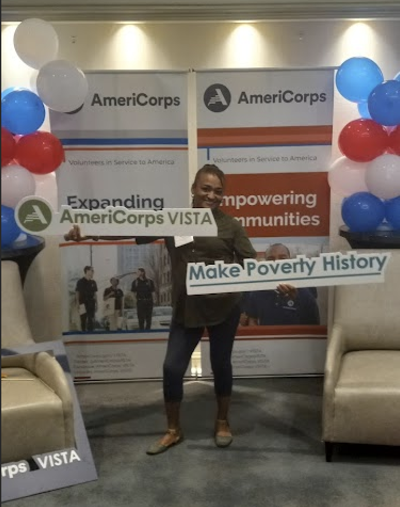
The gateway to that moment, the 45-year-old mother says, came in 2022, when she signed up for a digital skills training course offered through AmeriCorps VISTA at one of the city’s Opportunity Home apartment complexes where she lives on San Antonio’s cultural and historic East Side.

“If I didn’t have a laptop and the Internet, none of that would’ve happened,” she explains, sitting in her fourth-floor apartment before diving into a writing assignment for one of her classes as she works towards her bachelor’s degree.

She does her school work on a laptop – a refurbished Dell computer she earned through the digital skills training program. Before that, she didn’t have a computer or Internet access at home. The class provided her a laptop and through the Americorps program, she was able to enroll in the now-expired Affordable Connectivity Program (ACP), which allowed her to get home Internet service for the first time.

Image
Belinda Parker-Mendoza at digital skills event holding two signs. One says: "Americorps VISTA," the other reads: "Make Poverty History"

“Thank God,” she says. “Because when the ACP ended, I was working in the (Americorps) program – and getting paid – so it worked out.”

For millions of others, it did not.

Court Asked to Pause Digital Equity Act-Related Lawsuit, Pending Key Court Decision

*The following story by Broadband Breakfast Reporter Kelcie Lee was originally published here.

The lawsuit over the Trump administration’s suspension of grants from the $2.75 billion program to close the digital divide may come to a pause. 

The National Digital Inclusion Alliance (NDIA) filed a motion Wednesday to put its lawsuit suing President Donald Trump on hold, because there is a similar case further along that would control the outcome. 

NDIA was a key player in the Digital Equity Act (DEA), having been one of 65 recommended awardees that were blindsided after having spent two years building plans approved by the federal government. 

The DEA was a Biden-era program from the bipartisan Infrastructure Investment and Jobs Act of 2021 (IIJA) that worked to ensure Americans could access, afford and fully participate in the increasingly digital society. 

In May 2025, Trump halted $1.25 billion in DEA competitive grants, explaining that the act was unconstitutional, racist and illegal.

NTIA Signals It Will Follow Law on Non-Deployment Funds, But Wants More Ideas

Close to a 1,000 broadband-minded registrants attended yesterday’s listening session on how to spend an estimated $21 billion in “non-deployment” funds states should have at their disposal from the federal BEAD (Broadband Equity, Access and Deployment) program.

Hosted by the National Telecommunication and Information Administration (NTIA), the Commerce Department agency administering the program, the online listening session featured about 50 selected speakers. Most of those who spoke advocated using the money to tackle the array of non-infrastructure barriers to expand broadband (affordability, device distribution, and digital skills programs) – made all the more urgent in light of the Trump administration’s sudden “termination” of the Digital Equity Act last year.

Though it runs counter to the bipartisan infrastructure law that established the program, a handful of speakers actually suggested the funds simply be returned to the U.S. Treasury, presumably to “save taxpayer dollars.”

One speaker even tried to make the case that money Congress explicitly intended to address the nation’s massive digital divide should instead be given to Air Traffic Controllers.

Serving the Overlooked: Building Broadband for Manufactured Housing Communities - Episode 674 of the Community Broadband Bits Podcast

In this episode of the podcast, Chris and Sean Gonsalves are joined by Brendan Kelly, founder of REVinternet, a new Internet Service Provider focused on bringing better connectivity to manufactured housing communities. 

Brendan shares how years working inside large telecom companies—and later with smaller ISPs—revealed just how consistently these communities are overlooked, locked into aging coaxial networks, and offered little incentive for upgrades.

The conversation explores why manufactured housing parks present unique challenges for broadband deployment, from private land ownership and outdated infrastructure to stigma and lack of competition. 

Brendan explains REVinternet’s service-agnostic approach, combining fiber, fixed wireless, and other technologies to deliver affordable, reliable Internet while working directly with park owners and residents.

Chris, Sean, and Brendan also dig into the role of digital equity, customer support, and trust-building—discussing everything from payment flexibility and digital navigation to partnerships with municipal networks. 

The episode offers a thoughtful look at how targeted, community-centered broadband strategies can succeed where one-size-fits-all policies have failed, and why manufactured housing residents deserve the same quality connectivity as any other neighborhood.

This show is 28 minutes long and can be played on this page or via Apple Podcasts or the tool of your choice using this feed.

You can also check out the video version via YouTube.

Transcript below.

We want your feedback and suggestions for the show-please e-mail us or leave a comment below.

Listen to other episodes or view all episodes in our index. See other podcasts from the Institute for Local Self-Reliance.

Thanks to Arne Huseby for the music. The song is Warm Duck Shuffle and is licensed under a Creative Commons Attribution (3.0) license

A Constitutional Crisis in Broadband and The Fight to Restore Digital Equity Funding

The Trump administration's illegal “termination” of the 2021 Digital Equity Act continues to have devastating real world impacts on everything from affordable broadband access to protecting Americans from skyrocketing online scams.

The $2.75 billion Digital Equity Act was passed by Congress as part of the 2021 infrastructure law. It mandated the creation of three different major grant programs intended to shore up equitable, widespread access to affordable Internet, while providing the tools and digital literacy education needed to help neglected U.S. communities get online.

But last May the Trump administration unceremoniously demolished the Act, froze all program funding, and left countless states, programs and organizations – many on the cusp of major new efforts – high and dry.

At the time, President Trump and GOP leaders like Sen. Ted Cruz disingenuously attacked the Act’s programs as “racist” and "unconstitutional,” – part of a broader effort to dismantle programs deemed as “DEI,” even in instances where the programs had little to nothing to do with race or gender. Many of the “covered populations” covered by the bill included rural residents, veterans, and elderly Americans from all walks of life.

Funding Freeze Puts Most Vulnerable Americans at Risk

The sudden "termination" of the popular law resulted in dozens of states having to abruptly cancel major broadband expansion plans. But the freeze has also been a massive problem for state programs that were taking aim at a U.S. online fraud epidemic proving particularly harmful to the U.S. elderly and marginalized communities.

Big Apple Connect, Pole Attachments, and DEA Lawsuits | Episode 122 of the Connect This! Show

Connect This! Show

Edit: We encountered a technical issue with the streaming platform for the show; it resolves around 1:20.

Catch the latest episode of the Connect This! Show, with co-hosts Christopher Mitchell (ILSR) and Travis Carter joined by regular guests Kim McKinley (Tak Broadband) and Doug Dawson (CCG Consulting) and special guest Angela Siefer to talk about all the recent broadband news that's fit to print. On the docket today:

Join us live on October 10th at 2pm ET, or listen afterwards wherever you get your podcasts.

Email us at broadband@communitynets.org with feedback and ideas for the show.

Subscribe to the show using this feed or find it on the Connect This! page, and watch on LinkedIn, on YouTube Live, on Facebook live, or below.

B4DE: Moving At The Speed of Trust Reprise

Yesterday, the third Building for Digital Equity livestream of the year brought together policy experts and frontline workers to explore how community-driven connectivity solutions are inextricably tied to building local trust.

If you missed it, the entirety of the hour and 15 minute event can be viewed here.

Hosted by ILSR’s Community Broadband Networks initiative and the National Digital Inclusion Alliance (NDIA), this week’s B4DE served as an unofficial kick-off to Digital Inclusion Week and the variety of events that will mark the occasion in communities across the country.

With each B4DE guest focused on various aspects of the theme, “Moving At The Speed Of Trust,” the event provided attendees a jolt of hope and optimism, even as the world of digital equity has been upended by the demise of the federal Affordable Connectivity Program, the sudden termination of the Digital Equity Act, and numerous other Trump administration policy shifts that will make it harder to bridge the digital divide.

Vermont’s ‘Long’ Reach Toward Affordable Broadband

As states struggle to readjust their plans to expand high-speed Internet access in the wake of the Trump administration “termination” of the Digital Equity Act, Vermont is working to address the multi-million dollar shortfall by aligning the state’s Digital Empowerment initiative with its newly established Affordable Long Drop Program.

The Affordable Long Drop Program was established to provide grants to eligible Internet service providers (ISPs) in order to cover the connection costs for Vermonters whose homes are beyond standard drop distances.

Typically, an ISP will pay for a standard drop, which is the final external link that connects a provider's distribution network to the end-user's location – a distance that most often spans a couple hundred feet or less.

In rural areas around the country, community-minded operators like telephone and electric cooperatives will often cover the first quarter of a mile. This has also been the case in Vermont, where many of the state’s Communications Union Districts (CUDs) have been footing the bill to cover as much as the first 2,000 feet of drop distance. But, as with any predominantly rural state, there are a number of homes located just beyond that 2,000 foot range.

The construction costs of extending fiber lines can get pricey the further the home is away from the main fiber routes. Vermont’s Affordable Long Drop Program aims to help pay for the drops costs of the last mile networks that are currently being built across the state to help ensure residents in harder-to-reach locations can still get Internet access.

California’s Affordable Broadband Bill At Risk Of Being Destroyed By Lobbying

California lawmakers’ efforts to pass a new law mandating affordable broadband access is at risk of being destroyed by industry lobbying. California insiders say the changes are so dramatic they may wind up making broadband affordability in the state worse – undermining years of digital equity activism and discarding a rare opportunity to bridge the digital divide.

The California Affordable Home Internet Act (AB 353), introduced by Assemblymember Tasha Boerner last January, would require that broadband providers in the state provide broadband at no more than $15 per month for low-income households participating in a qualified public assistance program.

The original legislation mandated that state residents should be able to receive $15 for all ISPs for broadband at speeds of 100 megabit per second (Mbps) downstream, 20 Mbps upstream. The proposal mirrored similar efforts by New York State which opened the door to other state efforts after the Supreme Court recently refused to hear a telecom industry challenge.

Image
Several dozen digital equity advocates hold a rally on the lawn of the California statehouse

“I want to get something fair and reasonable that helps those who need it most,” Boerner said in a press release. “AB 353 will fill the gap and ensure our children can turn in their homework, families can get access to telehealth, and apply for jobs online.”

On June 4 a vote moved the legislation through the state Assembly and on to the state senate by a 52-17 margin.