
BEAD

Content tagged with "BEAD"

Displaying 1 - 10 of 279

Condition 50: The Fine Print Threatening California’s Internet Protections – Episode 30 of Unbuffered

Unbuffered Logo - Two text bubbles

In this episode of Unbuffered, Chris is joined by Chao Jun Liu (Electronic Frontier Foundation) to discuss Condition 50. NTIA added this term to the BEAD program last November. 

It would bar states that accept BEAD funds from enforcing laws that regulate the rates, terms, or conditions of broadband service, including net neutrality, open access, and affordability rules.

Together, they break down what California stands to lose. That includes its landmark 2018 net neutrality law and the $20 low-income plans required as conditions of the Charter-Cox and Verizon-Frontier mergers. 

Chao explains net neutrality’s core protections against blocking, throttling, zero rating, and paid prioritization. She also recounts how Verizon throttled firefighters during a record wildfire in 2018, which helped push California’s law over the finish line.

Moving to the stakes, they weigh roughly $1.4 billion in BEAD deployment funds against a Public Knowledge estimate that Condition 50 could cost California $5 to $16 billion in existing broadband benefits. 

They also cover New York’s decision to sign the agreement despite its Affordable Broadband Act, and how NTIA’s exemption from the Administrative Procedure Act let it add the condition without public comment.

Concluding with the decision facing Governor Newsom ahead of the November 1 deadline, they explore the legal and strategic calculus for a state that has already filed 100 lawsuits against the administration. They also discuss what the outcome could mean for Internet users well beyond California.

This show is 42 minutes long and can be played on this page or via Apple Podcasts or the tool of your choice using this feed. 

You can also check out the video version via YouTube.

Transcript below.

We want your feedback and suggestions for the show-please e-mail us or leave a comment below.

Listen to other episodes (formerly Community Broadband Bits) or view all episodes in our index. See other podcasts from the Institute for Local Self-Reliance.

Thanks to Whitedrift for the song Operator, licensed Creative Commons Attribution (3.0).
Why ISPs Fail and the Reality Facing State Broadband Offices - Episode 29 of Unbuffered

Unbuffered Logo - Two text bubbles

In this episode of Unbuffered, Chris is joined by Doug Dawson (CCG Consulting), Doug Adams (Broadband.io), and Jade Piros de Carvalho (IdeaTek) for a candid, wide-ranging discussion on why new Internet Service Providers stumble and the administrative realities bearing down on state broadband offices.

Together, they break down the common operational traps that derail network builds—from easily overlooked execution details like pouring concrete pads for field huts, to vendor bottlenecks with OSS/BSS software, poor contractor restoration that angers local communities, and the pitfalls of passive marketing. 

Moving behind the scenes of federal policy, the panel tackles the mounting compliance fatigue surrounding the BEAD program, examining high staff turnover in state offices, environmental review delays, pole attachment friction with co-ops, and shifting NTIA timelines.

Concluding with a look at the future of digital infrastructure, the group explores what happens when federal funding programs hit administrative walls and how local, state, and community-driven efforts can maintain momentum to get unserved communities connected.

This show is 52 minutes long and can be played on this page or via Apple Podcasts or the tool of your choice using this feed. 

You can also check out the video version via YouTube.

Transcript below.

We want your feedback and suggestions for the show-please e-mail us or leave a comment below.

Listen to other episodes (formerly Community Broadband Bits) or view all episodes in our index. See other podcasts from the Institute for Local Self-Reliance.

Thanks to Whitedrift for the song Operator, licensed Creative Commons Attribution (3.0).
Washington State Selects Seven Partners In $165 Million Fiber Expansion

The Washington State Broadband Office (WSBO) says it has signed contracts with seven broadband providers, tribes, and municipalities to begin work on a major affordable Internet expansion plan that should deliver $165 million in investment across nearly a dozen rural Washington counties and Tribal territories.

“Broadband isn’t a luxury anymore,” WSBO Director Jordan Arnold said of the expansion plan. “It’s how kids do homework, how small businesses stay open and how families reach a doctor without driving an hour."

"These contracts cement our commitment to bring that access to communities across our state who’ve been left out for far too long.”

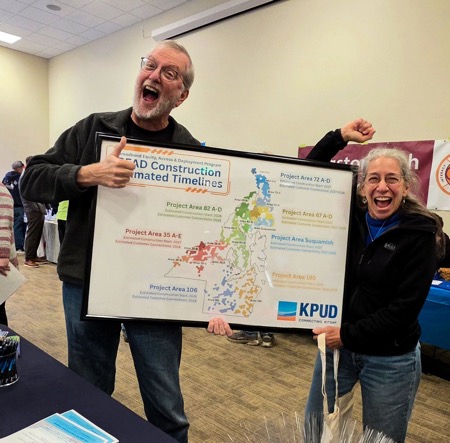
Broadlinc, Concept Communications, Declaration Networks Group, Hood Canal Communications, Kitsap Public Utilities District (PUD), Lummi Indian Business Council, and the Spokane Indian Tribe will leverage a combination of $165 million in federal, state, and private funds to connect an estimated 28,452 households to the Internet.

Image
Two Kitsap PUD officials celebrate getting BEAD grant holding a sign announcing construction deadlines

Most of the impacted areas are rural communities long-neglected by regional dominant telecom monopolies. Contract details indicate that Washington State provided $27.3 million in matched funding to the grantees, who’ll need to conduct National Environmental Protection Act and National Historic Protection Act reviews before construction.

Tree Canopies, Broken Data, and DOGE Math - Episode 26 of Unbuffered

Unbuffered Logo - Two text bubbles

In this episode of Unbuffered, Chris and Sean break down the flawed realities behind national broadband data and policy. They dive into the Federal Communications Commission’s latest 706 report, calling out its questionable citations and reliance on unchecked ISP claims. 

The conversation moves to the BEAD program, exploring why one-third of rural electric co-ops are pulling out of fiber awards, and examines new research from Ohio revealing how tree canopy issues and tall tower costs challenge Starlink’s promises.

Later in the show, Chris and Sean highlight a municipal fiber effort moving forward in Southwick, Massachusetts, discuss what a massive airport ground stop says about the fragility of fiber infrastructure, and tackle the risks of introducing AI into air traffic control in the What the Tech!? segment. 

Finally, they wrap up with a look at a Government Accountability Office report detailing the missteps and misleading figures surrounding DOGE.

This show is 42 minutes long and can be played on this page or via Apple Podcasts or the tool of your choice using this feed. 

You can also check out the video version via YouTube.

Transcript below.

We want your feedback and suggestions for the show-please e-mail us or leave a comment below.

Listen to other episodes (formerly Community Broadband Bits) or view all episodes in our index. See other podcasts from the Institute for Local Self-Reliance.

Thanks to Whitedrift for the song Operator, licensed Creative Commons Attribution (3.0).
The FWA Reality Check and the BEAD Final Numbers - Episode 25 of Unbuffered

Unbuffered Logo - Two text bubbles

In this episode of Unbuffered, Chris is joined again by Doug Dawson of CCG Consulting for a wide-ranging conversation about fixed wireless access performance, federal broadband definitions, the BEAD program's true-up process, and the potential impact of artificial intelligence on network infrastructure.

Chris and Doug begin by diving into a recent Ookla report on Fixed Wireless Access (FWA) from AT&T, Verizon, and T-Mobile. They break down how FWA operates on de-prioritized cellular capacity, why seasonal foliage can slow down speeds, and how the limitations of upload performance highlight the stark difference between cellular home broadband and wireline fiber connections.

From there, the conversation turns to federal policy and mapping challenges. Chris and Doug critique potential shifts at the FCC regarding broadband speed definitions and discuss a GAO report highlighting the hurdles local governments and Tribal nations faced during the bulk broadband collection challenge process. They also examine the NTIA’s plan for truing up unserved locations under the BEAD program, as well as the final funding distributions across fiber, Low Earth Orbit satellites, and fixed wireless networks.

Finally, Chris and Doug tackle the popular debate around AI and network congestion. They unpack why data center traffic differs from residential internet usage, address the security and infrastructural risks of rapid AI development, and discuss the long-term economic viability of major AI models.

Throughout the episode, Chris and Doug connect these technical and policy developments to broader questions about network reliability, federal oversight, market competition, and who will ultimately build and control the future of telecommunications.

This show is 46 minutes long and can be played on this page or via Apple Podcasts or the tool of your choice using this feed. 

You can also check out the video version via YouTube.

Transcript below.

We want your feedback and suggestions for the show-please e-mail us or leave a comment below.

Listen to other episodes (formerly Community Broadband Bits) or view all episodes in our index. See other podcasts from the Institute for Local Self-Reliance.

Thanks to Whitedrift for the song Operator, licensed Creative Commons Attribution (3.0).

New Hampshire Electric Cooperative Gets $5.5 Million BEAD Grant For Fiber


The New Hampshire Electric Cooperative (NHEC) says it has been awarded a $5.58 million federal broadband grant to help expand affordable fiber access to the rural and underserved parts of its service territory in The Granite State.

According to a cooperative announcement, NHEC officials say the New Hampshire Office of Broadband Initiatives has awarded it a $5.58 million grant courtesy of the Broadband, Equity, Access, and Deployment (BEAD) program, made possible by the 2021 infrastructure bill.

New Hampshire was originally allocated $196.5 million from the BEAD program (which included non-deployment funds), but the federal allocation was later adjusted to $18.6 million after significant unpopular changes by the Trump administration that eliminated affordability requirements and shifted a significant amount of funds from fiber to Elon Musk’s low-earth-orbit satellite venture. (NTIA has not yet released guidance on BEAD non-deployment funds).

NHEC’s $5.58 million chunk of BEAD funding will be used to bring 126 miles of new fiber to 2,500 homes and businesses across 23 rural communities, including Bath, Benton, Clarksville, Colebrook, Danbury, Dixville, Goshen, Grafton, Groton, Haverhill, Hill, Holderness, Lyman, Moultonborough, New Hampton, Orange, Orford, Piermont, Springfield, Thornton, Tuftonboro, Warren, and Wentworth.

Federal Agencies Still Can't Get Their Broadband Data Straight, GAO Finds

A recent Government Accountability Office (GAO) report reveals what’s been obvious to broadband deployment experts for years now: the federal government’s multi-agency approach to closing the digital divide is undermined by a lack of coordination and data-management among agencies.

The result is an FCC broadband coverage map with an amalgamation of inaccuracies that misrepresents where high-speed Internet service does or does not exist, a flaw that can steer taxpayer dollars away from communities that actually need them.

Since 2020, four federal agencies — the FCC, NTIA, USDA and Treasury — have been administering nine different grant programs to build-out new Internet networks in unserved and underserved areas across the nation, including the $42.5 billion federal flagship BEAD (Broadband Equity Access and Deployment) program.

As ILSR’s Senior GIS Analyst Christine Parker notes, the report devotes considerable attention to “de-duplication” — the process of cross-referencing which locations have already received funding or service commitments from one program so that other programs don't waste money doubling up, or worse, leave locations out entirely because it was wrongly assumed to be covered elsewhere.

Image
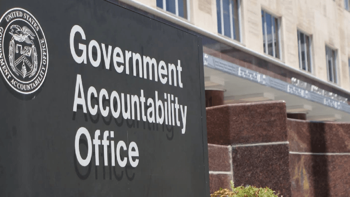
GAO sign and building in background

“But there’s no documented process or timeline for actually doing this,” Parker says.

Garbage In, Garbage Out

Part of the problem, the report notes, is that agencies track and report funding data in different formats, with some programs collecting far more granular location-level detail than others so that it is much harder to reconcile the datasets and match them up. GAO indicates the agencies are aware of the issue and are working to reconcile it, but as of the report’s release, no consistent process was in place.

Can't See the Sky for the Trees: Obstruction Could Plague Ohio’s Planned Starlink BEAD Plan

Researchers say they’re concerned that a massive influx of new federal grant money being redirected to Elon Musk’s Starlink satellite broadband company in Ohio will be thwarted by the simple fact that many targeted locations don’t have a clear, unobstructed view of the sky.

Tom Reid of Reid Consulting conducted a study earlier this year taking a closer look at the 30,000 locations in Ohio that are poised to receive subsidized service from Starlink, and found that as many as 70 percent of the target locations were covered by tree canopy preventing the minimum 110-degree field of view Starlink dishes require.

“Only about 30 percent of the households awarded in the state of Ohio have a clear enough view of the sky to get a good, stable Starlink signal,” Reid recently told local Ohio public media.

Ohio is slated to receive $793 million in federal Broadband, Equity, Access, and Deployment (BEAD) grants to fund fiber expansion. But after the Trump NTIA last year changed the program to benefit Elon Musk, Starlink quickly became the biggest state beneficiary of public tax money, receiving more than $51.6 million in grants.

The Trump administration’s changes not only eliminated affordability and equitable deployment requirements, they directed millions of dollars away from higher-capacity future-proof fiber, and toward the back pocket of a billionaire who had already planned to deploy the LEO satellite network without subsidization.

Paulding Putnam Electric Cooperative Gets $13.2 Million BEAD Grant For Fiber Expansion

Paulding Putnam Electric Cooperative (PPEC) says it has received $13.2 million in federal broadband grant support to help fund a major fiber-to-the-home expansion to rural unserved segments of northeast Indiana.

According to a cooperative announcement, the co-op will receive $13.2 million in BEAD (Broadband, Equity, Access, and Deployment) federal grant funding from the Indiana Broadband Office, matched by $10.3 million in cooperative investment, to bring affordable fiber to thousands of unserved residents in Allen, Adams, DeKalb and Noble counties.

PPEC’s fiber network passes more than 18,600 locations in Ohio and Indiana, with the cooperative having formally launched its major expansion project last year.

"This investment will make a lasting difference for the communities we serve," PPEC CEO Randy Price said of the grant award. "Reliable, high-speed internet has become a necessity for education, healthcare, agriculture, business, and everyday life. Many of our members have waited far too long for access to dependable broadband. With support from the BEAD program, we're able to accelerate fiber deployment and deliver a long-term solution that will benefit our members and strengthen our communities well into the future.”

In deployed fiber markets, the cooperative offers symmetrical 250 megabit per second (Mbps) fiber for $60 a month; symmetrical 500 Mbps fiber for $80 a month; and symmetrical 1 gigabit per second (Gbps) fiber for $120 a month, with a variety of additional phone, Wi-Fi, and battery-backup add-on options.

Researchers Say Federal Policy Is Pricing Low-Income Pennsylvanians Off the Internet

Persistent attacks by the federal government on Internet affordability protections and social safety nets are directly resulting in a drop in overall broadband adoption, with large numbers of low-income Americans unable to afford modern connectivity — and the vast benefits it provides.

That was the message sent by local and national broadband researchers attending an informational meeting last month in Indiana, Pennsylvania before the Pennsylvania House Communications & Technology Committee.

Researchers noted that sustained efforts by the federal government across numerous fronts — from attacks on the social safety net to the Republican destruction of the FCC Affordable Connectivity Program (which provided $30 broadband discounts to more than 23 million households) are directly driving vulnerable populations away from Internet adoption.

Attendees noted that the One Big Beautiful Bill (OBBB) alone — which dramatically lowered taxes for U.S. corporations and the wealthy — is projected to reduce broadband connections by approximately 233,000 in Pennsylvania's lowest income quintile.

One attendee, Indiana County Commissioner Sherene Hess, pointed to 2024 data from public-benefit corporation Ready.net showing that Indiana County is among the least-connected counties in Pennsylvania, with 22 percent of county locations without broadband access.

According to notoriously unreliable FCC data (coverage and speed gaps are usually worse than the federal government claims), of the 103,986 “serviceable locations” in Indiana County, 23,049 locations are unserved and 3,927 locations are underserved — meaning they fail to meet FCC minimum broadband speed standards.

Hess combined data from the U.S. census and a 2022 United Way ALICE (Asset Limited Income Constrained, Employed) report to conclude that 46 percent of Indiana County was facing financial hardship, suggesting that $80 to $200 monthly Internet bills “create a choice between Internet service and other basic needs.”