Fast, affordable Internet access for all.
AT&T
Content tagged with "AT&T"
Wisconsin Republicans Want More Local Tax Dollars Flowing to AT&T
The angst is over nearly $30 million that was awarded to build more than 600 miles of fiber optic cable that will bring high-capacity broadband connections to a range of key public entities and health care providers in the four communities, each of which has indicated a desire for more reliable broadband service and, not coincidentally, has a UW campus. This project’s budget is nearly $43 million when one adds in funds contributed from groups that will benefit from the infrastructure upgrade in each community. … [T]hose backing the undertaking argue it will bring faster and more reliable Internet service to public safety agencies, health care providers, schools and community organizations in Platteville, Superior, Wausau and the Chippewa Valley (Eau Claire) area.Private telecom companies (led by AT&T) are protesting the project with a rejoinder we commonly hear in these issues:
Bill Esbeck, the executive director of the Wisconsin State Telecommunications Association, argues the project will duplicate an existing network and take revenues out of the pockets of local Internet providers. The group is asking for a state review of the plan and is considering legal action, says Esbeck.Interestingly, both sides are mostly right. The public safety, health care, and educational institutions will see faster, more reliable, and less expensive broadband. Private existing providers (mostly AT&T), will lose some revenues. Of course, those lost revenues would have come from the tax base in the form of local governments having to greatly overpay for telecom services. The fiscally responsible path for local governments is to build and own (perhaps operate if they wish) their own broadband networks rather than leasing overpriced services from carriers like AT&T.
More Details Emerging about Fibrant in Salisbury
“If you get deal you can’t refuse from someone else, just thank Fibrant for it because you wouldn’t have gotten it if we hadn’t been here,” Clark [Fibrant Marketing Director] said.Fibrant aims for a 30% take rate (4400 subscribers) by the end of year 3 and a positive cash flow in year 4. Pricing and channels lineups are available at the end of this Salisbury Post article.
If Only George Carlin Were Here
The safety lecture continues... "In the unlikely event…" This is a very suspect phrase! Especially, coming as it does, from an industry that is willing to lie about arrival and departure times!After reading Larry Press' account of ordering DSL from Verizon, I couldn't help but wish George Carlin were still with us and also a giant broadband geek. Larry Press' account on dealing with Verizon should be read in full, but this is what got me thinking:
Last week I ordered 7 mbps service from Verizon, but, after they switched it on, I was only getting about 1.5 mbps. I assume there were tons of retransmission errors due to an overly aggressive modulation scheme. When I called to complain, a Verizon "technician" kept me on the phone … [and finally] got his bosses permission to schedule a "truck roll" to come to my house and fix the problem. The minute the driver arrived, he told me that, at 9,000 feet from my central office, there was no way I was going to get 7 mbps.We have long known that Verizon and similar companies are similarly willing to lie about their available broadband speeds (yah, I know, I'm no Carlin). As I recently testified in a MN House hearing, the Connected Nation maps systematically overstate available broadband (particularly for DSL). And of course they do - Verizon doesn't even know what it can achieve at each premises (thought it damn well should know what it cannot offer 9,000 feet from the DSLAM). The dumb question is: Does Verizon actually maintain a database of what it could really offer, in real world conditions, to each house (or what speeds are actually achieved when they take service).
Time Warner Reverses Direction in NC, Fights Competition with New Strategy
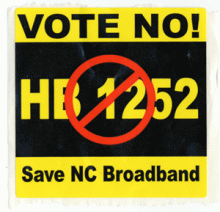
Yet, if the HB 1252's intent becomes reality, such areas will be severely hobbled in their near-term ability to tap into the broadband revolution.

Re-Defining Broadband
The key metric for broadband should be the applications and needs that drive consumer requirements and choices. In this way, broadband should be understood as a connection that is sufficient in speed and capacity such that it does not limit a user’s required application.Their magic broadband number is a reasonable and doable 10Mbps symmetric connection for residential and small businesses as well as a 1Gbps level for enterprise users. Importantly, they note that a single broadband connection supports far more than a single computer or use - these connections are shared, often among many wired and wireless devices. Compare these comments to those of the NCTA [pdf] (lobbying organization for cable companies) that argue broadband is nothing more than an "always on" connection regardless of the speeds or user experience. This is how they justify maintaining the international laughingstock definition of 768kbps/200kbps.
Statewide Video Franchising: Bad for Communities
Free Press Responds to 'Sloppy' Incumbent Broadband Arguments
The American Recovery and Reinvestment Act of 2009 directed the Federal Communications Commission (FCC) to develop a national broadband strategy. FCC invited comments and then invited replies to those comments in summer 2009. The Free Press Reply Comments deserve to be singled out for revealing some of the lies of large telecommunications companies like Verizon, AT&T, Comcast, Qwest, and others. It also describes many of the ways that these companies harm the communities that are dependent on them for essential services. I've highlighted some passages below that show the ways in which these companies put profit above all else. These companies claim that regulation discourages investment and deregulation (allowing a higher degree of concentration or larger monopolies) encourages increased investment in better networks - an incredibly self-serving claim that Free Press shows to be false on pages 13-29.
Competition -- meaningful and real competition -- and not regulation is the primary driver behind investment decisions. Where meaningful competition exists, incumbents are compelled to innovate and invest in order to maintain marketshare and future growth. Where competition is lacking -- such as it is in our broadband duopoly -- incumbents will delay investment, knowing full well they can pad their profits on the backs of captured customers who have no viable alternatives. (Page 14)
Regulations like open access and non-discrimination encourage competition and should be strengthened. Free Press offers an in-depth explanation of how Verizon has dumped millions of customers on other companies that clearly could not handle the burden.
Verizon began the purging of less lucrative areas with the sale of Verizon Hawaii to the Carlyle Group in 2005, a company that had no previous experience in operating telecommunications services. By Dec. 2008, the company, now called Hawaii Telecom, had lost 21% of customers and filed for bankruptcy. (Page 26)
Verizon then sold most of their New England lines to Fairpoint, which is currently heading for bankruptcy. Fairpoint's customers are not the only ones suffering - the independent companies that resell services over that infrastructure are also suffering because Fairpoint is utterly unable to meet its obligations.
How NTIA Dismantled the Public Interest Provisions of the Broadband Stimulus Package
Creating the Broadband Stimulus Language
The debate began in Congress as the House and Senate drafted broadband plans as part of the American Recovery and Reinvestment Act The House language on eligibility for stimulus grants made little distinction between global, private entities and local public or non-profit entities.the term `eligible entity' means--The Senate language clearly preferred non-profit or public ownership.(A) a provider of wireless voice service, advanced wireless broadband service, basic broadband service, or advanced broadband service, including a satellite carrier that provides any such service; (B) a State or unit of local government, or agency or instrumentality thereof, that is or intends to be a provider of any such service; and (C) any other entity, including construction companies, tower companies, backhaul companies, or other service providers, that the NTIA authorizes by rule to participate in the programs under this section, if such other entity is required to provide access to the supported infrastructure on a neutral, reasonable basis to maximize use;
To be eligible for a grant under the program an applicant shall—The final language, adopted by the Conference Committee and passed by both houses in February was a compromise. It favored a public or non-profit corporation but allowed a private company to be eligible only if the Assistant Secretary of the Department of Commerce found that to be in the public interest.(A) be a State or political subdivision thereof, a nonprofit foundation, corporation, institution or association, Indian tribe, Native Hawaiian organization, or other non-governmental entity in partnership with a State or political subdivision thereof, Indian tribe, or Native Hawaiian organization if the Assistant Secretary determines the partnership consistent with the purposes this section