
Public Access Media and Community Owned Networks - Community Broadband Bits Podcast #81
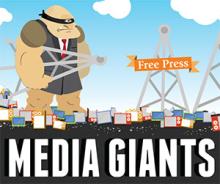
When we think of the enormous cyclops we don't usually imagine him in a suit and tie but the Free Press does and it works. In their recent Media Giants infographic, the Free Press uses the hulking one-eyed beast to represent corporate behemoths slowly taking control of our media through smaller shell companies.
As media power is consolidated, every one else's voices fade. We all become like the one-eyed cyclops: seeing things through his limited vision. The Free Press sums it up like this:
Media companies are using shady tactics to dodge the Federal Communications Commission’s ownership rules and snap up local TV stations across the U.S.
Gannett, Nexstar, Sinclair and Tribune are on major buying sprees. To grow their empires, these corporations are using shell companies to evade federal caps on how many stations one company can own. And so far the FCC has done nothing to stop this trend.
In some communities, one company owns two, three and even four local TV stations — and airs the same news programming on all of these outlets. The result: An echo chamber where all the news looks and sounds the same.
Take action now through the Free Press' campaign or contact your elected officials directly.
On August 14th, Christopher Mitchell and I visited Senator Amy Kobuchar's office in Minneapolis. We arranged the meeting in coordination with Free Press and the Media Action Grassroots Network to talk with our Senator about the Television Consumer Freedom Act, also known as S.912.
Senators John McCain (R-AZ) and Richard Blumenthal (D-CT) are sponsoring this effort to scale back cable program bundling. ILSR and the Free Press recognize this as a good start to reforming our deeply flawed video market. We also see it as a foothold to inching closer to the wide ranging and affordable broadband we desperately need.
We met with Senate staff to present 594 Minnesota petition signatures in support of the legislation. Free Press has collected over 27,000 signatures from across the country asking Congress to pass the Television Consumer Freedom Act.
The bill provides options for consumers beyond today's restrictive bundled services. By offering channels a la carte, consumers can pay for what they want rather than being forced to pay for many channels they do not. Bundling also limits independent channels by crowding out capacity and creating onerous financial barriers for entrepreneurial media ventures. This bill will not eliminate bundling, but will require cable providers to also offer a la carte pricing. It is important to note that the cable companies themselves are often forced to bundle by channel owners like Viacom or Disney. This bill restricts that practice as well.
We also give two thumbs up for the sports fans' provision in the bill. From an LA Times opinion piece written by Senator McCain:
Another provision in the bill seeks to end the practice of sports team owners punishing fans by blacking out home games that don't sell out. It provides that games taking place in publicly financed stadiums can't be blacked out.
Since the story broke about the NSA domestic spying practices, debate among concerned citizens has revolved around the Big Brother surveillance model. Most of us shudder at the thought of our federal agencies from DC watching, noting, and recording our actions. However, there is another type of Internet surveillance that largely escapes notice and likewise threatens our liberty.
Both types of surveillance are perversely encouraged by a poorly regularly market that allows big corporations to profit from violating our privacy.
We have long known that our online habits are being recorded and combined with other personal data that allows companies to show us personalized ads. But Free Press recently offering a compelling explanation for how this model can harm us. From the Dana Floberg article:
And about those “personalized ads” — this isn’t about Facebook learning you prefer Coke over Pepsi. This is about corporations targeting us where we’re vulnerable. This is about your Latina neighbor who sees ads for risky high-interest credit cards. This is about your cousin who just got laid off and now sees ad after ad selling him dangerous fast-cash offers and subprime mortgages. This is about your friend who lives in a rougher part of town and sees higher prices whenever he shops online. This is about all of us.
These ads aren’t personalized — they’re predatory.
Floberg goes on to describe how shopping sites alter prices based on income and location so more affluent shoppers can access better prices and coupons. These sites both use and reinforce stereotypes as they take advantage of the most vulnerable in our society.
Without laws to protect consumers, there is little we can do to stop this predatory behavior. Just as the market encourages corporations to violate our privacy to sell its goods, big corporations are also profiting in their work with law enforcement at all levels.
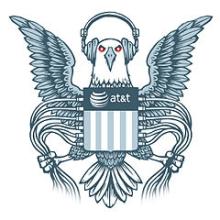
An AP article by Anne Flaherty notes that AT&T charges $325 to activate a wiretap and $10 per day to maintain it. Verizon charges the government $775 for the first month and $500 per month after that to continue it. It is hard to believe these charges are in line with actual costs.
Municipal broadband networks have been gaining traction across the country. It's easy to see why: In many rural and low-income communities, privately offered broadband services are nonexistent. In its 2012 Broadband Progress Report the Federal Communications Commission counted nearly 20 million Americans (the vast majority living in rural areas) beyond the reach of broadband.
The Free Press' Timothy Karr's words are supported by the growing number of pins on our Community Network Map. We connect with places nearly every day where municipal networks fill the cavernous gaps left by the massive corporations. Large cable and telecom providers do not hide their aversion to servicing rural areas, yet year after year their lobbying dollars persuade state politicians to introduce bills to stop the development of municipal networks. Karr reviewed recent efforts to use state laws to stifle community owned networks in a Huffington Post article.
As readers will recall, this year's front lines were in Atlanta, where HB 282 failed. We hope that loss may indicate a turning point in advancing municipal network barriers because the bill lost on a 94-70 vote with bipartisan opposition. If it had succeeded, Georgia would have been number 20 on a list of states that, thanks to ALEC and big corporate sponsors like AT&T, Comcast, Verizon, and Time Warner Cable, have decided to leave their citizenry begging for the private market to come their way.
Time and again, the supporting argument goes like this:
"A vote 'yes' for this bill means that you support free markets and free enterprise," [Rep Hamilton, the Chief Author of HB 282] said [on the House Floor].
A 'no' vote means that you want more federal dollars to prop up cities, Hamilton said.
But Karr points out that some policy makers are starting to question that argument, with good reason. From his article:
F2C: Freedom to Connect is designed to bring under-represented people and issues into the Washington, DC based federal policy discussion. F2C: Freedom to Connect revolves around three central topics. The first is an open infrastructure owned or controlled by and responsive to the community it serves and whose resources it depends upon. The second is a publicly specified set of Internet protocols open to all who meet its specifications. The third is the use of the Internet to promote government of, by and for the people, and to counteract autocratic government power.To learn who will address each topic, visit F2C. Below is a short video with some of the fun moments of this conference in 2012. (You can see the presentations and panels from 2012 here.) Register by Jan 18 to get the early bird discount: $195. Don't forget, this event always has world-class music between sessions -- always a great experience.
Not long ago, we told you about Farmington, New Mexico, a community of 32,000 residents who want to capitalize on its current fiber network. Residents are tired of waiting for private investment in their community and want to take matters into their own hands. The city's electric utility uses the existing fiber network and the city has encountered five separate companies interested in leasing dark fiber as a means to offer services.
New Mexico does not currently have state barriers in place, but its residents recognize the important role of municipal networks and want to proactively block restrictive state legislation. The Media Literacy Project and the Free Press recently met with New Mexico's U.S. Senator Tom Udall's staff in Albuquerque. Udall is a member of the Senate Committee on Commerce, Science, and Transportation and a member of the Subcommmittee on Communications, Technology, and the Internet.
The goal of the meeting was to make sure he knows the potential for publicly owned networks in the state. Both groups encouraged him to take the lead on federal legislation that will prevent anti-competitive state bans on municipal networks. At least 19 other states' legislatures have responded to heavy lobbying from large telecommunications companies. The results are crippling restrictions and outright bans on publicly owned networks.
In July, Udall officially announced that the first phase of the Connect America Fund would bring high-speed Internet to 8,000 New Mexicans within three years. According to Udall's announcement:
Broadband and telecommunications companies CenturyLink and Windstream will receive $2.3 million to build broadband infrastructure for New Mexico homes and businesses that currently lack high-speed internet access, connecting them to the $8 trillion global internet economy.
Several months ago, we wrote this post but it got lost in the system. We think it still worthwhile, so here it is.
The word "cartel" drums up many negative annotations - drug cartels, oil cartels. Never anything positive, such as bunny cartels or chocolate cartels. Harold Feld (of Public Knowledge) explains the emergence of another cartel in My Insanely Long Field Guide To The Verizon/SpectrumCo/Cox Deal, on his Tales of the Sausage Factory blog. This is great tutorial on how the deal came about and what it can mean for the future of broadband.
Rather than chocolate, drugs, oil, or bunnies, the product in question is telecommunications services. At the heart of the cartel are the familiar names: Verizon, Cox, and SpectrumCo. The latter being a consortium of Comcast, Time Warner Cable, and Bright House. All the big hitters in telecom are involved in a way that is veiled, secretive, and not good for competition.
"It's almost as if your companies got in a room together, and you agreed to throw in the towel and stop competing against each other," Sen. Al Franken to representatives from Verizon and the cable companies at the Senate Judiciary Subcommittee on Antitrust, Competition Policy, and Consumer Rights, March 21, 2012.
Feld's investigation begins with the licensing and collecting of spectrum by SpectrumCo but ends with a more practical look at how these big hitters have decided that it is better to join forces than to compete. Side agreements, secretive multi-layered entities, and threaded loopholes keep the FCC at bay. This begins as an article about telecommunications, but quickly expands into an antitrust primer. The most alarming facet of this situation is that the product in question is information.
Joel Kelsey of Free Press testified at that same committee, warning how this deal will compromise access, quality, and affordability to broadband in America and how drive us further behind the rest of the world.
Update:
On August 16, 2012, the Department of Justice announced that it approved the deal with changes. Citing: