
op-ed

Content tagged with "op-ed"

Related Topics
Displaying 31 - 39 of 39

Op-Ed Praises UTOPIA for Helping Utah

Kane Loader, the City Manager for Midvale and Chair of the UTOPIA board, penned a recent op-ed explaining why UTOPIA is important to readers. UTOPIA is a trailblazer in the US open access fiber-optic network space. After initial problems, the network is showing a lot of promise and has long offered some of the fastest speeds available in the US at the lowest prices.
Utah can lead the way in this digital future, and the cities of UTOPIA are proud to be part of the cutting-edge solution. We are building this network not as a money-making operation, although our financial situation improves as our subscriber base grows. We are building this network for the same reason local governments built highways in the 19th century and airports in the 20th century: This infrastructure will be what connects our 21st century world.

Whose Internet? NC Communities Should Defend Freedom to Build Networks

Durham's Herald Sun published our op-ed about community broadband networks in North Carolina. Reposted here:

Who should decide the future of broadband access in towns across North Carolina? Citizens and businesses in towns across the state, or a handful of large cable and phone companies? The new General Assembly will almost certainly be asked to address that question.

Fed up with poor customer service, overpriced plans and unreliable broadband access, Wilson and Salisbury decided to build their own next-generation networks. Faced with the prospect of real competition in the telecom sector, phone and cable companies have aggressively lobbied the General Assembly to abolish the right of other cities to follow in Wilson and Salisbury's pioneering footsteps.

The decision by Wilson and Salisbury to build their own networks is reminiscent of the decision by many communities 100 years ago to build their own electrical grids when private electric companies refused to provide them inexpensive, reliable service.

An analysis by the Institute for Local Self-Reliance (http://tiny.cc/MuniNetworks) compares the speed and price of broadband from incumbent providers in North Carolina to that offered by municipally owned Greenlight in Wilson and Fibrant in Salisbury.

Wilson and Salisbury offer much faster connections at similar price points, delivering more value for the dollar while keeping those dollars in the community. For instance, the introductory broadband tiers from Wilson (10 downstream/10 upstream Mbps) and Salisbury (15/15 Mbps) beat the fastest advertised tiers in Raleigh of AT&T (6/.5 Mbps) and TWC (10/.768 Mbps). And by building state-of-the-art fiber-optic networks, subscribers actually receive the speeds promised in advertisements. DSL and cable connections, for a variety of reasons, rarely achieve the speeds promised.

Curbing innovation

To communities that seize broadband initiative, benefits flow fast

On November 29, 2010, MPR published our commentary about community broadband. The Twin Cities has slower and more expensive broadband Internet than the nearby town of Monticello. The Twin Cities metro area has a population of 2.8 million and the highest density of people and businesses in the state. So why is our broadband Internet slower and more expensive than that enjoyed by Monticello, population 12,000? Several years ago, the city of Monticello (45 miles northwest of Minneapolis) recognized the increasing importance of reliable, high speed, low cost broadband. After the incumbent telephone and cable companies declined to build the network city leaders had in mind, the community decided to build one itself. Now, FiberNet Monticello offers some of the best broadband packages available in the country, while the Twin Cities is lagging. A new analysis by the Institute for Local Self-Reliance compares the available broadband speeds in Monticello to those available in the Twin Cities metro. In the metro, as in most of the United States, broadband subscribers choose between DSL from the incumbent telephone company (Qwest) and cable broadband from the incumbent cable company (Comcast). Monticello's offerings are faster at every price point, but Comcast appears to offer comparable downstream speeds in the highest tier of service. This apparent equivalence, however, is like comparing dirt roads with interstates. Both are roads that allow you to travel from point A to B, but they have fundamentally different characteristics in carrying capacity and reliability. For a variety of reasons, DSL and cable almost always fall short (and often, well short) of the advertised "up to" speeds, whereas full fiber networks regularly achieve the speeds they promise. In the metro, cable offers most residents the fastest option for broadband, but only one choice of provider. The Monticello network not only created a new choice for its residents, it induced the incumbent telephone company to greatly upgrade its network to remain competitive. Now, Monticello residents can choose between two extremely fast broadband providers, as well as a cable internet connection. The community-owned network may have only been the third broadband option, but it fundamentally changed the market.

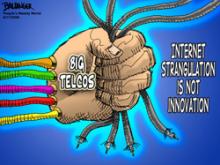
Cities Take On AT&T, Time Warner and Verizon

We have a piece published on Alternet about the battle to maintain an open Internet and proper access to it.

A battle is raging for control of the Internet and it is not taking place in Washington. Scores of cities, fed up with the recalcitrance and outright arrogance of their providers and Washington’s lack of action are taking their information future into their own hands by building their own high-speed networks. To Harold DePriest, head of Chattanooga’s municipally owned fiber network, currently the largest in the country, the issue is clear: “Does our community control our own fate or does someone else control it?” He who owns the information highways makes the rules of the road. Today those rules are made by a handful of global corporations with little public oversight.

Photo used under Creative Commons License - Courtesy, Baldinger

Understanding - and Rethinking - Broadband Regulation

Though we certainly support the FCC's reclassification of broadband to ensure companies like Comcast do not interfere with the open Internet, we focus on policy at the community level. We fully support the efforts of organizations and people in DC to work at the federal level. But for those who are utterly baffled at the questions being raised the the last 15 years of Internet policy, I strongly recommend a recent op-ed by Wally Bowen: "FCC needs to rethink broadband regulation."
The stakes are high. The Internet's explosive growth – and the spectacular innovation it spawned – were enabled by common-carrier rules that still govern the nation's dial-up telephone networks. Before 2002, online users were at the center of the Internet and World Wide Web, free to choose among competing ISPs, and free to roam and innovate. With the removal of common-carrier rules, the cable and telephone companies occupied the center of a broadband-driven Web, free to pick winners and losers among innovators (e.g. AT&T's exclusive iPhone deal with Apple) – and free to dictate when and where broadband access will be deployed. In short, the definitive battle for the future of the Internet is underway.

Op-Ed: In Minnesota, a de facto limit on broadband

The Star Tribune ran my opinion piece on Monday, March 15 The vast majority of Minnesotans, like the rest of the country, are served by only two broadband suppliers: the cable or telephone company. These companies generally want to maintain their monopolies because they can postpone upgrades while keeping prices and profits high. Just about everyone else just wants a better choice among providers. The result of this structure is that we pay much higher prices for slower internet connections than our peers in Europe and Asia. Here in Minnesota, Monticello has broken the mold. It has transitioned from relying on an overpriced and slow DSL network to now offering the best broadband in the entire state. Monticello residents can choose between a symmetrical 20 Mbps connection (extremely fast) from the City for $35/month or the incumbent telephone company’s new 50 Mbps downstream and 20 Mbps upstream option for $50/month. They have better packages than Comcast’s best residential offers in the Twin Cities – and available at half the price! Entering the local telecommunications market is quite difficult. Building a network costs hundreds of millions for large cities and tens of millions for communities from 10,000 to 50,000. Once the network is built, the costs of adding new customers actually decreases as the number of subscribers increases. This cost structure gives incumbents tremendous advantages because they can drop their prices precipitously if a new entity – public or private – tries to build a competing network. To date, incumbents have largely succeeded in fending off competition. Given the sorry state of broadband in many communities, especially rural ones, it should be no surprise that many cities and counties have started to build their own networks. And happily, they’ve done so with great success. Creating competition forces incumbents to invest and cut prices, generating significant community savings as well as other advantages from a network that operates in the public interest. Unfortunately, there are additional barriers for communities attempting to build their own state-of-the-art broadband networks. As a result of lobbying by incumbents, some eighteen states have created obstacles to publicly owned networks. The need for any state barrier to community networks is dubious.

Lafayette Plans Faster Growth; US BB Embarrasses; Seattle Needs Volunteers

Catching up a variety of recent stories:
  • An article from the Lafayette Advertiser notes: LUS Fiber plans faster rollout. Community networks are frequently attacked by incumbent groups and private providers for failing to immediately turn a profit after launching a network (something we have addressed here). LUS Fiber wisely started slow and will now start to ramp up the number of customers as they progress further along the learning curve of running the fiber-optic network.

    logo-LUS.gif

    As LUS Fiber passes the six-month mark, officials are planning to significantly increase the number of customers and areas that receive television, telephone and Internet service.

    The system launched in some areas of the city in February, and thus far, the rollout has been somewhat slower than many anticipated. Lafayette Utilities System Director Terry Huval said the process hasn't gone faster because of a desire to focus on providing high-quality customer service.

    "This is a new business," Huval said. "I intentionally held back because I wanted to make sure that every attempt we made to serve a customer was the best we could deliver. Now, we can start really accelerating."

  • A commentary worth reading: American broadband infrastructure: A national embarrassment

    Several months ago, I visited the Netherlands and had the rare opportunity to be personally embarrassed by our terrible broadband infrastructure. The Dutch were literally making fun of me. The fact that our country, with its vast resources and its illustrious history -- Benjamin Franklin, Alexander Graham Bell, Thomas Edison, Steve Jobs -- has such terrible internet service should be an outright national scandal.