
Fast, affordable Internet access for all.
Christopher Mitchell
Content tagged with "Christopher Mitchell"
Policy In-Depth: Debate over Muni Broadband Competing With Private Sector
On June 1, the Information Technology and Innovation Foundation held an oxford-style debate over the proposition: "Governments should neither subsidize nor operate broadband networks to compete with commercial ones."
Jim Baller and I spoke against the proposition while Rob Atkinson and Jeff Eisenach defended it during the 2 hour, 15 minute session. I was unable to be in DC and thus participated by the magic of modern telecommunications.
This is a long but valuable and unique discussion. We left talking points behind, actually responded to the points raised by the other side, and presented both sides of this debate in a reasonable manner. In short, this is exactly the kind of discussion we would elected officials to consider before legislating on the matter. But it very rarely happens -- nothing even remotely close to it occured in North Carolina when Time Warner Cable pushed its bill through the Legislature to enact a de facto ban on muni networks in the state.
You can watch it here.
Mitchell and Baller Defend Community Networks in ITIF Debate on June 1
Sign up for a live webcast (or if you are in DC, please attend) of Jim Baller and Christopher Mitchell engaging in an Oxford-style debate on the subject of community broadband with Rob D. Atkinson and Jeff Eisenach on June 1 at 9:00 EDT.
The statement to be debated is: "Governments Should Neither Subsidize nor Operate Broadband Networks to Compete with Commercial Ones." Guess which side Jim and I will take?
Government Technology on TWC Bill in North Carolina
“Essentially this bill is a cable monopoly protection bill,” said Doug Paris, assistant city manager of Salisbury, N.C., another city with its own broadband service. “It protects Time Warner Cable and ensures they will continue to do what they’ve been doing for decades, which is serving where they want to serve and not serving where they don’t want to serve.”And though it may be tacky to quote myself, I do quite like the quote…
Christopher Mitchell, director of the Telecommunications as Commons Initiative for the Institute for Local Self-Reliance, a nonprofit economic and community development consulting group, agreed and said that there is “almost no chance” another community in North Carolina will be able to build a new broadband network under the law. “The Legislature, in passing laws like this, shows just how out of touch they are,” Mitchell said. “It’s very clear to me that North Carolina’s legislators don’t understand the difference between a slow DSL connection and a modern, reliable fiber-optic connection. They don’t understand that what Time Warner [Cable] and CenturyLink are selling isn’t helping communities be competitive in the modern era.”I hope communities and activists around the country have taken note of the power incumbents wield and are starting to talk to elected officials to educate them and build the relationships necessary to counteract all the money in politics.
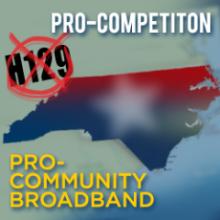
Time to Act: North Carolina Senate Finance Committee Votes on H129 on Wed
Listen to Progressive States Network Phone Call about Community Broadband
- Washington State Representative John McCoy
- Ben Lennett, Senior Policy Analyst, New America Foundation
- Craig Settles, Founder and President, Successful.com
Breaking Through Time Warner Cable's Misinformation in North Carolina
Christopher Mitchell Discusses NC Muni Network Ban on Tech News Today
Yesterday, the Tech News Today netcast on the TWiT network invited me on to discuss the North Carolina legislation to kill community networks and the Google Gigabit network decision to build in Kansas City, Kansas. I am on the first 12 minutes or so of the show, embedded below.
Ask Me Questions on Rural America Radio Friday
I just joined the community at RuMBA - the Rural Mobile & Broadband Alliance - and will be appearing on Rural America Radio to discuss rural broadband issues on Friday, March 18. You can call in with questions. Details from Rural America Radio here:
Listen here: http://www.blogtalkradio.com/luisahandem
Fiber Networks are admittedly the most powerful tools for delivery of high-speed Internet anywhere. How can communities take ownership of their broadband choices and funding so as to ensure the best outcome? From Minnesota to North Carolina, there is clearly a battle of words going on between private corporations and rural counties, municipalities and other underserved areas on decision-making. In this edition of Rural America Radio, showhost Luisa Handem interviews Christopher Mitchell, a strong proponent of publicly owned broadband networks. He is the Director of the Telecommunications as Commons Initiative with the New Rules Project of the Institute for Local Self-Reliance. He has been published in a number of online magazines as well as print publications. Mitchell is the author of last year's report on publicly owned broadband networks titled “Breaking the Broadband Monopoly: How Communities Are Building the Networks They Need.”
You may join the show by dialing 646-378-1746 to ask a question from 3:00-3:30pm CDT, every Friday.
Rural America Radio gives voice to rural residents and those who wish to promote the wellbeing and economic growth of rural communities across the U.S. We bring you the very best in talk-show programming related to rural American affairs, by deliberately focusing on the use of technology, especially high-speed Internet, and healthy living. Rural America Radio is a project of the Rural Mobile & Broadband Alliance (rumbausa.com).
Whose Internet? NC Communities Should Defend Freedom to Build Networks
Durham's Herald Sun published our op-ed about community broadband networks in North Carolina. Reposted here:
Who should decide the future of broadband access in towns across North Carolina? Citizens and businesses in towns across the state, or a handful of large cable and phone companies? The new General Assembly will almost certainly be asked to address that question.
Fed up with poor customer service, overpriced plans and unreliable broadband access, Wilson and Salisbury decided to build their own next-generation networks. Faced with the prospect of real competition in the telecom sector, phone and cable companies have aggressively lobbied the General Assembly to abolish the right of other cities to follow in Wilson and Salisbury's pioneering footsteps.
The decision by Wilson and Salisbury to build their own networks is reminiscent of the decision by many communities 100 years ago to build their own electrical grids when private electric companies refused to provide them inexpensive, reliable service.
An analysis by the Institute for Local Self-Reliance (http://tiny.cc/MuniNetworks) compares the speed and price of broadband from incumbent providers in North Carolina to that offered by municipally owned Greenlight in Wilson and Fibrant in Salisbury.
Wilson and Salisbury offer much faster connections at similar price points, delivering more value for the dollar while keeping those dollars in the community. For instance, the introductory broadband tiers from Wilson (10 downstream/10 upstream Mbps) and Salisbury (15/15 Mbps) beat the fastest advertised tiers in Raleigh of AT&T (6/.5 Mbps) and TWC (10/.768 Mbps). And by building state-of-the-art fiber-optic networks, subscribers actually receive the speeds promised in advertisements. DSL and cable connections, for a variety of reasons, rarely achieve the speeds promised.
Curbing innovation