
Electric Cooperatives Power Broadband Charge Across Rural Georgia

Fiber-to-the-home service is on its way to three counties in Southeast Georgia.

Fast, affordable Internet access for all.
Fiber-to-the-home service is on its way to three counties in Southeast Georgia.
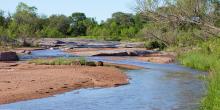
The cities of Corinth and Lake Dallas, as well as the towns of Hickory Creek and Shady Shores put out a Request for Proposal (RFP) at the beginning of September for a public-private partnership to deploy a fiber network to households and businesses in all four communities, collectively known as the Lake Cities. The project, with the help of $ 4 million in American Rescue Plan funds, would include building a middle mile fiber ring to support government services around the four cities, connecting public buildings and facilities.

If you missed the most recent episode of the Connect This! Show, Keith Hansen described the moment he realized he could map the city's digital divide by putting low-power computers attached to GPS chips on the city's garbage trucks.

If you missed the most recent episode of the Connect This! Show, Angelina Panettieri (National League of Cities) shared her take on the recent rules update on the $10 billion in broadband infrastructure funding released by the Treasury.
Watch the short clip below to hear how your community can prepare itself.

On Episode 20 of the Connect This! Show, co-hosts Christopher and Travis Carter (USI Fiber) will be joined by Doug Dawson (CCG Consulting) and Kim McKinley (UTOPIA Fiber) live on both YouTube and Facebook to talk about a grab-bag of issues including the new Treasury rules for the $10 billion in broadband infrastructure funding, digital redlining, and microtrenching.

This guide aims to assist communities interested in accessing federal funds to expand broadband infrastructure and digital inclusion services, by consolidating funding programs established under various federal stimulus relief packages - the American Rescue Plan Act, the Consolidated Appropriations Act, and the Infrastructure Investment and Jobs Act. This guide updates ILSR’s Community Guide to Broadband Funding released in April of 2021.

Some years ago the Community Broadband Networks initiative ran an email listserv for interested folks to sign up and get the latest news and resources regarding projects around the country and to advance efforts in their own communities.

On Episode 19 of the Connect This!

Just a year after city leaders of Superior, Wisconsin (pop. 26,000) passed a resolution declaring fiber optic cabling critical infrastructure, officials are beginning to put the city’s money behind an action plan.

A week from today, the Schools, Health, and Libraries Broadband Coalition (SHLB) is hosting a fireside chat on Tuesday, September 29th at 12-12:30p ET with SHLB Executive Director John Windhausen and Christopher Ali.
On Episode 19 of the Connect This!
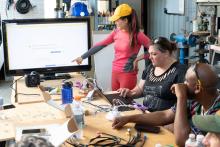
Earlier this summer, a small group of people gathered in the southern California desert for the first Tribal Wireless Bootcamp. Organized by a loose collection of people with a long history of building and encouraging nontraditional broadband networks, the focus was on building, maintaining, and troubleshooting wireless networks in Indian Country.
The San Marcos City Council held a working session in August to review a presentation on the state of broadband in the Texas city and decide whether it should pursue a municipal broadband option. While some members wanted to pursue a fiber-to-the-home municipal network after the presentation, others pushed back despite the fact that the city has its own fiber I-Net (Institutional Network).

In years past, states have implemented preemptive laws that make it more difficult or impossible for communities to build their own Internet networks.

Ponca City, Oklahoma (pop. 24,100) sits in the north-central part of the Sooner State 100 miles north of Oklahoma City. Its history as a community built and shaped by the oil town looms large, from the E.W.

The Institute for Local Self-Reliance (ILSR) is a national nonprofit working to empower communities by striking at the roots of monopoly power. Our Community Broadband Networks program focuses on local approaches to ensure everyone has high-quality Internet access.

The Connect This! show has officially returned, kicking off an unofficial Season 2 with better production value, worse jokes, and the same lively conversation and hot takes we've all become accustomed to.
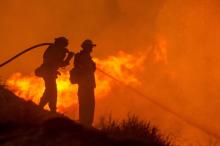
During fire season in Northern California, relaying critical emergency information with speed is paramount. It’s equally important for citizens to get timely information on the course of wildfires, receive evacuation orders, and be able to connect with friends and family. Living in that reality is one of the driving reasons the Chico City Council recently voted to earmark $5 million of the city’s $22 million in federal American Rescue Plan funds to research and implement a plan to improve citywide Internet access.
On Episode 18 of the Connect This! Show, co-hosts Christopher and Travis Carter (USI Fiber) are joined by Doug Dawson (CCG Consulting) and Kim McKinley (UTOPIA Fiber) to catch up after a frenzied summer.

In Larimer County, at the northern end of the Front Range in Colorado, county officials are looking to secure between $5 million and $30 million in federal grant money to expand broadband access into underserved areas.