

Tallahassee, Florida has spent years flirting with the idea of exploring a municipal broadband network, only to have the efforts scuttled by last-minute city commissioner reversals — and the lobbying influence of telecom monopolies.
But with a major midterm progressive shakeup at city hall, a community-owned fiber optic broadband network could soon be back on the table.
The progressive wing of the Democratic Party has finally secured a long-sought 3-2 majority over the Tallahassee City Commission.
Notably, Tallahassee Mayor-elect Jeremy Matlow was the original sponsor of a scuttled 2019 effort to issue an RFP exploring the potential construction of a citywide municipal broadband network.
The political shakeup could open the door to the city following the lead of cities like Chattanooga, Tennessee, and expanding affordable Internet access on the back of the city’s existing electrical utility.
“Previously, Tallahassee's City Commission had been locked into a 3-2 split on many of the biggest issues facing the city, from the budget and taxes to the sale of Tallahassee Memorial HealthCare's hospital to Florida State University,” the Tallahassee Democrat notes.
The paper notes that the simultaneous passage of Amendment 3 — which forces Florida municipalities to balance their budgets with substantially less property tax revenue — could create the fiscal disruption and political cover the newly elected majority needs to revive long-stalled plans for a city-run broadband network.
“The new majority could make a play for municipal broadband, a proposal the progressives supported but never picked up steam with their colleagues,” the paper optimistically posits.
The paper suggests that the revenue crunch triggered by Amendment 3 might actually accelerate interest in municipal broadband. By forcing the city to slash traditional budget lines, the amendment provides the new majority with both the license to cut legacy spending and the political momentum to pursue a self-sustaining public internet utility — something city advocates have championed for the better part of a decade.
Crucially, a municipal broadband network run through Tallahassee Electric wouldn't be funded out of the depleted general property tax fund. Instead, it would be financed through utility enterprise revenue bonds and supported entirely by subscriber fees—eventually generating non-tax operating margins that could be transferred back to help stabilize the municipal general fund.
A History Of Monopoly Frustration
Long angry about the slow, spotty, and expensive broadband options provided by regional monopolies like Comcast (Xfinity) and CenturyLink (now Quantum Fiber), the city in 2019 held a formal workshop and generated a Municipal Fiber Optic Network Overview from city staff.
That analysis leaned on unsubstantiated, private sector data insisting that deploying a citywide, publicly owned fiber-to-the-home network would cost the city upwards of $280 million. Still, buoyed by public anger at market failure, in a 3-2 vote, the commission at the time approved an RFP for a municipal broadband feasibility study.
It was short lived. Then-Commissioner Elaine Bryant cited the potential high costs — and her preference for private sector solutions — as justifications for her vote reversal just a few weeks later, scuttling both the RFP and the city’s interest in community-owned broadband.
“I am pro-business for this community,” Bryant said. “And I think that the city right now is not in the business of this particular industry. And I think we need to continue to do what we can to grow business in our city. I’m not in favor of the city owning broadband.”
Instead, the city pivoted more heavily to promoting a public-private partnership with MetroNet, which invested $75 million on city fiber expansion in exchange for streamlined local pole attachment, small cell placement, and rights-of-way permitting.
At the time, the city lauded its partnership with MetroNet as the arrival of Tallahassee as a “gigabit city.”
But while the city’s broadband performance dashboard attempts to claim that the city now sees 100 percent connectivity with locals having the option of more than 15 different ISPs, the city appears to be using unreliable industry-provided metrics, outdated broadband speed definitions (25 Mbps versus 100 Mbps), and is double counting providers in a way that obfuscates market failure and muted competition.
One of the references for the city’s numbers cites a 2019 survey conducted by a team from Florida A&M University that found 45 percent of city residents remained dissatisfied with local broadband access, with nearly three-fourths of those identifying slow internet speeds and connectivity unreliability as a key driver of dissatisfaction.
While the arrival of a commercial overbuilder delivered competitive fiber options to urban and suburban corridors, local broadband equity advocates have pointed out that cherry-picked deployments remain a problem, leaving large swaths of the city — particularly minority and marginalized populations — still stuck on the wrong side of the digital divide.
While public-private partnerships can sometimes help cities improve broadband access without the price tag of a municipal network, such partnerships often leave municipalities with little actual control over the resulting network footprint, speeds, or pricing. As a result, cities will still see inequitable availability, with already marginalized communities usually the most impacted.
Should Tallahassee officials finally begin seriously exploring a municipal broadband network, they will still need to account for a state regulatory environment that has historically been hostile to municipal broadband, courtesy of laws ghostwritten by regional telecom monopolies.
In 2005, the telecom industry encouraged the passage of Florida Statute § 350.81, which imposed burdensome procedural, public hearing, and accounting requirements on local governments attempting to offer retail communications services, requiring public networks to match private sector tax burdens and achieve operational cost recovery within four years or face mandatory review, sale, or closure.
Tallahassee’s ownership of its own electric utility provides a distinct foundation of conduit, poles, and public trust, but navigating Florida’s incumbent-friendly statutes will ensure that any renewed push for community-owned broadband remains a hard-fought climb.
Header image of voter handing in ballot courtesy of Pexels.com
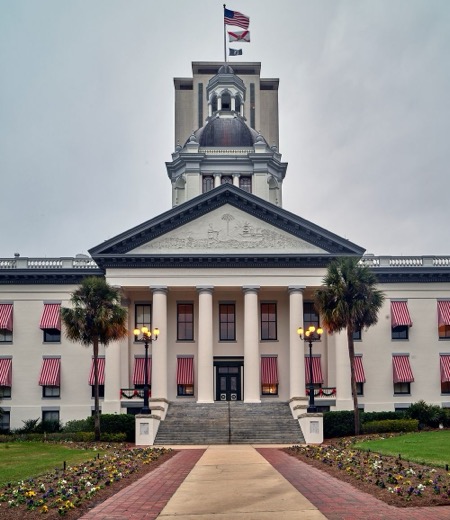
Inline image of Florida's Historic Capitol building in Tallahassee courtesy of rawpixel.com/Carol M Highsmith, Public Domain, CC0 1.0, CC0 1.0 Universal
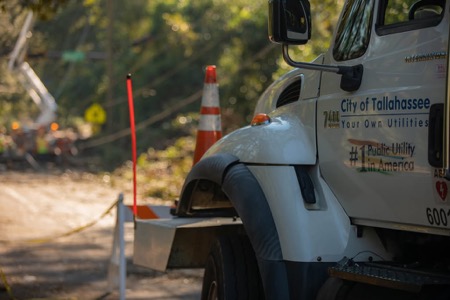
Inline image of Tallahassee city utility truck courtesy of City of Tallahassee Facebook page